Evanthe, Evanthia

Gender: Feminine
Origin: Greek
Meaning: “fair flower; good flower.”
Eng (eh-VAN-thee); Grk (ay-VAHN-thee-ah).

The name is derived from the Ancient Greek (Euanthe), which is composed of the elements ev meaning “good; fair” and anthos meaning “flower; blossom.”

In Greek mythology, Euanthe is the mother of Charites by Apollo.

In English literature, the name appears in one of John Fletcher’s novels A Wife for a Month as well as in Thomas Godfrey’s The Prince of Parthia.

Its modern Greek form of Evanthia, is still relatively popular. It is borne by a Greek Christian martyr, who was martyred, with her son in Rome, for proselytizing Christianity.

In Greece, the designated name day is September 11th.

Athene, Athena, Athina

Gender: Feminine
Origin: Greek
Meaning: debated
Αθηνα
Eng (uh-THEE-nah; uh-THEE-nee); Mod Grek (ah-THAY-nah; ah-THEE-nah).

The name is of debated origin, but is speculated to be composed of the elements ather meaning “sharp” and aine meaning “praise.” Others suggest that it is composed of pre-Greek elements, possibly constructed from the Lydian word ati meaning “mother” and combined with the name of a Hurrian goddess: Hannahanna or Ana. Plato himself claimed the name was derived from Atheonoa, a compound of the Greek theos meaning “the gods” and nous meaning “mind.”

In Greek mythology, the name is borne by the goddess of wisdom, reason, warfare and peace. She was also the patron goddess of the region of Attica and the city of Athens, which was named for her. I don’t believe I can do justice to the role Athena played for the ancient Greeks. But to be to the point, the Greeks so admired Athena that she appears as a recurrent figure in many Greek tragedies and epics. Athena was also the goddess of weaving and handicrafts. It is interesting to note, that unlike the other Greek goddesses, Athena remained a virgin, and was celebrated for her chastity. Though Greece no longer worships the ancient pantheon of Mt. Olympus, the names Athena and Athina still prevail in the small mediterranean country.

The name is borne by the grand-daughter of Greek shipping magnate, Aristotle Onassis, Athina Onassis Rousel (b. 1985).

In Greece, its designated name day is September 1st. Other interesting forms include: the Ancient Attic Athenaia and the Doric Athana.

Other modern forms include:

  • Atenea (Asturian/Spanish)
  • Afina (Azeri/Russian)
  • Atena (Catalan/Italian/Polish/Portuguese/Romanian/Serbo-Croatian/Slovene)
  • Athéna (Czech)
  • Athene (Danish/French/German)
  • Athéna/Athéné (French)
  • AÞena (Icelandic)
  • Atēna (Latvian)
  • Atėnė (Lithuanian)
  • Atene/Athene (Norwegian)
  • Aténa (Slovakian)


Hermione, Ermioni

Gender: Feminine
Origin: Greek
Ερμιόνη
Eng (/hərˈmaɪ.ɵniː/ hər-MYE-o-nee); mod Grk (air-MYOH-nee)

She probably reminds you of Hermione Granger, the character from J.K. Rowling’s Harry Potter series. The name is of ancient Greek origin and it is derived from the masculine name Hermes.

In Greek mythology, Hermione was the only daughter of Helen and Menelaus. The name is also found in the calender of Saints, Hermione of Ephesus was an early martyr, and as an interesting side note, the Hermione of Harry Potter is named for the saint and not for the maiden of Greek Legend.

Hermione of Sicily is a character featured in Shakespeare’s Play, A Winter’s Tale (1610).

The name, though quirky and a bit extravagent, seems to have been a common moniker in Britain prior to Harry Potter fame. It is borne by several British actresses, Hermione Baddeley (1906-1986), Hermione Cockburn (b.1973) Hermione Gulliford, Hermione Hannen (1913-1983) and Hermione Norris (b.1968). It is also borne by British painter, Hermione Hammond (1910-2005).

It is also the name of an Opera, based on the Hermione of Greek Mythology.

In modern Greece, the name is often transliterated as Ermioni and Ermione where its designated name day is September 4th. It is also the name of a town in the Peloponnese.

In Italy, Ermione is the prefered form.

Despite the charming associations with Harry Potter, the name has not ranked in the US top 1000. In Britain, it does not appear in their top 100, but I have seen many instances of babies with the middle name or even the first name of Hermione in the British birth announcements. Other forms Herminie and Hermia. To hear the way the name is pronounced in Italian, you can listen to it here: http://www.forvo.com/search/Ermione/

Other forms include:

  • Hermiona (Croatian/Czech/Serbian)
  • Hermioné (Czech/Hungarian)
  • Hermelien (Dutch: could also be a feminine form of Herman)
  • Hermine (German/Norwegian)
  • Hermione (French)
  • Ermione (Italian: air-MYOH-nay)
  • Hermiona (Lithuanian/Polish)
  • Ermion (Piedmontese)
  • Hermiuona (Saimogaitian)
  • Hermíone (Spanish/Portuguese)

Antigone, Antigoni

Gender: Feminine
Origin: Greek
Meaning: debated
Greek Pronunciation: http://www.forvo.com/search/Antigoni/
English: http://www.forvo.com/search/Antigone/

The name is a feature in Greek tragedy, and the story of Antigone’s origins are not too pretty.

Despite it’s rather unsavory connotations, the name is still a regular in Greece and Albania. The Greeks tend to favor the more modern form of Antigoni, while the Albanians like the elaborated version of Antigona.

The meaning of the name is debated. Some say it is composed of the elements anti meaning “against” or “opposed to” and gon meaning “corner, bend, angle.” Others argue that the second part is actually derived from gonē which refers to semen and signifies motherhood. So in either case, the name may mean “against the bend” or “against motherhood.”

Back to its associations:

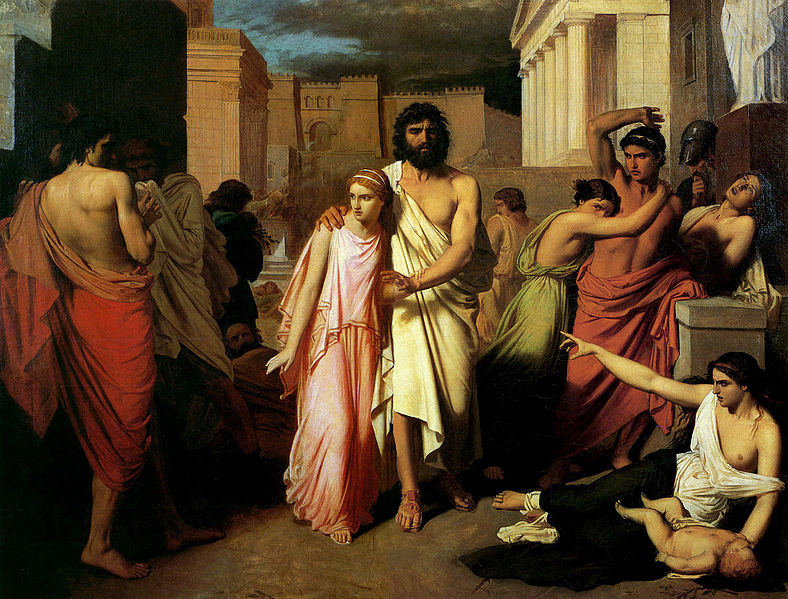
Antigone is the daughter of Oedipidus and Jocasta, she is the product of an incestuous relationship, Oedipidus accidentally married his biological mother.

Antigone is known for trying to secure a proper burial for her brother Polynieces even though he was a traitor to the small Greek city state, Thebes. She is the subject of many ancient classical Greek plays, the most widely known being the one written by Sophocles in 442 B.C.E.

It is also the name of a few other women in Greek Mythology.

Other forms of the name include: (Note: many of these forms are very rare in their home countries)

  • Antígona (Catalan/Galician/Portuguese/Spanish)
  • Antigoné (Hungarian)
  • Antygona (Polish)
  • Antigona (Romanian/Serbo-Croatian/Slovakian)


Despoina, Despina

Gender: Feminine
Origin: Greek/Romanian
Meaning: “miss; damsel; lady.”
(des-PEE-nah)

This popular Greek name started off in Greek Mythology as both an epithet for Persephone as well as the name of a separate goddess who was considered the sister of Persephone and second daughter of Demeter. According to legend, after Persephone had been kidnapped by Hades, Demeter went out to look for her when she caught the attention of the god Poseidon. Poseidon was completely enamored with Demeter. In order to avoid him, Demeter transformed herself into a mare while Poseidon followed suit by transforming himself into a stallion. Demeter could not fight off his advances and she ended up conceiving and giving birth to twins: Despoina, and a beautiful stallion by the name of Arion. Demeter was very angry and took the name Erinyes, meaning raging. In some renditions of the myth, the name of the child is not mentioned and was only revealed to the initiates of Demeter, and Despoina was just a generic term to describe the girl child as in “the Lady”. Despoina was worshipped in the Arcadian region, her temple being in the town of Lykosoura, where she became an even more important goddess than her mother. The name is also borne by a saint and a Romanian queen. It is the name of one of the moons of Neptune. The designated name day in Greece is August 15. In Romanian, it is often rendered as Despina.

Helara

Gender: Feminine
Origin: Greek/Latvian
Meaning: unknown.
Lat (HEL-uh-ruh); Grk (ay-LAH-rah).
The name is borne in Greek mythology by a daughter of a Orchomenus. She was impregnated by Zeus and gave birth to the hut god Tityus. Zeus had to hide her away from the wrath of Hera by concealing her under a mound of earth. The name is sometimes listed as Helare and it is most often used in Latvia where its designated name day is Aug 7th.

Sotiria

Gender: Feminine
Origin: Greek
Meaning: “salvation.”
(so-TEER-ee-ah).
Σωτηρια

The name comes from the Greek word for salvation and its name day is August 6. Its a fairly common name in modern Greece and it was borne by Greek songstress Sotiria Bellou (1921-1997). The masculine form is Sotiris.

Melissa, Melitta

Gender: Feminine
Origin: Greek
Meaning: “honey bee.”
Μελισσα, Μελιττα
(meh-LIS-sah); (meh-LIT-tah)

Melissa feels dull and rather dated, though it should not be overlooked that Melissa actually has a cool meaning and a pretty interesting mythological story behind it. Melissa comes directly from the Greek word for a honey bee. Some sources insist that the Greek word Melissa is a bastardization of an ancient Hititte word for honey, though I was unable to confirm this. In Greek mythology, Melissa was a Cretan princess who served the god Zeus honey. Out of appreciation, he transformed her into a honey bee. In 1984, Melissa had a peak, where it came in at # 8. It currently stands at # 134. Though Melissa has run her course, the ancient Attic variation of Melitta might be a far more refreshing alternative. Melitta has been in usage in Germany for quite awhile. In fact, its the name of a German coffee company. The company was named in honour of the wife of the company’s founder, Melitta Bentz (1873-1950).

Lydia

Gender: Feminine
Origin: Latin/Greek
(LID-dee-uh)

Lydia has a sweet feminine vibe. Its classic without sounding too stuffy. Lydia could work just as well on a five month old as it would on a 55 five year old. It has the same feel as the popular Olivia and it wouldn’t be surprising if Lydia soon took Olivia’s place. Lydia currently stands as the 120th most popular female name in the United States.

As for Lydia’s history, it first appears as a given name in the New Testament. It was the name of a woman who had converted to Christianity after befriending St. Paul. Some scholars believe that Lydia was not her actual name, rather, it was a nickname to denote her place of origins, (Lydia in Asia Minor).

Lydia is a Greek word for an ancient country, known in Assyrian as Luddu, this particular’s country’s culture and language has been lost to history and speculation. The Greeks talked quite a bit about it, and in the Bible it is often refered to as Lud.

Lydia has multiple forms, including:

  • Lidiya Лидия (Bulgarian/Russian: Lidochka is a Bulgarian diminutive form)
  • Lídia (Catalan/Hungarian/Portuguese/Spanish)
  • Lýdie (Czech: LEED-yeh)
  • Lydia Λυδια (English/Estonian/Greek)
  • Lii/Ly (Estonian)
  • Liidia/Liidi (Estonian)
  • Lyydia/Lyyti (Finnish)
  • Lydie (French: LEE-DEE)
  • Lida (Hungarian)
  • Licia (Italian: lee-CHEE-ah).
  • Lidia (Polish/Italian/Romansch: a Polish diminutive form is Lidka.)
  • Livli (Sami)
  • Lýdia (Slovakian)
  • Lidija (Slovene/Croatian: diminutive forms are, Lidonka, Lidunka and Liduška)

In other Continental European countries, the name is usually rendered the same as it is in English. In German speaking countries its pronounced (LUY-dee-ah). Its designated name day is August 3rd.