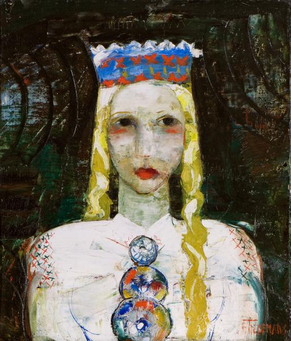
Daila, Daile

  • Origin: Latvian, Lithuanian, Estonian
  • Meaning: “beauty, grace, artistic refinement.”
  • Lithuanian form: Dailė
  • Gender: Female
  • Pron: DYE-lah; DYE-leh

Derived from the Latvian poetic word daile, meaning, “beauty, grace, or artistic refinement.”
The noun daile itself was standardized by linguist and writer Atis Kronvalds in 1868, who likely modeled it on Lithuanian dailė (“art, artistic creation”). Both words share the Baltic root dail-, conveying ideas of beauty, craftsmanship, and aesthetic harmony.

As a personal name, Daila and its variant Daile first appeared in Latvian name calendars in the late 19th century, but did not come into regular use until the 1920s, during the national revival when many symbolic native words were adopted as given names.

Regional and Linguistic Variants

  • Daile – an older or alternative Latvian form, also used in Estonia.
  • Dailė – Lithuanian form (still occasionally used).
  • Dailīte – rare Latvian diminutive (dye-LEE-teh).
  • Dailis – masculine form used in both Latvian and Lithuanian (DYE-lis).
  • Dailonis – rarer Latvian masculine variant (DYE-loh-nis).

The designated name-day for Daila is February 4th (Latvia); and December 3 for Daile (Latvia).

Sources

Riku

In Finnish and Estonian, this is a form of Richard. It was among the top 100 most popular boys’ names in Finland in 2004, ranking in at #48. The designated name-day is February 7th in both countries.

It is also a Japanese male name (very rarely female), and can have various meanings depending on the Kanji but the most popular is 陸 (Riku), “land, shore, continent.”

Riku is a familiar character name in anime, manga, and games — for example, in Kingdom Hearts, where Riku is a central figure.

Sources

Vootele

Photo by Gioele Fazzeri on Pexels.com
  • Origin: Estonian
  • Meaning: unknown
  • Gender: masculine

The name is a Medieval Estonian male name of unknown meaning. It seems to be a reconstruction of a Germanicized Estonian name recorded in the 13th-century as Wottele. It was the name of a 13th-century Estonian warrior, an associate of King Lembitu, who fought in the battle of St. Matthew’s Day.

The designated name day in Estonia is May 12th.

Sources

Võitur

Photo by Kadir Polat on Pexels.com
  • Origin: Estonian
  • Meaning: “anointed.
  • Gender: masculine

The name comes directly from the Estonian word võitud (anointed).

The name is currently very rare in Estonia, being given to less than 5 people.

The designated in Estonia is May 12th.

Sources

Tapper

Photo by Zaur Takhgiriev on Pexels.com
  • Origin: Estonian
  • Meaning: “battle ax.”
  • Gender: masculine

The name comes directly from the Estonian word for battle ax. It ultimately derives from the Russian, topor. It has been in use as a given-name, though rarely, there are fewer than 5 bearers of this name in Estonia.

It has a designated name day in Estonia of May 12th.

Sources

Pinja

Gender: Feminine
Origin: Estonian/Finnish
Meaning: “pine.”

The name is derived from the Finnish word for a species of pine tree known as pinus pinea. This might be the perfect autumnal name. Its designate name-day is October 6.

As of 2011, Pinja was the 35th most popular female name in Finland.

Helmi

Gender: Feminine
Origin: Finnish/Estonian
Meaning: “pearl”
(HEL-mee)

The name was originally a diminutive form of the name Vilhelmiina, but later became an independent name in Finland due to its coincidental meaning of “pearl,” in Finnish. The pronunciation could be heard here: http://www.forvo.com/word/helmi/

As of 2011, Helmi was the 11th most popular female name among Finnish speakers in Finland.

The designated name-day in Finland and Estonia is May 7th. In Sweden, it is April 6th.

Meri

Gender: Feminine
Origin: Finnish/Estonian
Meaning: “the sea.”
(MEH-ree). Pronunciation can be heard here: http://www.forvo.com/word/meri/

The name comes directly from the Finnish and Estonian word for the sea, but it is also speculated that it may have originally been used as an alternative for Maria. As of 2008, approximately 5521 women in Finland bore the name Meri. There is also a popular compound form, which is Meri-Tuuli, literally meaning “sea wind.” The designated name-day in Finland is December 3, while in Estonia, it is April 22nd.