The name is of uncertain meaning, it is possibly a feminine form of the Welsh male name, Lleu (bright, light), or composed of the Welsh element, lleu (bright; light) and cu (dear), or derived from the Welsh lleuad (moon).
It is the name of a heroine in the 14th-century Welsh poem by Llywelyn Goch ap Meurig Hen, Marwnad Lleucu Llwyd, it is said to have been written for his deceased lover of the same name.
The name is a modern English form of the Anglo-Saxon male name, Wada which is derived from the Anglo-Saxon verb wadan (to go), spawning the modern English verb “to wade.” Several individuals with this as a first name are recorded in the Doomsday Book. It spun off the patronymic surname of the same meaning. It went out of use in Anglo-Norman England but was reintroduced in the 19th-century, possibly used in honor of a family surname.
It is the name of a legendary figure in Germanic folklore, the father of Wayland. The Anglo-Saxon poem, Widsith, makes mention of him and Wade’s Tale is alluded to by Chaucer in Troilus & Criseyde.
In its Old Norse incarnation of Vadi or Vaði, he is made mention of in the Þiðrekssaga and the Poetic Edda.
It is currently the 345th most popular male name in the United States (2022).
Meaning: warrior; soldier; brave; name of a type of tree endemic to Hawaii
Gender: masculine
The name comes directly from the Hawaiian word for “brave; courage; fearless” also a warrior or a soldier and it is the name of a type of tree acacia koa, which is endemic to Hawaii.
It currently ranks in as the 97th most popular male name in Australia, NSW (2022), the 349th most popular male name in the United States and the 489th most popular in England and Wales (2021).
The name is composed or the Yoruba elements, ọmọ (“child”) + rè (“to give attention to”) + èmi (“me”).
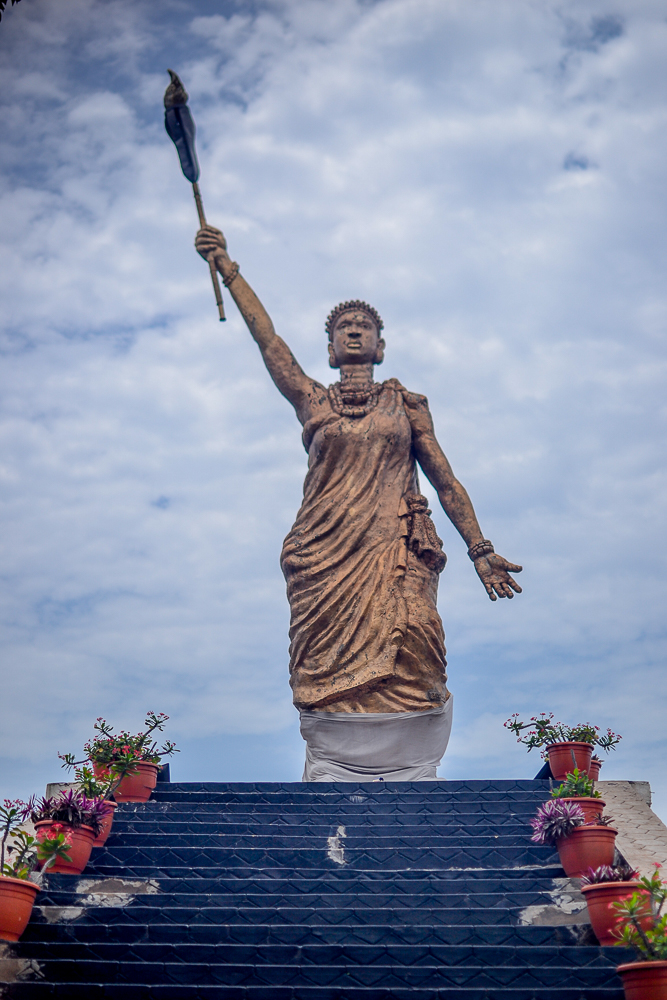
In Yorubaland, the southwestern part of Nigeria, it is the name of a legendary 12th-century Queen, Moremi Ajasoro. Queen Moremi sacrificed her son to the spirit of the Esimirin river in exchange for power to stop the raids and enslavement of her people by the Ugbo, the Yoruba still commemorate this sacrifice during the Edi Festival. Her story has been adapted into a 2018 musical of the same name. In 2017, a statue was commemorated in her honor (pictured above) in Osun State, Nigeria, and is currently the fourth largest structure in Africa.
Drew is the modern English form of the Anglo-Norman Dreu(x) which ultimately comes from the Frankish, Drogo, which is likely derived from the Proto-Germanic, *draugaz (illusion, mirage), which later transformed into the Saxon drog (ghost, illusion), compare to the Old Norse word draugr, a type of vampiric supernatural being in Old Norse folklore. The name was introduced into England by the Normans. It has also been linked with the Slavic dragan (dear, precious) but this etymology is less likely.
Dreu(x) was borne by a son of Charlemagne (8th-century CE). It was also borne by a 12th-century saint of Flanders, who has the distinction of being the patron saint of coffee.
It is the progenitor of the French surname Drieux.
Dreux is also the name of a commune in France, but this has a different etymology, possibly related to the Latin Drocus (unknown meaning).
In the 20th-century, Drew was often listed as an offshoot of Andrew in many baby name books. It also was occasionally bestowed on females.
Drew currently ranks in as the 512th most popular male name in the United States (2022), and the 840th most popular female name. As of 2021, it was the 790th most popular male name.
Notable bearers are Drew Carey and Dr. Drew Pinsky.
Drogo is the name of several Hobbits in the Tolkien universe and of the name of the Dothraki lord in the George R.R. Martin book, A Throne of Ice and Fire.
Meaning: “praiseworthy; new; new bride; navigable; boat; sailor.”
Gender: feminine
Pronunciation: NAHV-ee-uh; NUV-ee-yuh
The name comes directly from the Sanskrit नव्य (navya) which could either mean “praiseworthy; new,” also could be used to describe a newly married woman. Alternately, the same word could mean “navigable; boat” or “sailor.” It ultimately comes from the Indo-European root word, n*ehaus (boat), which also gave us the modern English word “navy.”
The name is of unknown origin or meaning, the consensus is that it is Germanic but which Germanic language it originates from is up for debate. Since it first occurred in Spain, the most likely is that it is of Gothic origins, possibly composed of the Germanic elements *allaz “all, whole, every”‘ and wart “‘guard, ward.” The second element may also stem from wars (cautious, guarded). Others have related it to the Old Norse, Hallvadr (hall-guard) or Alfarr (elf-warrior), but this is less likely.
The name has been in use in the Iberian peninsula since Medieval times, it was borne by Álvar Fáñez (12th-century), a vassal of El Cid and the subject of the Spanish epic poem, El Cantar de mio Cid.
It is the progenitor of the Spanish surname, Alvarez/Álvarez and the Portuguese, Alves.
Álvaro is the 10th most popular male name in Spain as of 2022. His rankings in other countries/regions are as follows:
#22 (Galicia, Spain)
#69 (Catalonia, Spain)
#97 (Chile, 2021)
#99 (Basque Country, Spain)
#188 (Mexico, 2021)
#794 (United States)
Usage/Forms
Àlvar (Catalan)
Álvaro (Portuguese, Spanish)
Álvaro (Galician)
Alvar (German, Scandinavian)
Alvaro (Italian)
Alvarus (Latin)
Alwar (Polish)
Feminine forms include, Álvara (Portuguese, Spanish), Alvara (Italian, Scandinavian).