The name is composed of the Welsh words, gwyn (white, fair, blessed) and llwyf (elm tree). The name was borne by a 7th-century Welsh saint of whom very little is known. Her feast day is November 30th.
Gwawr is derived from the Welsh word for “dawn,” whereas Gwawrdydd is from the Welsh meaning, “daybreak.”
In Welsh legend and early medieval hagiography, Gwawr is mentioned as one of the daughters of Brychan Brycheiniog, a 5th-century Welsh chieftain and saint reputed to have had many saintly children.
A notable bearer is Welsh concert soprano, Gwawr Edward (b. 1984).
Gwawr continues to experience quiet usage in Wales, whereas Gwawrdydd remains rare, last experiencing rare use in the mid 1800s. Another rarer variation is Gwawrwen (fair dawn; white dawn; holy dawn).
From the Welsh afal, meaning “apple,” Afallach is the name of a male deity in early Welsh mythology. He is described as a god of the Otherworld and of healing—figures sometimes link him to the Isle of Apples (Ynys Afallach), the mythic realm better known to us as Avalon. Through this association, Afallach is regarded as the mythic progenitor of the name Avalon, the legendary paradise of Arthurian lore.
Avalloc is its Anglicized form. Other Anglicized forms includem Evelake, and Aflach.
It has seldom use, if at all, as a given-name in the modern era, but it’s a bold, evocative choice pulled straight from Welsh mythology. It is ideal for those drawn to ancient, nature-infused names with literary and mystical resonance or those who want a pagan inspired name.
Mannix is the Anglicized form of the early Irish given name Mainchín, a diminutive of Old Irish manach, meaning “monk.” The root manach comes from Latin monachus, “monk,” introduced to Ireland through early Christian monasticism.
Mainchín was a popular given name among early Irish saints, particularly during Ireland’s monastic age (6th–8th centuries). Notable bearers include: Saint Mainchín of Limerick, a 6th-century bishop and the patron saint of the city; and Saint Mainchín of Corann, a lesser-known saint of County Sligo.
As Irish names were adapted into English, Mainchín became Mannix (also occasionally Manix or Mannex). Over time, this Anglicized given name also evolved into a family surname, carried by descendants of those named Mainchín.
The name gained brief international attention through Archbishop Daniel Mannix (1864–1963) of Melbourne, a prominent Irish-Australian religious leader, and through the late-1960s detective series Mannix, which reintroduced the name to modern audiences.
Today, Mannix is a rare but genuine revival of an ancient Irish Christian name — never invented, never fabricated from a surname, but descended directly from one of Ireland’s earliest monastic names. It combines the humility of its meaning (“little monk”) with the strong, contemporary rhythm of names ending in -x (Felix, Lennox, Maddox).
A modern Welsh girls’ name formed from tan (“fire”) + gwen (“white, fair, blessed”), often interpreted poetically as “white fire” or “holy fire.”
It is not known in medieval Welsh name lists; several modern sources suggest it was first coined or adopted around the 1960s in Wales. Its usage appears to be modest and not widespread historically. However, since it has cultural significance and is used, I consider it legitimate.
At least 5 girls were given this name in the U.K. in 2024
The name is likely derived from the Welsh word, teg, meaning (fair; comely; beautiful; handsome). It has also been suggested to be a Welsh form of the Latin male name, Tacitus (quiet, serene).
Tegid Foel—whose epithet Foel means “bald” in Welsh—is a shadowy but evocative figure in Welsh mythology. He is remembered as the husband of the enchantress Ceridwen and the father of Creirwy and Morfran (Afagddu), the family whose story frames the birth of the poet-prophet Taliesin.
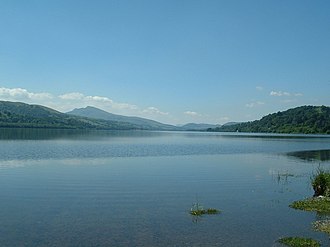
His name is inseparable from Llyn Tegid (Bala Lake), the largest natural lake in Wales. Local lore long treated the lake as a living presence, and many scholars think Tegid may once have been its protective spirit or ancestral deity. It is believed his court is within the shadowy depths of Bala Lake. The same lake is also said to have a large Loch Ness like sea-monster living in it, named Teggie.
In 2024, 5 babies were given this as a name in the U.K.
In Welsh, Rhain is an old personal name with roots in early medieval Wales.
Rhain appears in early Welsh royal genealogies—e.g., Rhain Dremrudd and Rhain ap Cadwgan, princes of Dyfed and Brycheiniog in the 7th–9th centuries. Medieval English chroniclers translated the name as Regin.
It survives mainly in historical records and place-names (such as Llanrhian in Pembrokeshire, which means “church of Rhain”).
The exact origin is not completely certain, but most Celtic scholars connect it to the Old Welsh and Brittonic stem rān / rēn, which meant “spear” or “lance,” or figuratively “arm of strength, leader.” It has also been linked with the Welsh word, rhain (stiff). In modern Welsh, y rhain means “these.”
Today Rhain is rare as a given name, used mostly in Wales by families reviving early medieval names.
Pronunciation in modern Welsh: /r̥aɪn/ — roughly “rhine,” with the initial rh being the voiceless rolled “r” unique to Welsh.