Cyprian

Gender: Masculine
Origin: Latin
Meaning: “from Cyprus.”
Eng (SIP-ree-ən)

The name is derived from the Roman family name, Cyprianus, which means, “from Cyprus.”

The name was borne by a 3rd-century Christian theologian, writer, martyr and saint.

As of 2009, its French form of Cyprien was the 272nd most popular male name in France.

Other forms of the name include:

  • Çipriani (Albanian)
  • Cyprian (Albanian/English/German/Polish/Romansch)
  • Sybryan سيبريان (Arabic)
  • Kiprianos Կիպրիանոս (Armenian)
  • Zipriano (Basque)
  • Kiprijan Киприян (Bulgarian)
  • Cebrià (Catalan)
  • Ciprijan (Croatian/Macedonian/Serbian/Slovene)
  • Cyprián (Czech)
  • Cyprianus (Dutch/Latin)
  • Cyprien (French)
  • Ciprian (Fruilian/Romanian)
  • Cibrán (Galician)
  • Kvipriane კვიპრიანე (Georgian)
  • Kyprianόs Κυπριανός (Greek)
  • Cipriano (Italian/Portuguese/Spanish)
  • Kiprijonas (Lithuanian)
  • Kiprián Киприа́н (Russian)
  • Cebrián (Spanish)
  • Kypryan Кипріян (Ukrainian)
Feminine forms include:
  • Cyprienne (French)
  • Cipriana (Italian/Portuguese/Spanish)
  • Cypriana (Latin/Polish)
The name was borne by several other saints, another notable bearer is Polish romantic poet, Cyprian Kamil Norwid (1821-1883).

Hippolytus, Hippolyte

Gender: Masculine
Origin: Greek ‘Ιππολυτος
Meaning: “freer of horses.”
Eng (hip-PAHL-ih-tus); Eng Fem (HIP-poh-LY-tee; hi-PAHL-i-tah) Fre (EEP-poh-LEET)

The name is derived from the Greek, Hippolytos (‘Ιππολυτος), which is composed of the elements, hippos (‘ιππος), meaning, “horse” and lyo (λυω) meaning, “to loosen.”

The name was borne in Greek mythology by a son of Theseus, and depending on some sources either the Amazon, Hippolyte (hence the name) or Antiope. He rejected the advances of his step-mother, Phaedra, who, when spurned, complained to Theseus that his son had raped her. In anger, Theseus cursed his own son, using of the his three wishes granted by Poseidon, Hippolytus was dragged to death by his horses after being frightened by a sea-monster. The story was retold both by Euripides in his play Hippolytus and by Seneca the Younger in his play, Phaedra.

His possible birth mother of Hippolyte was an Amazonian queen who possessed a magical girdle which denoted her rank. She appears in the legend of Hercules who seeks her girdle for the princess, Admeta. Hippolyte is so impressed with the immortal’s prowess that she gives Hercules her girdle as a gift. William Shakespeare may have based his character of Hippolyta who appears in A Midsummer’s Night Dream off of Hippolyte the Amazon queen.

The male form of Hippolytus appears several more times throughout Greek mythology as the name of minor characters.

It was also borne by some early renowned Christian saints, including Hippolytus of Rome a 3rd-century Christian theologian, writer and martyr.

In English and early Greek, Hippolyte often appears as a feminine form, but in French, it is an epicène name, that is a unisex name, however, it is more often used on males than on females. As of 2009, Hippolyte was the 286th most popular male name in France.

Other forms of the name include:

  • Ipolit Иполит (Bulgarian/Serbian)
  • Hipòlit (Catalan)
  • Hipolit (Croatian/Polish/Romanian/Slovak)
  • Hippolyt (Czech/German)
  • Hippolytus (Dutch/English/Latin)
  • Hippolyte (French)
  • Ipolite იპოლიტე (Georgian)
  • Hippolütosz (Hungarian)
  • Ippolito (Italian)
  • Hipolitas (Lithuanian)
  • Hipólito (Portuguese/Spanish)
  • Ippolit Ипполит (Romansch/Russian/Ukrainian)
  • ‘Ipołito (Venetian)
Feminine forms include:
  • Hipolita Хиполита (Albanian/Bulgarian/Serbian)
  • Ipalita Іпаліта (Belarusian)
  • Hipòlita (Catalan)
  • Hippolyta ‘Ιππολυτη (English/Greek/Latin/Romanian)
  • Hippolyte ‘Ιππολυτη (English/French/Greek)
  • Hippolüté (Hungarian)
  • Ippolita Ипполи́та (Italian/Russian/Ukrainian)
  • Hipolitė (Lithuanian)
  • Hippolita (Polish)
  • Hipólita (Portuguese/Spanish)

Virgil

Gender: Masculine
Origin: Latin
Meaning: unknown
Eng (VUR-jəl); Fre (vare-ZHEEL)

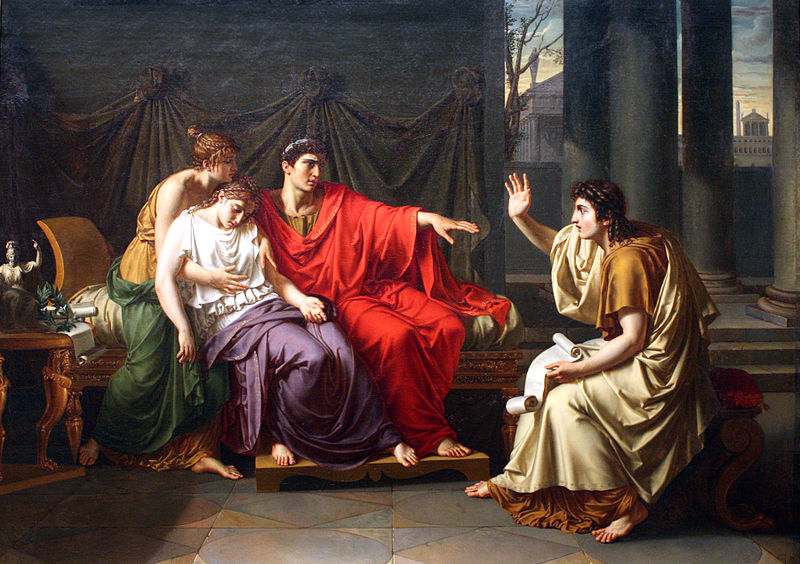
The name was borne by famous Latin poet, Publius Vergilius Maro (70–19 BCE), the author of the Aenead, credited for being one of Rome’s most epic poems.

Dante used Virgil as the guide in his Inferno and part of Purgatorio.

The origins of the name are unclear, Virgil itself is derived from the Latin, Virgilius/Vergilius, a Roman family name of uncertain meaning.

At one time, Virgil was one of the most popular male names in the United States. The highest he ranked was in 1907 coming in as the 93rd most popular male name. As of 2010, Virgil no longer appears in the U.S. top 1000

As of 2009, its French counterpart of Virgile was the 333rd most popular male name in France.

Other forms of the name include:

  • Virgiliu (Albanian/Romanian/Sicilian)
  • Virchilio (Aragonese)
  • Virxiliu (Asturian)
  • Virgili (Catalan/Lombard/Occitanian)
  • Virgilije Вергилиј (Croatian/Macedonian/Serbian/Slovene)
  • Virgilius (Dutch/Latin)
  • Vergil (English/German/Plattdeutsch/Ripoarisch/Scandinavian)
  • Virgil (English/Romanian)
  • Vergíliu (Extramaduran)
  • Virgile (French)
  • Virgjili (Frulian)
  • Feirgil/Veirgil (Gaelic)
  • Virxilio (Galician)
  • Virgill (Icelandic)
  • Virgilio (Italian/Spanish)
  • Vergilius (Latin)
  • Vergīlijs (Latvian)
  • Virgilijus (Lithuanian)
  • Virġilju (Maltese)
  • Bergílio (Mirandese)
  • Wergiliusz (Polish)
  • Virgílio (Portuguese)
  • Vergėlėjos (Samogaitian)
  • Vergílius (Slovak)
  • Fyrsil (Welsh)
The name was also borne by an 8th-century Irish saint and missionary, Virgil of Salzburg.

Eulalia, Eulalie

Gender: Feminine
Origin: Greek Ευλαλια
Meaning: “to talk well.”
Eng (yoo-LAY-lee-uh; yoo-LAY-lee); Fre (eu-lah-LEE); Cat (oo-LOW-lee-ah); Sp (oo-LAH-lee-ah)

The name is composed of the Greek elements, eu ευ (good) and laleo λαλεω (talk).

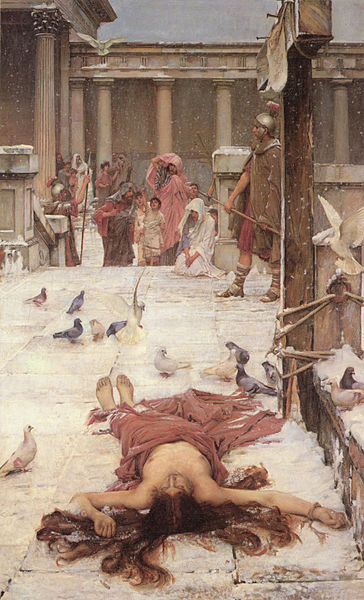
The name was borne by two different early Spanish saints, both of whom are believed to be one and the same person. St. Eulalia of Mérida was a 3rd-century teenage Roman girl who refused to give up her faith, she was subsequently tortured and crucified, legend has it that when she was cut down from her cross, a layer of snow fell to cover her nakedness. The story was the subject of the famous painting by John William Waterhouse, (above).

In the English-speaking world, especially in the United States, Eulalia and her other forms appeared in the U.S. top 1000 from the 19th-century till the 1930s. She never ranked high, the highest only being # 365 in 1893. Her French form of Eulalie also experienced some usage but fell out of the top 1000 by 1900. The highest Eulalie ever ranked in the United States was at # 687 in 1893. Eulalie’s introduction into the United States may have had something to do with Edgar Allan Poe’s 1845 poem, Eulalie.

Eulalie is one of Poe’s less Gothic works, it recounts how a widower once again finds happiness in a girl named Eulalie.

Two famous American bearers were Silent film actress, Eulalie Jensen (1884-1952), and  Eulalie Spence (1894-1981) an African-American play-write of West Indian extraction.

Further up in North America, the name was borne by French-Canadian Blessed and religious foundress, Eulalie Durocher, aka, Soeur Marie Rose Durocher, who is credited for finding the Order of the Holy Name of Jesus and Mary (1811-1849).

In French naming history, Eulalie appears in a famous folktale, Jean, the Soldier, and Eulalie, the Devil’s Daughter.

Notable French bearers are numerous, but one of the most famous has to be an early female journalist by the name of Eulalie de Senancour (1791-1896).

In the United States, Eula was probably the most common form. She consistently remained within  the U.S. top 1000 between 1880 and 1960. The highest she ever ranked was at # 122 in 1908.

As of 2009, its French form of Eulalie was the 472nd most popular female name in France.

Other forms of the name include:

  • Olaria (Aragonese)
  • Olarieta (Aragonese)
  • Olalia (Asturian)
  • Olaya (Asturian)
  • Santolaya (Asturian: literally means, Saint Eulalia, used in reference to St. Eulalia very much in the same way Santiago and Santana)
  • Eulàlia (Catalan)
  • Eulalia (Dutch/English/German/Italian/Latin/Polish/Spanish)
  • Eula (English)
  • Eulalie (English/French)
  • Lalia (English)
  • Aulaire (French: archaic)
  • Evlalia (Greek)
  • Eulália (Hungarian/Portuguese/Slovak)
  • Aulazia (Occitanian/Provençal)
  • Olalla (Spanish)
Eulalia is also the name of a type of grass.
A common French and English short form is Lalie.

Theophilus

Gender: Masculine
Origin: Greek Θεοφιλος
Meaning: “love of God.”
Eng (thee-AHF-ə-ləs); Fre (TAY-o-FEEL); Grk (THAY-oh-FEE-lose)

The name is derived from a theophoric Greek name composed of the elements, theos θεος (god) and philos φιλος (love), hence: “love of God.” It is the Greek cognate to the Latin, Amadeus.

It was a common name in pre-Christian Greece and appears in the New Testament as the name of a person that the Gospel of Luke and the Acts of the Apostles address. It is argued that this was actually a title used to refer to Christian followers in general, others argue that it was indeed the name of one actual person. As to who exactly Theophilus was is shrouded in mystery. Many different Biblical scholars have their own ideas and common theories include that he was either a Roman official, or Theophilus ben Ananus, who was the High Priest at the Temple of Jerusalem during that time, or even the lawyer of St. Paul.

The name was borne by several Byzantine personages, including an Emperor, a famous astrologer and a scientist.

In the English-speaking world, the name was used in Medieval England, it was borne by Theophilus Presbyter (1072-1125), a Benedictine monk a wrote a medieval guide to several medias of art. Theophilus also experienced a vogue among the Puritans of the 17th-century.

As of 2009, its French form of Théophile was the 343rd most popular male name.

Other forms of the name include:

  • Teofil Теофил (Bulgarian/Hungarian/Polish/Russian)
  • Theophilus (Dutch/English/Latin)
  • Théophile (French)
  • Theofil (German)
  • Theophilos (Greek)
  • Teofilo (Italian)
  • Teófilo (Portuguese)
  • Teofilus (Scandinavian)
  • Teófilo (Spanish)
  • Feófil Фео́філ (Russian/Ukrainian)
Feminine forms are Theophila and Teofila.

Nabil

Gender: Masculine
Origin: Arabic نبيل
Meaning: “noble”
(NAH-BEEL)

The name comes from the Arabic meaning, “noble”, and is popular among Christians, Muslims and even Baha’i.

It was borne by a an early Christian saint and martyr, a king of Mauretania, who was martyred under his brother Gildon, who took the side of the Pagan Romans.

It was also borne by Nabíl-i-Akbar (1829-1892), one of the 19 Apostles of Bahá’u’lláh and the Great Nabíl (1831–1892), a renowned Bahai historian.

As of 2009, Nabil was the 399th most popular male name in France.

A Berber form is Navil and a feminine form is Nabila.

Pakhom, Pacôme

Gender: Masculine
Origin: Ancient Egyptian
Meaning: “he-falcon.”
Fre (PAH-kome)

The name is composed of the ancient Egyptian elements, pa (he) and akhom (falcon).

The name was later hellenized to Pachomius and franconized to Pacôme.

The name is borne by a major Coptic Christian saint (circ.3rd-century C.E), who is also revered in the Roman Catholic and Eastern Orthodox Churches. Pakhom is credited for being the founder of Coptic Monasticism.

As of 2009, its French form of Pacôme was the 412th most popular male name in France.

Other forms of the name include:

  • Bakhoum باخوم (Arabic/Assyrian/Lebanese/Syrian)
  • Pacomi (Catalan)
  • Pacumi (Catalan)
  • Pakhom (Coptic)
  • Pacôme (French)
  • Pachôme (French)
  • Pakhomios Παχώμιος (Greek)
  • Pacomio (Italian/Spanish)
  • Pachomiusz (Polish)
  • Pacômio (Portuguese-Brazilian)
  • Pacómio (Portuguese-European)
  • Pahomie (Romanian)
  • Pahomij Пахомий (Russian/Slovene)
  • Pahomije (Serbian)
  • Paho (Slovene)
  • Paxomij Пахомій (Ukrainian)
The name was also borne by a 15th-century Serbian hagiographer and two patriarchs of Constantinople.
Pachomius is also the name of a genus of spider.

Phoebe

Gender: Feminine
Origin: Greek
Meaning: bright; light
(FEE-bee).

To many Americans, Phoebe brings to mind the wacky yet lovable character of Phoebe Buffay on the popular SitCom, Friends. To the British, she is of an upper crust trendy sort, to Christians, she is an admirable woman in the New Testament, and to the Greeks, she is a classic, featured in both the Greek Orthodox calendar of saints as well as in Greek myth.

The name is derived from the Greek, Phoibus, which means “bright, light.”

In Greek Mythology, Phoebe was a pre-Olympic goddess, a Titan. She was the goddess of the moon and the consort of her own brother Coeus, from him, she mothered Asteria and Leto and was believed to be the grandmother of Artemis and Apollo.

The Greeks later associated her with the goddess Artemis. Phoebe was often used as an epithet for Artemis, while the masculine form, Phoebus, was used for Apollo.

Phoebe was also associated with the Oracle of Delphi.

There are a few other Phoebes mentioned in ancient Greek religion, one was a Heliade nymph, another was the daughter of Leucippus and Philodice.

Phoebe, daughter of Leucippus, and her sister Hilaeira, were priestesses to Artemis and Athena. They were both betrothed to Idras and Lynceus. Castor and Pollux, the divine twins, were so impressed by their beauty, that they fell in love with the two maidens and carried them off for themselves. Idras and Lynceus, outraged, sought the two immortals but were both slain. Nevertheless, Phoebe married Pollux. It was also the name of a sister to Leda.

In the New Testament, the name is borne by a woman of Cenchrae, many scholars argue that she was a deaconess, the Catholic Church especially seems to support this stance. She is also believed to have brought Paul’s Epistle of the Romans to Rome. She is a canonized saint in both the Catholic and Greek Orthodox Churches, both rites hold her feast on September 3rd.

Fast forward to the 1500s and you will find the name Phebe, (an older English spelling), as the name of one of Shakespeare’s characters in his play, As You Like It. In the modern American Classic, she is the younger sister of Holden Caulfied in J.D. Salinger’s Catcher in the Rye. Polish Science Fiction writer, Jacek Duraj, uses the name as an acronym for post-human beings in his novel Perfekcyjna niedoskonałość.

Phoebe is also the name of a genus of evergreen tree, a species of bird and a moon of the planet, Saturn.

As of 2010, Phoebe was the 29th most popular female name in England/Wales. Her rankings in other countries are as follows:

  • # 56 (Australia, NSW, 2010)
  • # 90 (Northern Ireland, 2010)
  • # 93 (Scotland, 2010)
  • # 309 (United States, 2010)

Other forms of the name include:

  • Febe (Asturian/Danish/German/Italian/Norwegian/Polish/Portuguese/Spanish/Swedish)
  • Foibe (Danish)
  • Phoebe (Dutch/English/German)
  • Phœbé/Phébé (French)
  • Phoibe (German)
  • Phoebi/Phoibi (Greek)
  • Feba (Serbo-Croatian)
  • Foibe (Swedish)

Vadim

Gender: Masculine
Origin: Slavic Вади́м
Meaning: debated
(vah-DEEM)

There are a few theories as to the origins and meaning of this name, the most popular being is that it is composed of two Slavic roots, vadit (to attract, to possess) and ima; imati, meaning, (possessing property). Another possibility is that it is derived from the Slavic, vaditi, meaning, “to accuse; to slander; to sow discord.” It has even been suggested to be related to the Persian Badian meaning, (anise).

The name was borne by a semi-legendary East Slavic ruler, Vadim the Bold (circ.9th-century), who led a revolt against Rurik. He is a popular character in 18th-century Russian literature and came to be viewed as a symbol of freedom for the Russian romantic movement.

The name is used in all Slavic-speaking countries, and is occasionally used in German-speaking countries and in Romania.

As of 2009, Vadim was the 423rd most popular male name in France.

Other forms of the name include:

  • Vuadim (Armenian)
  • Vadzim (Belarusian)
  • Vadim Вади́м (Bulgarian/Croatian/Czech/Romanian/Russian/Slovak/Slovene/Ukrainian)
  • Wadim (German)
  • Wadym (Polish)

A common Russian diminutive is Vadik.

Idris

Gender: Masculine
Origin: Arabic إدريس‎ or Welsh
Welsh Meaning: “ardent lord.”
Arabic Meaning: uncertain

Idris is of two different origins and is used in two separate cultures. In Welsh, it is composed of the elements, udd (lord; prince) and ris (ardent, enthusiastic.” In Welsh mythology it was borne by a giant who used the mountain peak of Cadair Idris (Seat of Idris) as an observatory. Legends claims that if you spend one night on the mountain peak you wake up either as a madmen or as a great poet. The name was also borne by a 7th-century Welsh prince, Idris ap Gwyddno.

In the Qu’ran, the name is borne by a prophet, traditionally ascribed to being the same as the Biblical prophet Enoch. Many modern Islamic scholars now believe that Idris was a separate person from Enoch. In this case, the name is believed to be of pre-Islamic and possibly of non-Arabic roots of undeterminate etymology, some, however have connected the name with the Arabic root d-r-s, meaning, “study.”

As of 2009, Idris was the 479th most popular male name in France. In France it is used both among the Bretons and among recent Muslim immigrants.

Other forms of the Arabic include:

  • Idris إدريس‎) Идрис (Albanian/Arabic/Baloch/Bosnian/Bulgarian/Circassian/Dagestani/Ethiopian/Indonesian/Javanese/Malaysian)
  • İdris (Azeri/Turkish)
  • Idriss (Chadian)
  • Driss (Berber/Maghrebi Arabic)
  • Ydyrys Ыдырыс (Chechen/Kazakh/Kyrgyz/Tajik/Tatar/Turkmen/Uzbek)
  • Idrîs (Kurdish)
  • Idriis (Somali)
  • Idrissa (West African)