From the Old Norse word for “embers,” in Norse Mythology, this was the daughter of the jötunn known as Logi (fire), the latter who is considered the personification of fire, a long with his wife Glöð (glowing embers). He fathered another daughter Eisa (glowing ember), both of whom were said to be stunningly beautiful.
Its status as a given-name in most Scandinavian countries is a relic from the past but may appeal to parents drawn to authentic early Nordic names.
The name comes directly from the Old Norse word meaning “glowing ember.” In Norse Mythology, this is the name of one of the beautiful daughters of Logi (fire), and Glöð (glowing embers).
Later, it came to be associated as a pet form of Elizabeth or a German form of Aise (short form of any Nordic name beginning in the Egg-, Agi– element.)
Note: the name can also be an Arabic form of Jesus.
The name comes directly from the Old Norse word for “flame; blaze,” and is also used as a poetic word for a sword. It is born in Norse Mythology by Logi, a jötunn and the personification of fire. He was the son of Fornjótr. He is known for winning a meat eating competition against Loki.
A Swedish variation is Loge
It is a cooler and fresher alternative to Logan, with a spark.
A 19th-century gem and late 20th-century vampiric monikor, the name is of uncertain meaning but has its origins in Medieval Spain. It is likely of Visigothic origins, possibly derived from Gailawera or Geloyra, which stem from gails (happy) or (spear); and wers (friendly, agreeable, true).
It should be noted that Elvira (Latin: Iliberri or Iliberis) was an ancient Iberian and later Roman city located near present-day Granada, in Andalusia, southern Spain. However, in this case, it is likely derived from an Iberian source, meaning “new town.”
It was a popular female name among the royal family of Castille & León, producing two queens who bore this name, Elvira of Castile, Queen of León (965–1017) and Elvira of Castile, Queen of Sicily (c. 1100–1135).
It was later used in Mozart’s 1787 opera Don Giovanni (libretto by Lorenzo Da Ponte), in which Donna Elvira is one of Don Giovanni’s former lovers. This likely popularized the name outside of the Iberian peninsula.
By the turn of the 20th-century, Elvira was not unknown in the United States, though never overly popular, it peaked at #254 in 1914, but fell out the Top 1000 by 1981, the same year Elvira, Mistress of the Dark came on the scene.
The real Halloween link began in 1981, when actress Cassandra Peterson created the camp-horror TV hostess Elvira, Mistress of the Dark for a Los Angeles late-night show (Movie Macabre).
Dressed in a plunging black gown with a beehive of jet hair, Elvira presented old horror movies with sardonic humor — blending Gothic sex appeal, irony, and B-movie kitsch.
The character became a pop-culture icon: Halloween TV specials, films, pinball machines, comic books, and even perfume lines immortalized her as the Queen of Halloween.
Outside the United States, this name does not have such associations. In Sweden, it has been among the top 100 girls’ since 1998 and peaked at #25 in 2014. As of 2024, it came in at #40.
It’s a popular name in the Balkans, even spinning off a male form of Elvir (Bosnian and Albanian).
Other forms include:
Elbire (Basque)
Elvíra (Czech/Slovakian)
Elviira (Estonian, Finnish)
Elvire (French)
Elwira (Polish, also an alternate Swedish spelling, Sorbian)
Elvīra (Latvian)
Elvyra (Lithuanian)
Obscure Lithuanian male forms are the Lithuanian, Elvyras; the Polish, Elwir(o), and the Italian Elviro.
Name days: August 25 (Austria), July 16 (Croatia), February 10 (Hungary), January 25 (Spain), March 1 (Sweden), November 21 (Slovakia), August 13 (Latvia).
Sources
Withycombe, E. G. The Oxford Dictionary of English Christian Names. Oxford: Clarendon Press, 1950.
The name is either derived from the Old Norse gandr (magic wand; magic staff), or the Old Norse gǫndul meaning, “magical animal; werewolf.”
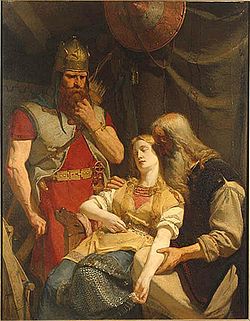
In Norse Mythology, this is the name of one of the Valkyries. She appears in several early sources, including the Heimskringla, in which it is written:
“Gǫndul and Skögul sent out / to choose among kings.” Their presence seals Hákon’s fate, and they greet him after death — both destroyers and honour-givers.”
In the Poetic Edda, specifically Hákonarmál, she is again one of the Valkyries who welcome Hákon to Valhalla, confirming her dual role as harbinger of death and divine escort.
In the Norse sagas and Skaldic poetry, gǫndul can also function as a kenning (poetic metaphor) for “valkyrie” or “battle-witch,” used interchangeably with other names like Skögul, Hildr, and Mist.
Its rarely used these days in Nordic countries, but whose to say it won’t become popular with the rise of other Norse myth names. However, in modern Icelandic, it may sound a touch to close to the Icelandic slang term, göndull (cock, dick, penis), which yes, shares the same etymology as the name, referring to a staff or a wand, but other Nordic languages wouldn’t have the same associations.
Derived from the ancient Greek male name Πτολεμαῖος (Ptolemaios), which in turn comes from πτόλεμος (ptólemos), meaning “war” or “battle.”
The word ptólemos is an older Aeolic dialectal form of πόλεμος (pólemos), the standard Classical Greek word for “war,” sharing the same root with the English word, “polemic.”
Ptolemy I Soter (367–283 BCE) was a general of Alexander the Great and later became Pharaoh of Egypt, founding the Ptolemaic Dynasty (323–30 BCE). This dynasty ruled Egypt for nearly three centuries and ended with Cleopatra VII, the most famous bearer of the family’s legacy.
Claudius Ptolemaeus (Ptolemy) (2nd century CE) was the famed Greek astronomer, mathematician, and geographer of Alexandria, whose Almagest shaped Western astronomy for over a millennium.
According to the Book of 1 Maccabees (135/4 BC), Ptolemy of Jericho betrayed his father-in-law, Simon the High Priest, by murdering him and his two sons while they slept as guests under his roof. This act of treachery is used in Dante Alighieri’s The Inferno, in which the ninth circle of Hell is called Ptolomea after him, a frozen realm reserved for those who betray their guests.
Ptolomy is also the name of an early Christian saint.
In the English-speaking world, Ptolomy has been used on and off since the 18th-century. It appeared in the U.K’s top 500 boys’ names in 2004, ranking in at #906.
A modern bearer is American author, Ptolemy Tompkins. Celebrity couple Gretchen Mol and Tod Williams bestowed this on their son in 2007.
Common English short forms include: Tollie, Tolly, and Tal.
Chariton is an ancient Greek masculine name derived from χάρις (charis), meaning “grace, kindness, favor.”
The name was borne by Saint Chariton the Confessor (4th century), a revered Christian monk and founder of several monasteries in the Judaean Desert. His feast day is observed in the Eastern Orthodox Church on September 28.
Chariton also appears in classical Greek literature as a personal name. It was the name of a 1st-century Greek writer.
The feminine form of Charitine (Χαριτίνη) is the feminine counterpart, and it was latinized as Charitina. An English pronuncitation would be KARE-e-TEE-nee (Grk), and KARE-e-TEE-nah or KARE-e-TIE-nuh).
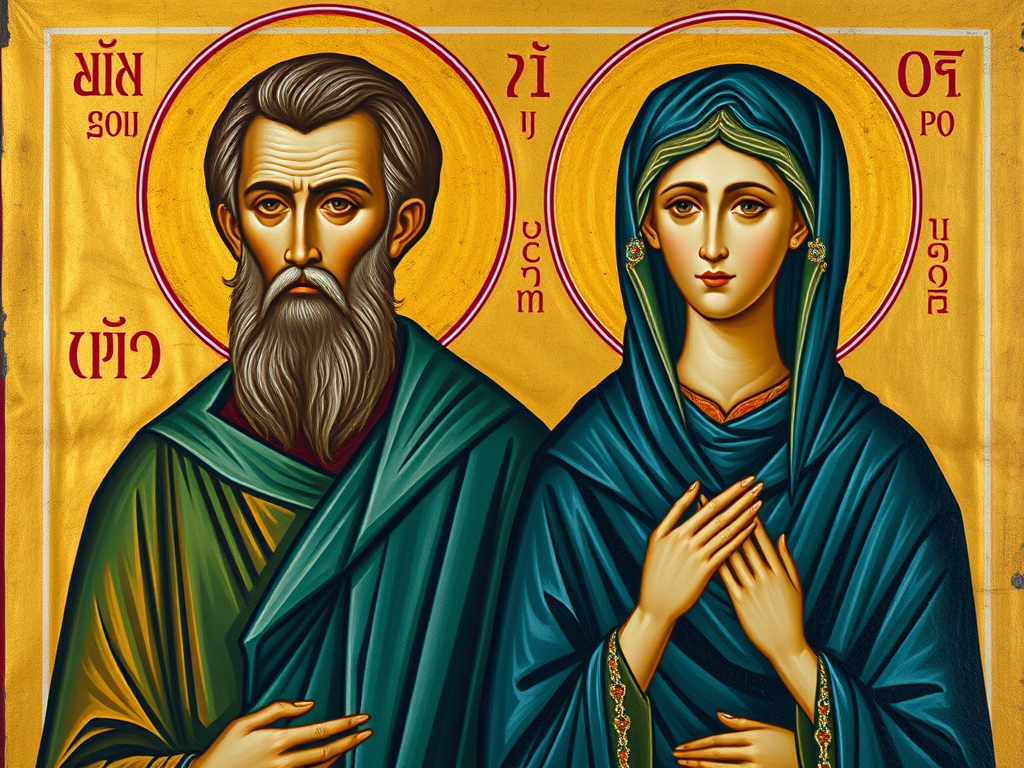
Saint Charitine of Rome (also known as Charitina, 4th century) is a virgin martyr honored in the Eastern Orthodox Church and Catholic Churches. The feast day and designated name-day is October 8th.
Charitina was later borne by a Medieval Russian Orthodox saint of Lithuania. Very little is known of her hagiography other than her being an indigenous Lithuanian woman who was born pagan but later converted to Christianity.
Female International Variations
Haritina خاريتينا / حاريتينا (Arabic, mainly used among Arab-speaking Christians)
From the Old Norse, Gandálfr, it’s a compound of gandr (“magic, charm, witchcraft; monster) supernatural being”) + álfr (“elf”).
Gandalf is listed in the Völuspá—one of the earliest poems of the Poetic Edda—as the name of a dwarf, not a wizard. Many dwarf-names in Tolkien’s The Hobbit and The Lord of the Rings come directly from this same list.
When creating the Grey Wizard of Middle-earth, Tolkien borrowed the ancient name wholesale, changing only the grammar from Old Norse Gandalfr to the more Anglicized Gandalf.
Cultural Impact: Since the publication of The Hobbit (1937) and The Lord of the Rings (1954–55), Gandalf has become one of the most recognized fantasy names worldwide.
Örvar (modern spellings often drop the umlaut to Orvar) is an Old Norse name meaning “arrow.” It comes from the Old Norse noun örvar (plural of ör “arrow, dart”).
The name is best known from the legendary Icelandic saga hero Örvar-Oddr (“Arrow-Odd”), a famous 13th-century saga recounting the adventures of a far-traveling archer and warrior.
The name was used across the Norse world and carried into later Scandinavian naming traditions
Its designated name-days are July 8th in Finland and September 18th in Sweden.
Notable bearers include Swedish football player, Orvar Bengmark (1930-2004) and Icelandic musician, Örvar Þóreyjarson Smárason (b. 1977).
Other forms include:
Ørvar (Faroese, Norwegian)
Orvar (Finnish, Icelandic, Scandinavian)*
Örvar (Icelandic)
Orwar (Swedish)
*Note: I use this term to designate Danish, Norwegian, Swedish)