Viola, Violet

Gender: Feminine
Origin: Latin
Botanical Name
Eng: VIE-lət, VIE-ə-lət. vaɪˈoʊlə, VIE-oh-LUH

One of the very few floral name to have been in usage since the Middle Ages, Violet is the English form of the French Violette, which was introduced to the English speaking world via the Normans. In England, Violet wasn’t very common till the 19th-century, it has been in prevalent usage in Scotland since the 15oos.Viola is a latinate form that was common in the Middle Ages and appears in Shakespeare’s Twelfth Night.

Violette was derived from the Old French Violaine which was from the Latin Viola which in itself is derived from the Greek ion and viera meaning “weaving; flexible; sinous.” Violet is also synonymous with the colour purple in most languages and is a shade of purple in English.

Both names have been in and out of vogue in the United States since the 1880s, its peak year was 1910 where it came in at # 79. The name fell out of the top 1000 by the 1960s. In recent years, the name has become more and more fashionable, as of last year, she stands as the 184th most popular female name, meanwhile in Canada, she comes in even higher at # 71.

Ben Affleck and Jennifer Garner named their eldest daughter Violet.

Usually the designated name-day is October 30. The violet is an autumnal flower, depending on the species.

Other forms of the name include:

  • Vjollca (Albanian)
  • Violeta (Bulgarian, German, Lithuanian, Romanian, Portuguese, Spanish)
  • Viola (Czech, English, German, Hungarian, Italian, Latin, Spanish, Swedish)
  • Jolana (Czech/Slovak)
  • Viol (Danish)
  • Jolanda (Slovene/Dutch)
  • Fjóla (Faroese/Icelandic)
  • Viula (Finnish)
  • Violette (French)
  • Iolana (Hawaiian)
  • Jola/Jolán/Jolánta (Hungarian)
  • Viole (Italian)
  • Violetta (Italian)
  • Violanta (Latin/Italian)
  • Violė/Vijolė (Lithuanian)
  • Iolanda/Violante (Medieval Spanish/Portuguese forms)
  • Violaine/Yolande (Old French)
  • Jolanta (Polish: Jola is the diminutive)
  • Wiola/Wioleta/Wioletta (Polish)
  • Vióla/Violétta (Russian/Ukrainian/Icelandic)
  • Vijoleta (Slovenian)
  • Yolanda (Spanish)

There are two Italian male forms: Violo and Violetto

Severin, Soren

Soren Kierkegaard

Soren Kierkegaard

Gender: Masculine
Origin: Latin
Meaning: “stern”
Eng(SEV-rin); Germ(Ze-ve-reen)

The name is derived from an old Roman family name which was derived from the Latin name Severus meaning “stern.” The name was borne by several saints, including a pope and a Roman theologian put to death under Theodoric 1.

The name is also borne by Danish philosopher Søren Kierkegaard (1813-1855), Søren is a fairly popular form throughout Scandinavia, especially Denmark and is even in usage in Germany.

The designated name-day is October 23.

Other forms of the name include:

  • Søren/Sørinus/Sørn (Danish/Norwegian)
  • Servin/Sevrin/Sørin (Faroese)
  • Severi (Finnish: diminutive forms include Seeve and Sever, Veeri)
  • Sévère (French)
  • Séverin (French)
  • Severin (German/Romansch)
  • Severinus (German/Latin)
  • Szevér/Szeverin (Hungarian)
  • Szörény (Hungarian)
  • Severino (Italian, Spanish, Portuguese)
  • Severo (Italian, Spanish)
  • Severus (Latin)
  • Severins (Latvian)
  • Severas/Severinas (Lithuanian)
  • Sevre/Sevri/Sevrin (Norwegian)
  • Söffren/Söfring/Sövrin (Old Swedish: out of usage)
  • Sewer/Seweryn (Polish)
  • Suulut (Saami)
  • Sören (Swedish)
  • Severián (Ukrainian)

Female forms include:

  • Sørina/Sørine (Danish/Norwegian)
  • Severiina (Finnish)
  • Séverine (French)
  • Severina (German, Italian, Lithuanian, Portuguese, Spanish)
  • Szörénke (Hungarian)
  • Sevrina/Sevrine/Søverine/Søvrina/Søvrine (Norwegian)
  • Sewera/Seweryna (Polish)
  • Severyna (Ukrainian)

Ingobert, Ingbert, Ingo

Gender: Masculine
Origin: German
Meaning: “bright Ing.”

Ingobert is composed of the Old Germanic elements Ing which was the name of an obscure Germanic god and beraht meaning “bright.” In Germany the designated name-day is October 22. The name is not very common in German speaking countries these days. Its shortened version of Ingo is far more prevalent. Other sources contend that Ingo has always been an independent name and that it is the masculine counterpart of Inga. Ingo is also the name of a tropical plant. Another form is Ingbert.

Blandina, Blandine

St. Blandine

St. Blandine

Gender: Feminine
Origin: Latin
Meaning: “charming; flattering; friendly”

Both names come from an early Roman name, a feminine form of Blandinus, which is a derivative of the cognomen, Blandus, meaning “charming; flattering” or “friendly” in Latin.

The name was popularized, in France, in the form of Blandine.

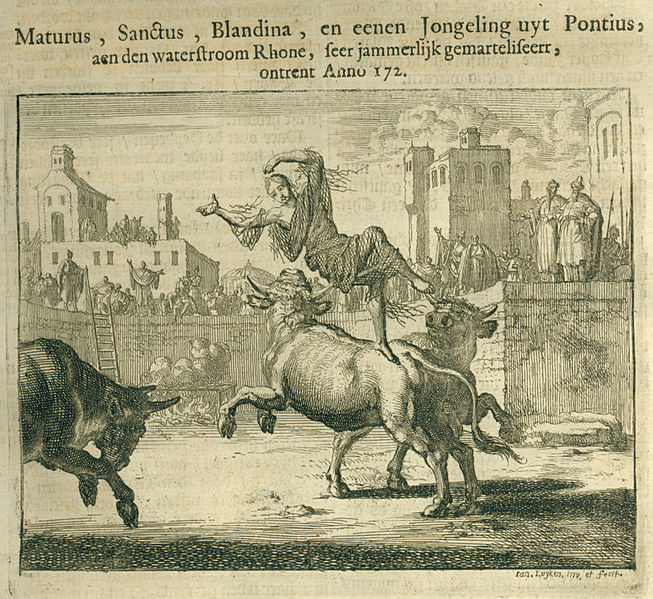
It was the name of an early Christian martyr who had been killed in Lyons in the first-century C.E.

According to legend, she was a slave and Christian of frail health and when an edict against Christians in the area was produced, she and her master were tried and executed.

Allegedly, Blandina was tied to a stake in the local arena where wild animals were set loose upon her, the animals did not harm her, afterwards, she was scourged, placed on a burning grate and then thrown before a wild bull. She still didn’t die. She was finally executed with a dagger.

In France the name-day is June 2nd, while in Germany it is October 22.

The name has also had some usage in Italy , Spanish-speaking countries and in the Romantsch speaking cantons of Switzerland.

The Polish forms are Blandyna and the masculine, but very unusual form, of Blandyn.

Salome

407px-GustavemoreauGender: Feminine
Origin: Aramaic
Meaning: “peace.”
(SAH-loh-MAY)

The name is derived from the Greek Σαλωμη which is from an Aramaic name that was related to the Hebrew word שָׁלוֹם (shalom). The name is associated with the notorious daughter of Herodias who danced for King Herod and was rewarded by dancing with the head of John the Baptist on a platter. Though it was the name of a Herodias’ daughter, the name was used by Christians in reference to the handmaid of the Virgin Mary, (mentioned in the New Testament), who witnessed the Crucifixion, and is considered a saint by the Catholic Church and Orthodox Church. The name was also borne by Salome Alexandra (136-67 BCE) who was the only Jewish regnant queen in history. In Jewish sources she is known as Shalomzion שְׁלוֹמְצִיּוֹ. There are a few other characters in the New Testament mentioned with the name Salome, and it seems to have been common in the Jewish royal family. The name has experienced prevalent usage in Poland, Germany, France, Spain and Portugal.

It was borne by Blessed Salomea (sometimes spelled Salomeja) also known as Salomea of Krakow and Błogosławiona Salomea in Polish, was a Polish princess (1211-1268) and upon being widowed entered the Poor Clares. She is up for canonization. In Polish literature it is the name of a character in Stefan Żeromski‘s 1912 classic the Faithful River (Wierna Rzeka). Polish diminutive forms are Meja, Salcia, Salka, Salomejcia and Salusia (thanks to Magdalena for contributing the latter two diminutive forms). The name is also borne by a famous Lithuanian poetess Salomėja Nėris (1904-1946) and a famous Ukrainian opera singer Salomiya Kruscelnytska (1872-1952).

The designated name-day is October 22.

Other forms of the name include:

  • Saloma (Croatian/Faroese)
  • Salome (Dutch/German/English/Latvian)
  • Saalome (Estonian)
  • Salomé (French/Portuguese/Spanish)
  • Salomi (Greek Modern)
  • Shlomtzion (Hebrew Modern)
  • Szalóme (Hungarian)
  • Salóme (Icelandic)
  • Salomè/Salomina (Italian: latter form was originally a diminutive form: thanks to Magdalena for contributing the info)
  • Salomėja (Lithuanian)
  • Salomea (Polish/Czech/Romanian/Romansch/Slovak)
  • Salomeja (Polish)
  • Saloména (Slovakian)
  • Solomia (Slovakian)
  • Salomiya (Ukrainian)
  • Saltscha (Yiddish)

Cordula

She has a similar feel to the romantic Cordelia, in fact, it is even argued that Cordelia came from Cordula, but I will go further into that in a different entry in the future. For now, the focus is on the lovely Cordula. According to legend, St. Cordula of Cologne was one of the 11,000 companions of St. Ursula, when her friends were being massacred, Cordula cowardly hid in fear and survived, feeling guilty that she survived while her friends were dead, she presented herself to the Huns the next day and was promptly executed. Supposedly Albert the Great found her remains hundreds of years later. Her body was in perfect condition and on her head was written “Cordula, Queen and Virgin.” Her feast day is October 22.

The name is believed to be derived from the Late Latin cor, cordis meaning “heart” with the diminutive feminine suffix -ula attached to the end, hence “little heart.” It has been a common enough name in Germany, due to the popularity of the Saint’s cult.

Cordula was an epic German poem written by Max Waldau in 1854. It is also the name of an orchid from the slipper orchid genus.

Other forms of the name include Kordula which is another form used in Germany but is also used in the Czech Republic, Slovakia and Poland. The Slavic diminutive forms are Kordulka, DulaDulka and Dalinka.

Adeline

411px-Adelina_Patti_1863Gender: Feminine
Origin: French
Meaning: “noble”
Eng (AD-eh-LINE); Fr (ah-de-LEEN)

The name was a Medieval French diminutive form of Adéle which is from the Germanic Adela meaning “noble.” The name fell out of usage as a diminutive form and has been used as an independent given name in its own right since the late Middle Ages. The name enjoyed a trend in English speaking countries during the 18th and 19th-century. It has since then been creeping back into widespread usage. In 1999, Adeline stood at # 924 in the Top 1000 Female Names, it has risen all the way up to #361 in 2008. The name was borne by Blessed Adeline (b. 1125) a French nun known for her piety. It was also the nickname of Adelina Patti (born Adela Juana Maria Patti 1843). She was a famous opera singer of Italian descent. Other forms of the name excluding Adele are:

  • Aline (French: popularized by a 1950s French pop song sung by Christophe of the same name)
  • Alina (Polish/Russian/German/Finnish: diminutives in Polish include Alinka)
  • Adelina (Spanish/Italian/Romanian/Romansch/Portuguese/Finnish/Bulgarian)
  • Adelita (Spanish diminutive form, occasionally used as an independent given name, especially in Latin American Countries. It was popularized as an independent given name by a Mexican folk song of the same name)

Popular English nicknames include: Addie, Adele, and Del. In France, the designated name-day is October 20.

Hilary, Hilaria, Ilario, Ilaria

san_hilarioOrigin: Latin
Meaning: “cheerful.”
(HIL-uh-REE; hih-LARE-ee-uh).

Hilary is the medieval English form of the Latin name Hilarius which is derived from hilaris meaning “cheerful.” It is also said to be from a Greek name Ιλαροσ (Hilaros) which also means “cheerful.” In ancient Roman tradition, the Hilaria were a series of festivals celebrated during the vernal equinox in honour of the goddess Cybele.

The name was borne by St. Hilaire of Poitiers (c.300-c.368) a Catholic theologian and bishop who is referred to as the Hammer of the Arians (Malleus Arianorum) as well as the Athanasius of the West. It is borne by several other male saints including, St. Hilaire of Arles (403-449), St. Ilaro of Galatea (476-558). It is also borne by Hilarius an English poet who wrote in Latin (1125). It is name the name of a few places, one is a town in Cornwall and the other is a village in Glamorgan Ireland, both of which were named for St. Hilaire of Poitiers.

The name was used as a male name all the way up to the early 20th-century (this does not stop the name from being unusable for a male 😉 It was especially popular in Medieval Britain. In the 1930s, the name seemed to have become prevalent among females, though its true feminine version should be Hilaria in English. It is borne by former First Lady and current Secretary of State Hillary Rodham Clinton (b.1947). Other forms of the name include (male versions first):

  • Hilar (Czech/Slovak)
  • Hillar (Estonian)
  • Ilari (Finnish/Russian)
  • Hilaire (French)
  • Ilarion/Ilarionas (Greek Modern)
  • Hiláriusz/Hilár/Ilárion/Lárion (Hungarian)
  • Ilaro/Ilario (Italian)
  • Hilarius (Latin)
  • Hilaras/Hiliaras (Lithuanian)
  • Hilary (Polish)
  • Hilário (Portuguese)
  • Ilarie/Ilarion (Romanian)
  • Hilario (Spanish)
  • Ilarion/Larry (Ukrainian)
  • Ellery/Ilar (Welsh)

Female versions are:

  • Hilarija (Croatian)
  • Ilaria/Ilariada/Lariada (Greek Modern)
  • Ilaria (Italian/Romanian)
  • Hilaria (Latin/Romansch/Spanish)
  • Hilária (Portuguese)

Griselda

The_Story_of_Patient_Griselda_circa_1490Origin: German/Italian/Portuguese/Spanish
Gender: Feminine
Meaning: “grey battle; grey gravel.”
(grih-ZEL-dah)

The name is either derived from the Germanic gris meaning “grey” and hild meaning “battle” or the Germanic gries meaning “gravel, stone.” The name was used in folklore as a sort of euphemism for a patient and obedient woman. In the dark tale written by Italian poet Boccaccio, it is the name of the wife of a nobleman who is told by husband that her children must die. She obeys, but does not realize that she is being tested by her husband, who has taken the children away and hid them in another town, rather than kill them. Griselda’s husband then tells her that he must divorce her and marry another woman, when he introduces her to the “new wife” (a twelve year old little girl who is actually her daughter), Griselda wishes them well and at this her husband reveals that all he had put her through had been a test. The same tale is retold in Chaucer’s The Clerk’s Tale, in which case, Griselda is treated as an allegory for the Biblical Job. Charles Perrault took the same tale and wrote Patient Griselda. There was a play based off of the French version entitled Patient Grissel (1599). There are several Italian opera’s based off the story including La Griselda by Alessandro Scarlatti (1721). The name is used in Italy, Spain and was common in German speaking countries but is now considered dated. Other forms of the name include:

  • Grizelda (Czech/Slovak/Hungarian)
  • Selda (Dutch contraction)
  • Grissel (English)
  • Griselde/Grisold (German)
  • Zelda (German/English contraction)
  • Grizeldisz (Hungarian)
  • Grizel (Scottish)

Ursula

ursulaBritishMuseumGender: Feminine
Origin: Latin
Meaning: “little she-bear; she-cub; little female bear.”
Eng (ERS-uh-LAH)

The name is of Latin origin but is suggested that is may be a latinization of the old Germanic female name Yrsa meaning “bear” and was popularized by a medieval Christian saint said to be martyred in Cologne. Not much is known about the saint, other that she was martyred under Huns along with 11,000 other virgins, which is now believed to be a misprint from the written source of the legend. What is known for sure is that there was a basilica built in honour of a virgin Christian martyr in Cologne and from this arose several different legends referring to a St. Ursula and St. Cordula. According to the legend, St. Ursula was a British princess who was sent by her father to Germany to marry a prince, along with her, were sent 11,000 maidens, however,  her ship was taken off course due to a storm and instead ended up in France where she then decided to do a pan-European Christian pilgramage before meeting her future husband. She made a pilgramage to Rome where she tried to pursuade the pope to do a pilgramage with her and her 11,ooo companions. When she reached cologne she and her companions were massacred by the Huns.

The legend is based off of a 4th century inscription written in the Basilica which was built in the saint’s honour. It is believed that the 11,ooo handmaidens was confused with a female martyr named Undecimilia, Undecimila or Xemilia and that the abbreviation XI.M.V was misread as a number. The same saint has also been referred to under the names Pinnosa or Vinnosa. The name was quite prevalent in Great Britain before the Reformation and went out of usage afterwards. The name is also borne by Swiss actress Ursula Andress (b. 1936). It has also appeared in popular culture as the name of the evil sea-witch in Disney’s the Little Mermaid and as the name of the wife of Nigellus Phineas Black in the Harry Potter Series.

In Poland, the name is associated with a great piece of Polish Literature written by Jan Kochanowski. Known as Laments (Treny) 1580, they are a series of 19 elegies which talk about the author’s grief after the death of his two and half year old daughter Orszola (Urzula) which he refers to as the Slavic Sappho.

Other forms of the name are (divided alphabetically by nationality):

  • Orsula (Corsican)
  • Uršula (Croatian/Czech/Slovakian/Slovenian)
  • Yrsa (Danish/Faroese/Icelandic/Norwegian/Swedish)
  • Orsel (Dutch)
  • Ursule/Ursuline (French)
  • Ursula/Ursel (German/Dutch/Estonian/Finnish/Spanish: German diminutive forms are Ulla, Uli and Uschi)
  • Orsolya (Hungarian: or-SHOH-lah was the 56th most popular female name in Hungary in 2006)
  • Úrsúla (Icelandic)
  • Orsina/Orsola/Orsolina (Italian)
  • Ursa (Latin)
  • Urzula (Latvian)
  • Uršulė (Lithuanian)
  • Urszula/Orszola/Warszula (Polish: Latter two forms are older forms and are rarely used. Diminutive form is Ula and Urszulka. Older diminutive forms are Ulicha and Ulita)
  • Úrsula (Portuguese)
  • Ursetta/Ursina/Urschla (Romansch)
  • Urška (Slovenian: originally a diminutive now used as an independent given name, it was the 51st most popular female name in Slovenia in 2005)
  • Orscheli (Swiss-German: ORSH-lee)

There are a few male equivalents which include:

  • Orso/Orsino/Ursio/Ursino (Italian)
  • Urs (German)
  • Ursinus/Ursus (Latin)
  • Ursyn/Ursycjusz (Polish: very rare)
  • Ursin/Urosin (Romansch)