Ava

Gender: Feminine
Origin: German/Persian
Eng (AY-vah); Germ/Per (AH-vah)

This vintagy, two syllable name has risen way up to the US top 10, coming in at # 5 most popular female name in the United States, (2010).

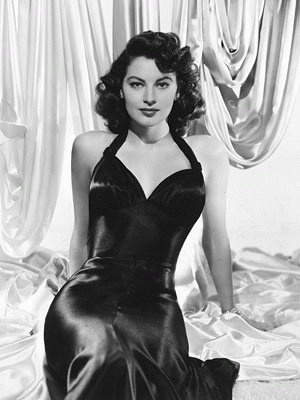
The name was relatively rare before 2000, and came out of nowhere, thanks, no doubt, to such Hollywood trendsetters as Heather Locklear and Reese Witherspoon, both of whom used the name for their daughters in the late 1990s. Both actresses named their daughters in honour of actress, Ava Gardner (1922-1990), whose full name was Ava Lavinia Gardner.

The name has several different origins and meanings, the beloved English counterpart is probably derived from a medieval Frankish name, which was borne in the 9th-century by a saint and the daughter of King Pepin II. In this case, it might be derived from the Germanic element avi meaning “desired.” Other sources have related it to the Frisian awa (water) or from the old Saxon, aval (power).

Another notable bearer is Ava of Melk (1060-1127), a Medieval poetess credited as being the first German language writer. Its recent popularity in German-speaking countries may in part be in tribute to her millennial anniversary and in part to Hollywood.

The name is also a popular Persian female name and is commonly used in Iran and throughout Central Asia. It can either be related to the Persian meaning, “sound, voice” or it may be connected with the Avestan word meaning “first.”

In Ireland and Scotland, it is sometimes used as an anglicized form of Aoife.

Its rankings in other countries are as follows:

  • # 3 (Scotland, 2010)
  • # 6 (Canada, B.C., 2010)
  • # 6 (Ireland, 2010)
  • # 11 (England/Wales, 2010)
  • # 14 (Australia, 2010)
  • # 20 (Northern Ireland, 2010)
  • # 188 (Germany, 2011)
  • # 246 (France, 2009)
  • # 444 (the Netherlands, 2010)

Janosch

Gender: Masculine
Origin: German
(YAH-noshe)

The name is a Germanized form of the Hungarian, János or the Polish, Janusz, both of which are forms of John or even the Latin, Janus.

Currently, Janosch is the 275th most popular male name in Germany, (2011).

Sandro

Gender: Masculine
Origin: Italian სანდრო, Сандро

The name is a contracted form of Alessandro and is used as an independent given name in Italy,  Hungary, the Ukraine, Georgia, throughout South Eastern Europe, Spanish-speaking countries and in German-speaking countries, especially Switzerland.

The name was most notably borne by Sandro Botticelli (1445-1510).

Currently, Sandro is the 267th most popular male name in France (2009) and the 269th most popular male name in Germany, (2011).


Leonidas

Gender: Masculine
Origin: Greek Λεωνιδας
Meaning: “lion.”
Eng (lee-o-NYE-dus)

The name is derived from the Greek λεων (leon) meaning “lion.”

The name was borne by several famous leaders in Classical Greek history, one being King Leonidas I of Sparta, known for his heroic defense of the Thermopylae Pass from the Persians in the 5th-century B.C.E. His life has been the inspiration of Frank Miller’s 1988 comic 300, later adapted into a movie of the same name. He came to be deified in Sparta as a hero god. A Belgian Chocolate company is also named in his honour and he is the inspiration for their logo.

The name was also borne a teacher of Alexander the Great and by the father of Origen, St. Leonidas (3rd-century CE).

Leonidas seems to have enjoyed some popularity in 18th and 19th-century America and England. This may have been due to the epic eponymous poem based on the Spartan hero, written by Richard Glover (1737).

In more recent history, it was borne by Confederate general, Leonidas Polk (1806-1864) and the first modern Greek Olympic gold medalist, Leonidas Pyrgos (*1871).

Currently, Leonidas is the 282nd most popular male name in Germany, (2011) and the 922nd most popular in the United States, (2010).

Other forms of the name include:

  • Leonit (Albanian)
  • Ljeanid Леанід (Belarusian)
  • Leònides (Catalan)
  • Leonida (Croatian/Italian/Serbian)
  • Leónidás (Czech)
  • Leonidas Λεωνιδας (English/German/Greek/Lithuanian/Romanian)
  • Léonide (French)
  • Leonidasi ლეონიდასი (Georgian)
  • Leoneidas (German)
  • Leonides (German)
  • Leónidasz (Hungarian)
  • Leonīds (Latvian)
  • Leonid Леонид (Macedonian/Polish/Russian/Ukrainian)
  • Leónidas (Portuguese-European)
  • Leônidas (Portuguese-Brazilian)
  • Leónidas (Spanish)
A feminine form is Leonida, occassionally used in Spanish-speaking countries, Greece and Poland.

Soren, Sören

Gender: Masculine
Origin: Danish
Eng (SORE-en); Germ (ZUU-ren); Dan (SUR-en); Nor (SIR-en); Swe (SUYR-en)

Søren, is the Danish form of Severin.

The name was popularized outside of Denmark by the 19th-century Danish philosopher, Søren Aabye Kierkegaard. It has enjoyed prevalent usage in the United States, particularly among Scandinavian-Americans.

Currently, Sören is the 280th most popular male name in Germany, (2011). His rankings in other countries are as follows:

  • #346 (France, 2009)
  • #726 (United States, 2010)

Other forms include:

  • Søren (Danish/Norwegian)
  • Soren (English)
  • Sören (German/Swedish)


Annelie

Gender: Feminine
Origin: German
(AHN-neh-lee)

The name could either be from a Bavarian diminutive form of Anne or be a Swedish compound of Anne and Louise.

Currently, Annelie is the 270th most popular female name in Germany, (2011).

Other spellings include: Anelie (German); Anneli (Finnish/Scandinavian).

Alena

Gender: Feminine
Origin: Czech/German
(ah-LEH-nah)

The name has several possible derivations, the most popular being that it is a Czech contracted form of Magdalena or Helena. Other sources contend that it is derived from an archaic Russian diminutive form of Olga or Alexandra. It has even been suggested to be an earlier Czech feminine form of Alan

It is possible that it is derived from the Norman female name, Alenn, again, a form of Magdalena.

In Belarus, the name used as a form of Helen.

Currently, it is 226th most popular female name in Germany, (2011).

Other forms of the name include:

  • Alena (Belarusian/Croatian/Czech/German/Russian/Slovak/Slovene)
  • Aléna (Hungarian)
  • Alenka (Slovene)

In Czech and Slovak, Alenka is the diminutive form.

The name is borne by Czech supermodel Alena Šeredová Buffon (b.1978).