Clarimond(e)

  • Origin: Occitanian
  • Meaning: uncertain
  • Gender: Female
  • Eng pron: (KLAIR-e-mund)

A Medieval Occitanian name first recorded in 12th-century French chivalric literature, Clarimond (also found as Clarimonde, Claramonde, or Claramunda) is either a diathemic compound of the Latin clārus (“bright, light, clear”) and the Old High German mund (“protection”), or derived from an Occitanian phrase meaning “bright world; clear world”

In the 12th-century chanson de geste, Huon de Bordeaux, the name appears in its earlier form as Esclarmonde borne by a Saracen princess who converts to Christianity and marries the hero Huon. Similar formations (Florimond, Rosamond, Alemond) were fashionable among the knightly and aristocratic classes of the High Middle Ages. The 1889 opera by Jules Massenet, Esclarmonde, is loosely based on the character from Huon de Bordeaux.

Historically, Esclarmonde and its variants were borne by at least four noblewomen of the House of Foix, the most famous being Esclarmonde de Foix (d. 1215), sister of Count Raymond-Roger de Foix, who was noted for her learning and association with the Cathar movement in southern France.

Though rare, Clarimond saw occasional use in 17th-century England, likely revived through renewed interest in medieval romance literature. Clarimonde was also occasionally found in 18th-19th-century Acadia, and was used by the closely related Cajuns in Louisiana.

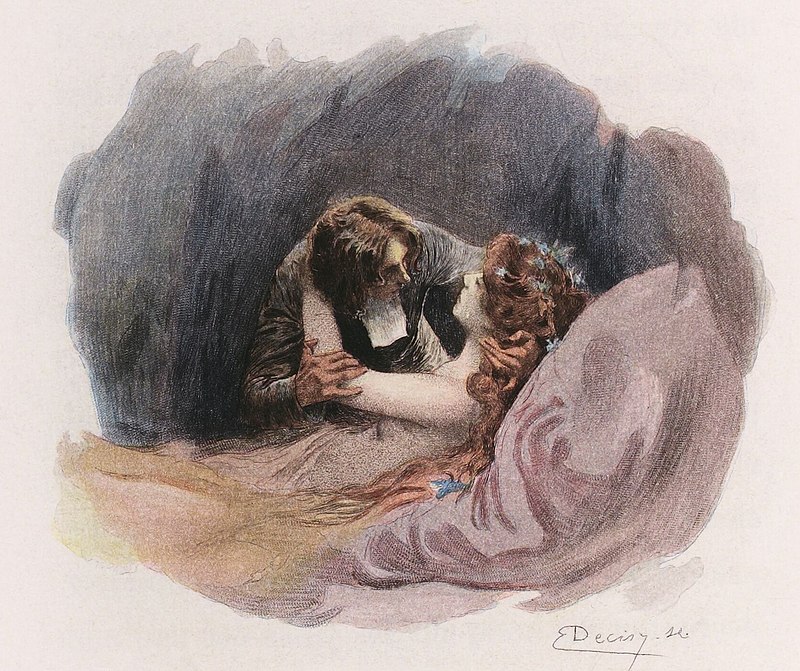
In 1836, French writer Théophile Gautier reintroduced the name in his celebrated vampire novella La Morte Amoureuse (Clarimonde in French; The Beautiful Vampire in English). Gautier’s heroine—a sensual courtesan who blurs the line between life and death—cemented Clarimonde’s association with Gothic beauty, nocturnal allure, and eternal fascination, making it an especially fitting name for Halloween

Other forms include:

  • Esclarmonda (Catalan, Occitanian)
  • Clarimond (English)
  • Clarimonde (French)
  • Clarimunda (Late Latin, Spanish)
  • Esclarmonde (Old French)
  • Clarmonda (Occitanian)
  • Clarmontina (Occitanian)
  • Mondina (Occitanian)
  • Esclaramunda (Spanish)

Sources

Nyx, Nox

  • Nyx: Greek; Nox: Latin
  • Meaning: “night”
  • Gender: Female
  • Eng (NICKS); Eng (NOCKS)

The Greek name Nyx (Νύξ) means “night.” It comes directly from the Proto-Indo-European root nókʷts, the same ancient word that produced Latin nox, Sanskrit nakta (नक्त)*, and Old English niht → modern English night.

Thus, Nyx and Nox are linguistic sisters — two ancient words expressing the same primordial idea: darkness, mystery, and the cosmic night from which creation emerges.

In Greek mythology, Nyx is the goddess and personification of the Night and Nox the Roman counterpart.

She is said to have arisen directly from Chaos, the void before creation, and is counted among the Protogenoi — the primal deities who gave birth to the cosmos itself.

Nyx was both feared and revered by the Olympians. Even Zeus, king of the gods, hesitated to cross her.

Hesiod’s Theogony (c. 700 BCE) describes her as a shadowy figure dwelling in the western lands of perpetual darkness, near the gates of Tartarus.

In recent years, Nyx has appeared more often as a middle name, to fill a void for a longer first name. Its Latin form of Nox may make an appealing choice for those seeking gender-neutral sounding female names, sounding similar to the trendy male name Knocks. It has recently come into use in the Netherlands as a male name for unknown reasons.

Sources

Peniel, Penuel, Phanuel

  • Origin: Biblical Hebrew
  • Meaning: “face of God; presence of God.”
  • Gender: Male
  • Eng (PEN-yel; PEN-you-el, FAN-you-wil)
  • Variations: Panuel, Paniel, Peniel, Penuel, Fanuel, and Feniel

The name is from the Hebrew פְּנוּאֵל (Pĕnū’ēl) or פְּנִיאֵל (Pĕnī’ēl), meaning “face of God” or “presence of God.” It is composed of two elements פָּנִים (panim) – “face” or “presence” אֵל (El) – “God.”

In the Book of Genesis (32:30), Penuel is the name Jacob gives to the place where he wrestled with the angel of the Lord. Later, in 1 Kings 12:25, Penuel appears as the name of a city built by Jeroboam, located east of the Jordan River near the Jabbok. It is also the name of a character mentioned in 1 Chronicles 4:4.

Its Greek form of Phanuel is borne in the New Testament (Luke 2:36) by the father of the prophetess Anna, who recognized the infant Jesus in the Temple. It is also the name of an angel in the Apocrypha Book of Enoch.

International Variations

  • Fanouel ፋኑኤል (Amharic/Ge’ez)
  • Penouel (French)
  • Phanouel Φανουήλ (Greek)
  • Fanuele (Italian)
  • Phanuhel (Latin)

A potential short form is Pen(n).

Sources

Padma

  • Origin: Sanskrit
  • Kannada: ಪದ್ಮಾ (Kanada)
  • Sanskrit, Hindi: पद्म, पद्मा
  • Tamil: பத்மா
  • Telugu: పద్మా
  • Tibetan: པདྨ
  • Gender: Unisex
  • Meaning: “lotus.”
  • (PUD-mah); (pəd̪.mə/)

The name Padma (पद्म) is derived from Sanskrit, meaning “lotus.” In South Asian tradition, the lotus is one of the most sacred flowers, symbolizing purity, beauty, spiritual awakening, and transcendence — a blossom that rises pristine from muddy waters.

Religious & Mythological Significance

Lakshmi: In Hindu texts, Padma is used as a by-name of the goddess Lakshmi, goddess of wealth, fortune, and prosperity. She is often depicted standing or seated upon a lotus, holding lotus flowers in her hands.

Vishnu: The lotus is also associated with Vishnu, Lakshmi’s consort, and the cosmic lotus from which the universe springs.

Attributes: The padma is one of the four attributes (ayudhas) often shown in iconography of deities — symbolizing purity, enlightenment, and divine perfection.

Buddhism & Jainism: The lotus also holds deep meaning in Buddhist and Jain traditions, where it represents spiritual liberation and the blossoming of wisdom.

The name is technically unisex but more commonly bestowed on females. A notable bearer is American author, Padma Lakshmi (b. 1970).

It is also the name of a major river in Bangladesh and in the Harry Potter series, Padma Patil is the twin of Parvati Patil.

International Variations

  • Padmé (f) – a pop-culture invention from the Star Wars franchise, which is based on the Sanskrit name.
  • Badma Бадма (u) (Buryat, Kalmyk)
  • Pema པད་མ (u) (Bhutanese)
  • Padmi (f), Padmo (m) (Javanese)
  • Bhotum បទុម (u) (Khmer)
  • Badmaa Бадмаа (f) (Mongolian)
  • Badam Бадам (u) (Mongolian)
  • Padam पद्म (u) (Nepali)
  • Patthama ปัทมา (Thai) (f)

Sources

Ptolomy

  • Origin: Greek Πτολεμαῖος
  • Meaning: “aggressive, warlike.”
  • Gender: Male
  • Eng (PTAHL-e-mee, TAHL-e-mee)

Derived from the ancient Greek male name Πτολεμαῖος (Ptolemaios), which in turn comes from πτόλεμος (ptólemos), meaning “war” or “battle.”

The word ptólemos is an older Aeolic dialectal form of πόλεμος (pólemos), the standard Classical Greek word for “war,” sharing the same root with the English word, “polemic.”

Ptolemy I Soter (367–283 BCE) was a general of Alexander the Great and later became Pharaoh of Egypt, founding the Ptolemaic Dynasty (323–30 BCE). This dynasty ruled Egypt for nearly three centuries and ended with Cleopatra VII, the most famous bearer of the family’s legacy.

Claudius Ptolemaeus (Ptolemy) (2nd century CE) was the famed Greek astronomer, mathematician, and geographer of Alexandria, whose Almagest shaped Western astronomy for over a millennium.

According to the Book of 1 Maccabees (135/4 BC), Ptolemy of Jericho betrayed his father-in-law, Simon the High Priest, by murdering him and his two sons while they slept as guests under his roof. This act of treachery is used in Dante Alighieri’s The Inferno, in which the ninth circle of Hell is called Ptolomea after him, a frozen realm reserved for those who betray their guests.

Ptolomy is also the name of an early Christian saint.

In the English-speaking world, Ptolomy has been used on and off since the 18th-century. It appeared in the U.K’s top 500 boys’ names in 2004, ranking in at #906.

A modern bearer is American author, Ptolemy Tompkins. Celebrity couple Gretchen Mol and Tod Williams bestowed this on their son in 2007.

Common English short forms include: Tollie, Tolly, and Tal.

International Variations

  • Butlimus بطليموس (Arabic)
  • Ptghomeos Պտղոմեոս (Armenian)
  • Ptaljemej Пталемей (Belarusian)
  • Ptolemej Птолемей (Bulgarian, Croatian, Serbian, Ukrainian)
  • Ptolemeu, Tolomeu (Catalan)
  • Ptolomeos ⲡⲧⲟⲗⲉⲙⲉⲟⲥ (Coptic)
  • Ptolemy (Another English form)
  • Ptolémée (French)
  • Tolomaes (Gaelic)
  • Ptolomeu (Galician, Occitanian, Romanian)
  • Ptolemäus (German)
  • Ptolemaiosz (Hungarian)
  • Ptólmæos (Icelandic)
  • Tolomeo (Italian, Spanish)
  • Tolommeo (Italian)
  • Ptolomaeus (Latin)
  • Ptolemajs (Latvian)
  • Ptolemėjus (Lithuanian)
  • Ptolomey, Ptolomej Птолемей (Macedonian, Russian)
  • Tolomé (Piedmontese)
  • Ptolomeusz (Polish)
  • Ptolomeu (Portuguese)
  • Ptolemæus (Scandinavian)
  • Ptolomaidh (Scottish-Gaelic)
  • Tulumeu (Sicilian)
  • Ptolomaj (Slovenian)
  • Ptolemeo, Ptolomeo (Spanish)
  • Batlamyus (Turkish)

Female forms include the sensual Ptolemaïs (Πτολεμαΐς) and the Italian, Tolomea.

Sources

Prosper, Prospera

  • Origin: Latin
  • Meaning: “prosper.”

The name Prosper comes from the Latin Prosperus, meaning “fortunate,” “successful,” or “prosperous.” It is derived from the Latin verb prōspere, “to cause to thrive, to be favorable,” ultimately from pro- (“forward”) and spēs (“hope”).

Saint Prosper of Aquitaine (c. 390–455) was a Christian writer and theologian who defended the doctrines of Saint Augustine. His influence made Prosper a well-established saint’s name in medieval France, especially in Aquitaine and Provence.

In France, the name was relatively common at the turn of the 20th-century, ranking in at #96 in 1902. In the USA, it never ranked as high but did make it to the Top 1000, peaking at # 886 in 1881.

Several other early Christian saints and bishops also bore the name.

The most famous literary bearer is Prospero, the magician-duke in William Shakespeare’s The Tempest (1611).

The Puritans occasionally used Prosper as well.

The designated name-days include: June 25th (Denmark & France), September 2nd (Croatia), June 23rd (Poland).

International Variations

  • Prósperu (Asturian)
  • Pròsper (Catalan)
  • Prosper (Croatian, Dutch, English, French, German, Hungarian, Polish, Scandinavian)
  • Prospert (French, rare)
  • Prospero (Italian)
  • Prosperino (Italian)
  • Prosperus (Latin)
  • Próspero (Portuguese, Spanish)

Female Forms

  • Prospera (Italian)
  • Prosperina (Italian)
  • Prospère (French)
  • Prospérine (French)
  • Próspera (Portuguese, Spanish)

Diminutives

  • Prop (English)
  • Sperry (English)
  • Rino (Italian)

Sources

Chariton, Charitina, Charitinë

  • Origin: Greek Χαρίτων
  • Meaning: “grace; kindness.”

Chariton is an ancient Greek masculine name derived from χάρις (charis), meaning “grace, kindness, favor.”

The name was borne by Saint Chariton the Confessor (4th century), a revered Christian monk and founder of several monasteries in the Judaean Desert. His feast day is observed in the Eastern Orthodox Church on September 28.


Chariton also appears in classical Greek literature as a personal name. It was the name of a 1st-century Greek writer.

International Variations

  • Khariton خاريتون, Խարիտոն, ⲭⲁⲣⲓⲧⲟⲛ, Харитон (Arabic, Armenian, Bulgarian, Coptic, Russian)
  • Hariton ܚܪܝܛܘܢ, Харитина (Assyrian, Bulgarian, Estonian, Macedonian, Romanian, Serbian)
  • Charitón (Czech)
  • Chariton (English, German, French, Polish)
  • Caritón (Galician, Spanish)
  • Kharit’on ხარიტონ (Georgian)
  • Karíton (Icelandic)
  • Caritone (Italian)
  • Charitonas (Lithuanian)
  • Caritão (Portuguese)
  • Kharyton Xaryton (Ukrainian).

Charitine, Charitina

The feminine form of Charitine (Χαριτίνη) is the feminine counterpart, and it was latinized as Charitina. An English pronuncitation would be KARE-e-TEE-nee (Grk), and KARE-e-TEE-nah or KARE-e-TIE-nuh).

Saint Charitine of Rome (also known as Charitina, 4th century) is a virgin martyr honored in the Eastern Orthodox Church and Catholic Churches. The feast day and designated name-day is October 8th.

Charitina was later borne by a Medieval Russian Orthodox saint of Lithuania. Very little is known of her hagiography other than her being an indigenous Lithuanian woman who was born pagan but later converted to Christianity.

Female International Variations

  • Haritina خاريتينا / حاريتينا (Arabic, mainly used among Arab-speaking Christians)
  • Kharitine არიტონ, ხარიტინე (Armenian, Georgian)
  • Haritini, Haritina ܚܪܝܛܝܢ (Assyrian)
  • Harycina Харыціна (Belarusian)
  • Haritina Харитина (Bulgarian, Macedonian, Serbian, Romanian)
  • Charitinë (English, Greek – Classical)
  • Charitine (French, SHAH-HHREE-TEEN)
  • Charitini, Haritini (Greek – Modern)
  • Charitina Харитина (Latin, Lithuanian, Russian)
  • Charytyna (Polish)
  • Kharytyna Харитина (Ukrainian)

Sources

Smiltė

  • Origin: Lithuanian
  • Meaning: “sandwort plant.”
  • Gender: Female
  • Pron: SMIL-tay

Currently a popular female name in Lithuania, it comes directly from the Lithuanian word for the sandwort plant of the species Arenaria.

Between 2009-2023, it was in and out of the Lithuanian Top 100 Female Names, it peaked at #12 in 2013. As of 2024, she has been dethroned.

A more unusual variation is Smiltija (SMIL-tee-yah).

Sources