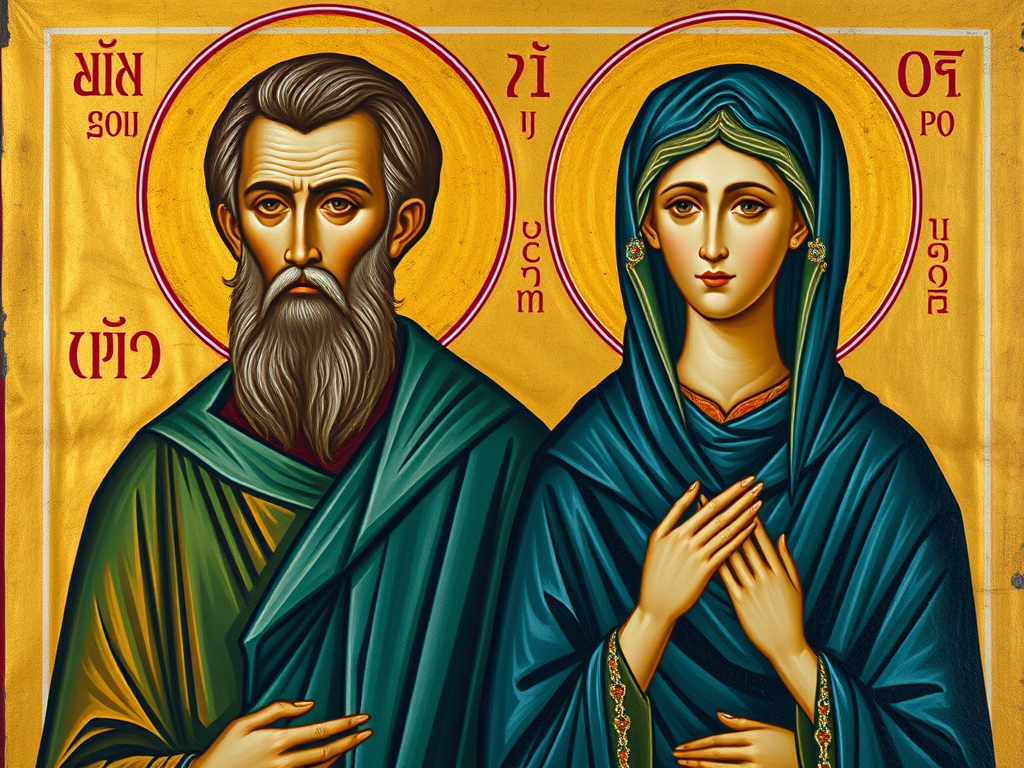
Prosdocimus is a Late Latin form of the Greek Προσδόκιμος (Prosdokimos), derived from prosdokein, meaning “the awaited; the expected,” allegedly used for a long awaited child.
The name is best known from Saint Prosdocimus, a 1st-century Christian bishop and missionary of Greek origin, who evangelized the region around Patavium (Padua) in northern Italy. He is venerated as the first bishop and patron saint of Padua, and a major church, the Basilica di San Prosdocimo, adjoining the Abbey of Santa Giustina, bears his name. His cult was established early in the Christian era and remained locally important throughout the Middle Ages.
Because of the saint’s regional veneration, the given name Prosdocimo remained rare and was used mainly in the Veneto, occasionally appearing in baptismal records in Padua and neighboring areas. Outside northern Italy it has always been exceptional, preserved chiefly in ecclesiastical or hagiographic contexts.
The Ancient Egyptian word and name Heka (transliterated ḥkꜣ, later Hkȝ) literally means “magic,” “sorcery,” or “divine power.” It derives from the root ḥk — “to work magic” — and the ending ꜣ (the Egyptian aleph) which functions as a nominal element.
In Egyptian cosmology, heka was not mere illusion or trickery, but a primordial creative force — the divine energy that allowed both gods and humans to act, heal, and give life. The term is thus best understood as “creative power made manifest,” and shares a root with the Ancient Egyptian ka, roughly translating to “soul.”
Heka was also deified as a god embodying magic itself. He appears as a male deity in Old Kingdom Pyramid Texts (c. 2500 BCE) and remained important through the Greco-Roman period.
In theology, Heka was said to have existed before all other gods — the power through which even the creator gods shaped the universe. The Coffin Texts describe him as:
“I am Heka, the magic, the child of Atum… before the gods came into being, I was.”
In later periods, he was depicted as a man holding two entwined serpents, sometimes accompanying deities such as Khnum and Neith, and invoked by priests and physicians in medical papyri. His power was integral to Egyptian medicine and ritual; magic (heka) was considered a sacred technology given by the gods for healing and protection.
The Coptic form is Hik, it is not used as a name among contemporary Copts but may make an interesting revival.
It is speculated that Hecate’s name and cult may have its roots in the Ancient Egyptian god.
The name is composed of the Greek words, ἱερός (holy to; sacred to) and θεός (God). It first appears as a given name in Christian tradition, being borne by the first bishop of Athens who was said to have been converted and trained by St. Paul himself.
The modern Greek form is ‘Ierotheos and the designated name-day in Greece is September 29th.
The name has also been borne by several Greek patriarchs.
Derived from the ancient Greek male name Πτολεμαῖος (Ptolemaios), which in turn comes from πτόλεμος (ptólemos), meaning “war” or “battle.”
The word ptólemos is an older Aeolic dialectal form of πόλεμος (pólemos), the standard Classical Greek word for “war,” sharing the same root with the English word, “polemic.”
Ptolemy I Soter (367–283 BCE) was a general of Alexander the Great and later became Pharaoh of Egypt, founding the Ptolemaic Dynasty (323–30 BCE). This dynasty ruled Egypt for nearly three centuries and ended with Cleopatra VII, the most famous bearer of the family’s legacy.
Claudius Ptolemaeus (Ptolemy) (2nd century CE) was the famed Greek astronomer, mathematician, and geographer of Alexandria, whose Almagest shaped Western astronomy for over a millennium.
According to the Book of 1 Maccabees (135/4 BC), Ptolemy of Jericho betrayed his father-in-law, Simon the High Priest, by murdering him and his two sons while they slept as guests under his roof. This act of treachery is used in Dante Alighieri’s The Inferno, in which the ninth circle of Hell is called Ptolomea after him, a frozen realm reserved for those who betray their guests.
Ptolomy is also the name of an early Christian saint.
In the English-speaking world, Ptolomy has been used on and off since the 18th-century. It appeared in the U.K’s top 500 boys’ names in 2004, ranking in at #906.
A modern bearer is American author, Ptolemy Tompkins. Celebrity couple Gretchen Mol and Tod Williams bestowed this on their son in 2007.
Common English short forms include: Tollie, Tolly, and Tal.
Meaning: “the most beautiful one; the beautiful one has come.”
Gender: Female
Eng pron: (NEF-er-TAH-ree)
The name comes from the Ancient Egyptian elements, nfrt-jrj. The first element nfrt means “beautiful,” the second element jry means, “the one who is near.”
Nefertari was most famously borne by Queen Nefertari Meritmut, the beloved Great Royal Wife of Pharaoh Ramses II (19th Dynasty, 13th century BCE). Her elaborate tomb in the Valley of the Queens is among the best-preserved monuments of the New Kingdom.
After the Ptolemaic and Roman periods, Egyptian high culture became heavily Hellenized. Names like Cleopatra, Arsinoe, and Berenike (Greek) dominated the elite. With the rise of Christianity and later Islam, names shifted almost entirely to Biblical (Greek, Hebrew, Latin) Arabic. As a result, “Nefertari” remained locked in the Pharaonic past, only rediscovered in the 19th century by archaeologists.
In the 1980s, the name started to be used sporadically by African Americans. In 2024, at least 3 baby girls in the U.K were bestowed this ancient gem as a given-name.
In Coptic, this name would be rendered as ⲛⲉⲫⲣⲧⲁⲣⲓ (Nephrtari). In modern Egyptian Arabic, it is نفرتاري (Nifirtārī).
This may be due for a comeback, especially if you are of Egyptian descent.
Chariton is an ancient Greek masculine name derived from χάρις (charis), meaning “grace, kindness, favor.”
The name was borne by Saint Chariton the Confessor (4th century), a revered Christian monk and founder of several monasteries in the Judaean Desert. His feast day is observed in the Eastern Orthodox Church on September 28.
Chariton also appears in classical Greek literature as a personal name. It was the name of a 1st-century Greek writer.
The feminine form of Charitine (Χαριτίνη) is the feminine counterpart, and it was latinized as Charitina. An English pronuncitation would be KARE-e-TEE-nee (Grk), and KARE-e-TEE-nah or KARE-e-TIE-nuh).
Saint Charitine of Rome (also known as Charitina, 4th century) is a virgin martyr honored in the Eastern Orthodox Church and Catholic Churches. The feast day and designated name-day is October 8th.
Charitina was later borne by a Medieval Russian Orthodox saint of Lithuania. Very little is known of her hagiography other than her being an indigenous Lithuanian woman who was born pagan but later converted to Christianity.
Female International Variations
Haritina خاريتينا / حاريتينا (Arabic, mainly used among Arab-speaking Christians)
The name ultimately comes from Greek Νεῖλος (Neílos), the ancient Greek name of the River Nile.
In Ancient Egyptian, the river was called jtr-w (Iteru, “Great River”). The Greek form Neílos may reflect a Semitic root n-h-r, meaning “river,” which is also the source of Hebrew nahar and related words.
In Greek mythology, Neilos was personified as the river-god of the Nile, one of the Potamoi (river deities).
The Latinized form Nilus became a well-known monastic name and is borne by several Christian saints, including St. Nilus the Syrian, a disciple of St. John Chrysostom, and St. Nilus of Sinai.
Nil is the Slavic form used for males. In Turkey, the same name arose independently as a female given name of the same etymology.
In Italian, it may also be used as a short form ofDanilo.
An Italian feminine form is Nila.
Nile is an English name that was often used in reference to the surname. It may make an interesting modern adaptation for parents looking for a cool but modern saints name.
The name is derived from the Greek genitive λέοντος (leontos), meaning, “belonging to a lion; lion-like.”
It was borne by an 8th-century Byzantine emperor and several saints.
The designated name-day is January 13th.
An early English form is perhaps, Leontes, which appears in Shakespeare’s play, The Winter’s Tale (1610).
Léonce is its unisex French form. It appeared in the French Top 1000 Male Names between 1900-1969, and peaked at #95 in 1909. It simultaneously appeared in the French Top 1000 Female Names between 1900-1940 and peaked at #187 in 1915.
Léonce also appeared in the U.S. Top 1000 Male Names between 1887-1895, peaking at #819 in 1887.
Another possible female off-shoot is Léontine – popular in France from the late 19th to early 20th centuries, it is pronounced [le.ɔ̃.tin]. It is debated whether it is a direct feminine form of Leontius or related to a Latin source meaning, “from Lentini.” A future entry will be written completely dedicated to Léontine.
S.L. Uckelman. “Leontius”. In S.L. Uckelman, ed. The Dictionary of Medieval Names from European Sources, Edition 2023, no. 1. http://dmnes.org/2023/1/name/Leontius
The name is from the classical Greek, related toApollo. It was borne by several early Christian saints. The most notable being St. Apollinaris of Ravenna, a Syrian Christian missionary to Ravenna who was martyred there and thereafter became the city’s patron saint.
The French form Apollinaire is linked to the Franco-Polish poet, Guillaume Apollinaire. He lived from 1880 to 1918. He was born Wilhelm Albert Włodzimierz Apolinary Kostrowicki.
Apolinary was common in Poland during the late 19th-century and early 20th-centuries, it is now obsolete. Diminutives include: Apolinek, Apollinek, Apolin, Apollin, Polin, Polinary, Polinarek, Polinaruś, Poli, and Polik.
In Italy, Apollinare was mainly used in the Romagna region due to it being the name of their patrion saint, but it has since fallen out of use.
Apollinaire sporadically appeared in the French Top 1000 between 1900 and 1926 and peaked at #403 in 1923. In 2024, 5 babies were given this name.
Neither its masculine form nor its feminine form had much usage in the English-speaking world. It was mostly used in families of Greek or Eastern European background during the late 19th-century.
Designated name-days include July 20th, July 23rd, and September 12th
A traditional feminine diminutive form in Russian is Polina. Polish diminutives include: Apollinka, Apollina, Apolinka, Apolla, Apola, Pola, Polka, Polcia, Polina, and Polinka. Modern Greek diminutives include: Nαρία (Naría), Πόλλα (Pólla), or Λίνα (Lina). Potential English short forms would include: Apple, Pollie, Polly, and Narey, or Narie.