Prosdocimus is a Late Latin form of the Greek Προσδόκιμος (Prosdokimos), derived from prosdokein, meaning “the awaited; the expected,” allegedly used for a long awaited child.
The name is best known from Saint Prosdocimus, a 1st-century Christian bishop and missionary of Greek origin, who evangelized the region around Patavium (Padua) in northern Italy. He is venerated as the first bishop and patron saint of Padua, and a major church, the Basilica di San Prosdocimo, adjoining the Abbey of Santa Giustina, bears his name. His cult was established early in the Christian era and remained locally important throughout the Middle Ages.
Because of the saint’s regional veneration, the given name Prosdocimo remained rare and was used mainly in the Veneto, occasionally appearing in baptismal records in Padua and neighboring areas. Outside northern Italy it has always been exceptional, preserved chiefly in ecclesiastical or hagiographic contexts.
A 19th-century gem and late 20th-century vampiric monikor, the name is of uncertain meaning but has its origins in Medieval Spain. It is likely of Visigothic origins, possibly derived from Gailawera or Geloyra, which stem from gails (happy) or (spear); and wers (friendly, agreeable, true).
It should be noted that Elvira (Latin: Iliberri or Iliberis) was an ancient Iberian and later Roman city located near present-day Granada, in Andalusia, southern Spain. However, in this case, it is likely derived from an Iberian source, meaning “new town.”
It was a popular female name among the royal family of Castille & León, producing two queens who bore this name, Elvira of Castile, Queen of León (965–1017) and Elvira of Castile, Queen of Sicily (c. 1100–1135).
It was later used in Mozart’s 1787 opera Don Giovanni (libretto by Lorenzo Da Ponte), in which Donna Elvira is one of Don Giovanni’s former lovers. This likely popularized the name outside of the Iberian peninsula.
By the turn of the 20th-century, Elvira was not unknown in the United States, though never overly popular, it peaked at #254 in 1914, but fell out the Top 1000 by 1981, the same year Elvira, Mistress of the Dark came on the scene.
The real Halloween link began in 1981, when actress Cassandra Peterson created the camp-horror TV hostess Elvira, Mistress of the Dark for a Los Angeles late-night show (Movie Macabre).
Dressed in a plunging black gown with a beehive of jet hair, Elvira presented old horror movies with sardonic humor — blending Gothic sex appeal, irony, and B-movie kitsch.
The character became a pop-culture icon: Halloween TV specials, films, pinball machines, comic books, and even perfume lines immortalized her as the Queen of Halloween.
Outside the United States, this name does not have such associations. In Sweden, it has been among the top 100 girls’ since 1998 and peaked at #25 in 2014. As of 2024, it came in at #40.
It’s a popular name in the Balkans, even spinning off a male form of Elvir (Bosnian and Albanian).
Other forms include:
Elbire (Basque)
Elvíra (Czech/Slovakian)
Elviira (Estonian, Finnish)
Elvire (French)
Elwira (Polish, also an alternate Swedish spelling, Sorbian)
Elvīra (Latvian)
Elvyra (Lithuanian)
Obscure Lithuanian male forms are the Lithuanian, Elvyras; the Polish, Elwir(o), and the Italian Elviro.
Name days: August 25 (Austria), July 16 (Croatia), February 10 (Hungary), January 25 (Spain), March 1 (Sweden), November 21 (Slovakia), August 13 (Latvia).
Sources
Withycombe, E. G. The Oxford Dictionary of English Christian Names. Oxford: Clarendon Press, 1950.
Lollius (pronounced LOH-lee-us) was an old Roman nomen gentilicium — that is, a family name identifying the gens Lollia, a plebeian family attested since the late Republic. The feminine form, Lollia (LOH-lee-ah), denoted women of that lineage.
The etymology is not entirely certain, scholars have proposed that it could derive from a Latin word, lolium, meaning (“darnel grass”), while others suggest a Sabine or Oscan origin of unknown meaning.
Notable bearers from antiquity include:
Marcus Lollius (M. Lollius) – Roman consul in 21 BC, a confidant of Augustus, later disgraced after a military defeat in Germany.
Lollia Paulina (15 BC – 49 AD) – renowned for her beauty and extravagance, she was briefly the wife of Emperor Caligula and later courted by Claudius before being exiled and forced to commit suicide by Agrippina the Younger for witchcraft.
Lollius Urbicus (2nd century AD) – a distinguished Roman governor of Britain under Antoninus Pius, remembered in inscriptions on the Antonine Wall in Scotland.
Other historical forms include:
Lòl·lia (Catalan)
Lollie (French)
Lolia (Portuguese, Spanish)
While Lollius remains primarily of scholarly or historical interest, Lollia has quiet potential as a revival name. It resembles fashionable names like Lola, Luna, and Lilia, yet carries an authentic Roman pedigree.
Pronounced LOH-lee-ah or LOH-lyah, it has a lilting, floral sound that feels simultaneously ancient and elegant.
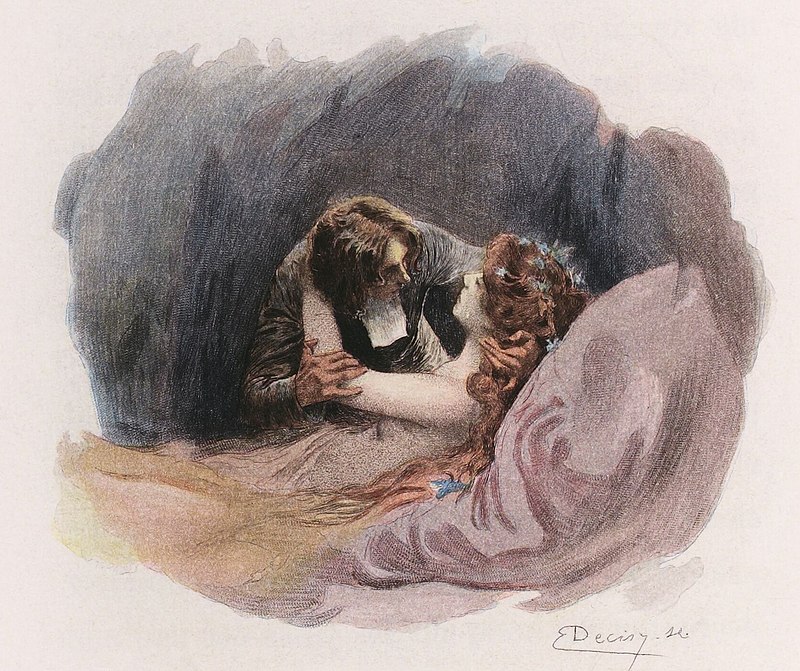
“Her head fell back, but she still wrapped her arms around me as if to hold me back.” Etching by Eugène Decisy [fr] after a watercolor by Paul Albert Laurens, 1904.
Origin: Occitanian
Meaning: uncertain
Gender: Female
Eng pron: (KLAIR-e-mund)
A Medieval Occitanian name first recorded in 12th-century French chivalric literature, Clarimond (also found as Clarimonde, Claramonde, or Claramunda) is either a diathemic compound of the Latin clārus (“bright, light, clear”) and the Old High German mund (“protection”), or derived from an Occitanian phrase meaning “bright world; clear world”
In the 12th-century chanson de geste, Huon de Bordeaux, the name appears in its earlier form as Esclarmonde borne by a Saracen princess who converts to Christianity and marries the hero Huon. Similar formations (Florimond, Rosamond, Alemond) were fashionable among the knightly and aristocratic classes of the High Middle Ages. The 1889 opera by Jules Massenet, Esclarmonde, is loosely based on the character from Huon de Bordeaux.
Historically, Esclarmonde and its variants were borne by at least four noblewomen of the House of Foix, the most famous being Esclarmonde de Foix (d. 1215), sister of Count Raymond-Roger de Foix, who was noted for her learning and association with the Cathar movement in southern France.
Though rare, Clarimond saw occasional use in 17th-century England, likely revived through renewed interest in medieval romance literature. Clarimonde was also occasionally found in 18th-19th-century Acadia, and was used by the closely related Cajuns in Louisiana.
In 1836, French writer Théophile Gautier reintroduced the name in his celebrated vampire novella La Morte Amoureuse (Clarimonde in French; The Beautiful Vampire in English). Gautier’s heroine—a sensual courtesan who blurs the line between life and death—cemented Clarimonde’s association with Gothic beauty, nocturnal allure, and eternal fascination, making it an especially fitting name for Halloween
Other forms include:
Esclarmonda (Catalan, Occitanian)
Clarimond (English)
Clarimonde (French)
Clarimunda (Late Latin, Spanish)
Esclarmonde (Old French)
Clarmonda (Occitanian)
Clarmontina (Occitanian)
Mondina (Occitanian)
Esclaramunda (Spanish)
Sources
Withycombe, E. G. The Oxford Dictionary of English Christian Names. Oxford: Clarendon Press, 1950.
The name is composed of the Greek words, ἱερός (holy to; sacred to) and θεός (God). It first appears as a given name in Christian tradition, being borne by the first bishop of Athens who was said to have been converted and trained by St. Paul himself.
The modern Greek form is ‘Ierotheos and the designated name-day in Greece is September 29th.
The name has also been borne by several Greek patriarchs.
Derived from the ancient Greek male name Πτολεμαῖος (Ptolemaios), which in turn comes from πτόλεμος (ptólemos), meaning “war” or “battle.”
The word ptólemos is an older Aeolic dialectal form of πόλεμος (pólemos), the standard Classical Greek word for “war,” sharing the same root with the English word, “polemic.”
Ptolemy I Soter (367–283 BCE) was a general of Alexander the Great and later became Pharaoh of Egypt, founding the Ptolemaic Dynasty (323–30 BCE). This dynasty ruled Egypt for nearly three centuries and ended with Cleopatra VII, the most famous bearer of the family’s legacy.
Claudius Ptolemaeus (Ptolemy) (2nd century CE) was the famed Greek astronomer, mathematician, and geographer of Alexandria, whose Almagest shaped Western astronomy for over a millennium.
According to the Book of 1 Maccabees (135/4 BC), Ptolemy of Jericho betrayed his father-in-law, Simon the High Priest, by murdering him and his two sons while they slept as guests under his roof. This act of treachery is used in Dante Alighieri’s The Inferno, in which the ninth circle of Hell is called Ptolomea after him, a frozen realm reserved for those who betray their guests.
Ptolomy is also the name of an early Christian saint.
In the English-speaking world, Ptolomy has been used on and off since the 18th-century. It appeared in the U.K’s top 500 boys’ names in 2004, ranking in at #906.
A modern bearer is American author, Ptolemy Tompkins. Celebrity couple Gretchen Mol and Tod Williams bestowed this on their son in 2007.
Common English short forms include: Tollie, Tolly, and Tal.
The name Prosper comes from the Latin Prosperus, meaning “fortunate,” “successful,” or “prosperous.” It is derived from the Latin verb prōspere, “to cause to thrive, to be favorable,” ultimately from pro- (“forward”) and spēs (“hope”).
Saint Prosper of Aquitaine (c. 390–455) was a Christian writer and theologian who defended the doctrines of Saint Augustine. His influence made Prosper a well-established saint’s name in medieval France, especially in Aquitaine and Provence.
In France, the name was relatively common at the turn of the 20th-century, ranking in at #96 in 1902. In the USA, it never ranked as high but did make it to the Top 1000, peaking at # 886 in 1881.
Several other early Christian saints and bishops also bore the name.
The most famous literary bearer is Prospero, the magician-duke in William Shakespeare’s The Tempest (1611).
The Puritans occasionally used Prosper as well.
The designated name-days include: June 25th (Denmark & France), September 2nd (Croatia), June 23rd (Poland).
S.L. Uckelman. “Prospero”. In S.L. Uckelman, ed. The Dictionary of Medieval Names from European Sources, Edition 2023, no. 1. http://dmnes.org/2023/1/name/Prospero.
Tarquin the Elder consulting Attus Nevius the Augur by Sebastiano Ricci
Origin: Etruscan
Meaning: Unknown
Gender: Male
Tarquin is the English form of Tarquinius, the Latin family name of a powerful Etruscan dynasty that ruled early Rome. The name’s exact Etruscan root is uncertain, but it may derive from the ancient city of Tarquinii (modern Tarquinia) in central Italy, itself probably from an older Etruscan personal or place name.
Two Roman kings bore this name: Lucius Tarquinius Priscus, the fifth king of Rome, and Lucius Tarquinius Superbus, the seventh and last king, whose overthrow in 509 BCE led to the founding of the Roman Republic.
While rare, Tarquin appears in English records from the Renaissance onward, often chosen for its aristocratic and classical resonance. Italian retains Tarquino as a given name. The name has also been used in literature and drama —Shakespeare famously tells the story of “The Rape of Lucrece” by Tarquin. It was recently used as the name of Tarquin Blackwood in Anne Rice’s The Vampire Chronicles.
Modern bearers include British journalist Tarquin Hall (b. 1969), the middle name of American actor, Timothy Tarquin Hutton (b. 1960).
Today Tarquin feels distinctive and slightly theatrical, blending ancient Roman history with a sleek, modern sound. If you are looking for a fuller name for Quinn, this may be the perfect choice for you.
International variations include:
Tarkinio (Basque)
Tarquini, Tarquí (Catalan)
Tarkvinije Тарквиније (Croatian, Serbian)
Tarquinius (Dutch, Latin)
Tarquin (English, French)
Tarquinio, Tarquino (Italian, Spanish)
Tarkvinijus (Lithuanian)
Tarkwiniusz(Polish)
Tarquínio, Tarquino, Tarquim (Portuguese)
Tarkvinij(Slovene)
Female Forms
Its Italian feminine form of Tarquinia was borne by Italian Renaissance singer, Tarquinia Molza (1542-1617). This would also make a fabulous fuller version for the nickname Quinn. Another Italian female form is Tarquina.
The name ultimately comes from Greek Νεῖλος (Neílos), the ancient Greek name of the River Nile.
In Ancient Egyptian, the river was called jtr-w (Iteru, “Great River”). The Greek form Neílos may reflect a Semitic root n-h-r, meaning “river,” which is also the source of Hebrew nahar and related words.
In Greek mythology, Neilos was personified as the river-god of the Nile, one of the Potamoi (river deities).
The Latinized form Nilus became a well-known monastic name and is borne by several Christian saints, including St. Nilus the Syrian, a disciple of St. John Chrysostom, and St. Nilus of Sinai.
Nil is the Slavic form used for males. In Turkey, the same name arose independently as a female given name of the same etymology.
In Italian, it may also be used as a short form ofDanilo.
An Italian feminine form is Nila.
Nile is an English name that was often used in reference to the surname. It may make an interesting modern adaptation for parents looking for a cool but modern saints name.
Hiltrud is a feminine Old High German name formed from hild, “battle,” and drud/þrūð, “strength.”
It was borne by two prominent eighth-century figures: Princess Hiltrud of the Franks, daughter of Charles Martel, who married Duke Odilo of Bavaria and later served as regent for their son Duke Tassilo III, and Saint Hiltrude of Liessies, a Frankish noblewoman venerated in northern France and Belgium.
The name remained in use throughout the medieval German-speaking world and saw a modest revival in the late nineteenth and early twentieth centuries, though it is now rare and considered old-fashioned.
In Austria, the designated name-day is September 27th.
Traditional German diminutives and familiar forms include: Hilde, Hildi, Trude, Trudi, and Trudel.
Hiltrud has also occasionally been used in Scandinavian Countries.