Latif is a masculine given-name which comes directly from the Arabic word لَطِيف (gentle; kind; benevolent). In Islam, Al-Latif لطيف, (the Kind; the Benevolent) is one of the 99 names of Allah (God). It’s feminine form is Latifa.
Latif & Latifa are commonly used throughout the Islamic world.
A notable American bearer is actress & singer, Queen Latifah.
The name comes directly from the Arabic word for heart. It is used equally among Arab- Muslims & Christians. Among Christians, particularly Palestinians, Chaldeans and Lebanese Christians who profess Roman Catholicism, it is used in reference to the Sacred Heart of Jesus or the Immaculate Heart of Mary, in the same way the Spanish name Corazónis used in the Spanish-speaking world, though in the Arabic case, the name is strictly masculine.
Among Muslims, the term fu’ad is used at least 5 times in the Quran. The name is used throughout the Islamic world.
It is even used among Non-Arab groups in the Middle East, such as Mizrachi Jews.
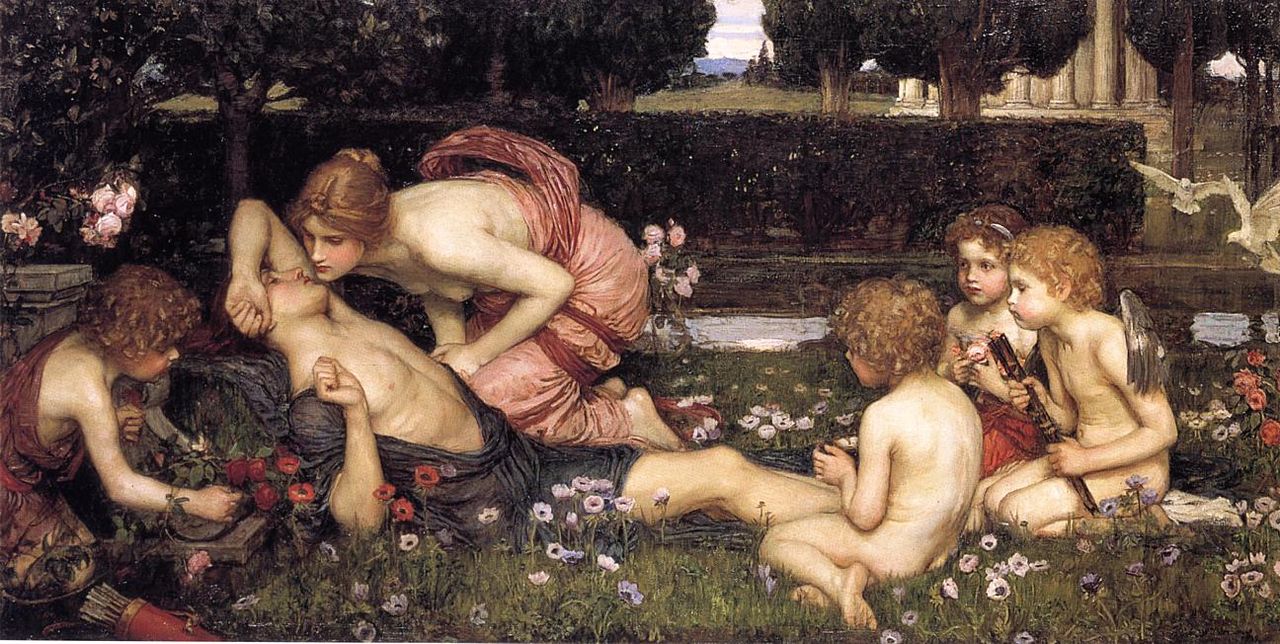
The Awakening of Adonis (1899-1900) by John William Waterhouse
Adonis is borne in Greek mythology by the god of beauty and desire. According to the most popular myth, he was born of the incestuous union of Theias and his daughter Myrrha. Myrrha had tricked her own father into having sex with her. The gods transformed Myrrha into a myrrh tree after Theias attempted to kill her whilst pregnant with Adonis. Adonis was beloved of Aphrodite and mothered by Persephone, but he was subsequently killed by a boar when Artemis, or in some versions, Ares, sent a boar to kill Adonis out of jealousy. When Adonis died, Aphrodite cried tears which mingled with Adonis’ blood, producing the Anemone flower. Aphrodite instituted the Adonia festival in his commemoration, whereby all women had a mass mock funeral of Adonis by growing plants in potsherds on their rooftops and performing a mass funeral ritual as soon as the plants sprouted.
It is likely Adonis was imported by the Greeks from the Phoenicians, the latter being the descendants of the Sumerians, Mesopotamians & Babylonians. It is believed by most scholars that Adonis is an adaptation of the Sumerian story of Dumuzid & Inanna (later Tammuz & Ishtar), in which a ritual funeral rite was also performed by women across the former Babylonian empire. Adonis itself is a Hellenized form of the Canaanite, adon, which means “lord” and was often used as an appellation by the Canaanites for the god Tammuz. The Jews adopted this appellation for Yahweh in the form of Adonai (my lord).
Adonis is borne by an 8th-century French saint of Vienne. He is also listed asAdon & Ado. Adonis has sporadically been used as a given-name in Greece, anglophone, francophone & hispanophone countries. The French feminine off-shoots, though rare these days, are Adonise (AH-do-NEEZ) and Adonie, and were actually prevalent in 18th-centurry Quebec & New Orleans. An obscure Italian feminine form is Adonella.
There is the male Biblical Hebrew name, Adonijah meaning (my lord is Yahweh). It is borne by a son of King David and was Hellenized in the Septuagint as Adonias.
Other forms include:
Adonies (Catalan)
Adonia (Dutch, Italian, Swedish)
AdonijaАдония (French, German, Russian)
Adonias Αδωνίας (French, Greek, Portuguese)
Adonías (Galician)
Adonja (Norwegian)
Adoniasz (Polish)
Adonías (Spanish)
Adoniya Адонія (Ukrainian)
Currently, Adonis is the 242nd most popular male name in the United States and the 461st most popular in France.
Rawdah روضة comes directly from the Arabic word for a “garden” or “meadow.” It is likely used by non-Arab Muslim parents in reference to Rawḍah ash-Sharifah (Arabic: روضة الشريفة, lit. ‘The Noble Garden’), which is a place located between the minbar and burial chamber of the Prophet Muhammed in Mecca.
The word itself is not used as a given-name in Arabic-speaking countries, but is used in non-Arabic Islamic countries, such as Southeast Asia and Turkey.
Its Turkish form of Ravza is currently the 78th most popular female name in Turkey. This form is also used among Bosnians & Albanians.
The name is of uncertain meaning but is believed to be from the Arabic root S-W-D which can mean “blackness” or “large number of palm trees.”
The name was borne by one of the wives of the Prophet Muhammed known as Sawda bint Zama, considered one of the Mothers of Believers. Sawda bint Zama was a widow who married Prophet Muhammed at around the age of 50 to help care for his children.
The name is of uncertain origin or meaning, since it appears in Muslim and Medieval Jewish tradition as the name of the wife of Potiphar (who is unnamed in the Old Testament), it is often suspected to be of Coptic origin, though the name is not traditionally used among contemporary Copts.
The wife of Potiphar is mentioned in the Bible as trying to seduce Joseph and later falsely claiming he tried to rape her, which leads to Joseph’s unjust imprisonment. In Medieval Islamic tradition, the story was reinterpreted as a popular love story, the subject of much poetry, she is named Zuleikha and her love for Joseph was interpreted by Sufi poets, especially Rumi and Hafez, to represent the longing the soul has for God. Zuleika is also attributed to be her name in the Sefer haYashar, also known as the Book of Jasher, a Jewish midrash of unknown authorship.
In the English-speaking world, the name first came into use in the early 19th-century, it was most likely popularized by Byron’s 1813 poem, The Bride of Abydos, in which it is the name of the heroine. It was also used by the German poet Goethe for his 1810 poem entitled, Book of Zuleika, in his collection of Eastern inspired poems called West–östlicher Divan. It is the name of the eponymous character in the 1911 novel, Zuleika Dobson by Max Beerbohn, which was later adapted into a musical.
The name is also used in Spanish-speaking countries and Brazil.