Dalileh

Gender: Feminine
Origin: Persian/Farsi
Meaning: “orchard; green field.”
(DAHL-lee-leh)

Note: the name has no correlation or etymological relation to the Biblical name Delilah. It appears in the Arabian Nights in the story entitled Dalilah the Crafty or Dalilah the Wiley, in which an old crone of Baghdad must figure out how to make ends meet for her and her daughter, Zaynab. Dalilah becomes a swindler, and when caught, is pardoned by the Caliph and becomes a governess, portress and carrier-of-pigeons to the Khan.

Shabnam

Gender: Feminine
Origin: Farsi/Persian
Meaning: “dew”
(SHAHB-nahm)

The meaning of dew is used to describe dew drops on a flower or plant. The name is a popular name in Iran and is used in Pakistan as well.

Sonnhild

Gender: Feminine
Origin: German
Meaning: “sun battle.”
(ZOHN-heelt)

The name is very rare in German speaking countries, but is a name with ancient Germanic roots, comprised of the elements sonne meaning sun and hild meaning battle.

Another form includes Sonnhilde (ZOHN-heel-deh). Other ancient Germanic names with the sonne element include Sonngard meaning “sun spear,” (ZOHN-gart); and Sonntraud meaning “sun truth.” (ZOHN-trout).

Bisera

Gender: Feminine
Origin: Slavic
Meaning: “pearl”
(bee-SARE-ah)

The name is derived from the Slavonic element, biser, meaning “pearl.”

The name is popular throughout the Southern Slavic countries.

It is borne by famous Croation actress, Bisera Veletanlic (b. 1942-).

Variations include Biserka.

Juno, June, Junia

Gender: Feminine
Origin: Latin
Meaning: uncertain
Eng (JOO-no); Lat (YOO-no); (JOON); Eng (joo-NEE-uh; JOON-yah); Lat (yoo-NEE-ah).

The name Juno is an ancient one; possibly going all the way back to the period of the Etruscans.

The origin and etymology is strongly contended and not quite certain. Some sources believe that it may be derived from the Etruscan name Uni which possibly means “alone; one; unit.” Others argue that it is derived from the Indo-European element Yeu, referring to youth and vitality.

In Ancient Rome, Juno was the supreme goddess. She was considered the protectress and counselor of the State. She was revered as a queen and known under the title of Juno Regina (Juno, the Queen).

Under the title of Juno Moneta, she was revered as the patroness of all things financial and econonimical.

The month of June gets its name from her, and as the patroness of women, marriage and fertility, the idea that June is the best time to marry comes from ancient Roman tradition, when young women chose to marry on the month in hopes that Juno would be more favorable in dispensing luck upon their marriage.

Juno was actually a goddess of many faces and incarnations. She was also revered as a counterpart to the Greek goddess Athene Pallas, as well as a counterpart to Hera. She was seen as the patroness of children and childbirth under the title of Lucina.

In Popular Culture, the name has recently sparked a small revival and interest thanks in part, to the 2007 independent film Juno (Ellen Page), in which it is mentioned in the movie that the character was named for the goddess, though the name has still yet to have even made it to the top 1000 names in the United States.

There is also the form of Junia, which was more often used on real people in ancient Rome rather than Juno itself. The name was ususually used in honour of the goddess and it appears in the New Testement as the name of a Roman matron.

There is also the masculine version of Junius or Iunius. Junilla was an ancient Latin diminutive form which might appeal to some modern parents.

The month name of June itself first became popular in the 19th-century. Another name to consider is the more unusual Cornish form of Metheven (METH-eh-VEN).

Other forms of the name include:

  • Junona (Croatian/Czech/Lithuanian/Polish/Serbian/Slovene)
  • Junon (French)
  • Júnía (Icelandic)
  • Giunia (Italian)
  • Giunone (Italian: joo-NOH-nay)
  • Ġunone (Maltese: joo-NOH-nay)
  • Iuno (Latin/Romanian: YOO-no)
  • Giununi (Sicilian)
  • Juni (Norwegian/Swedish)

Wanda

Gender: Feminine
Origin: Polish
Pol (VAHN-dah); Eng (WAHN-duh).

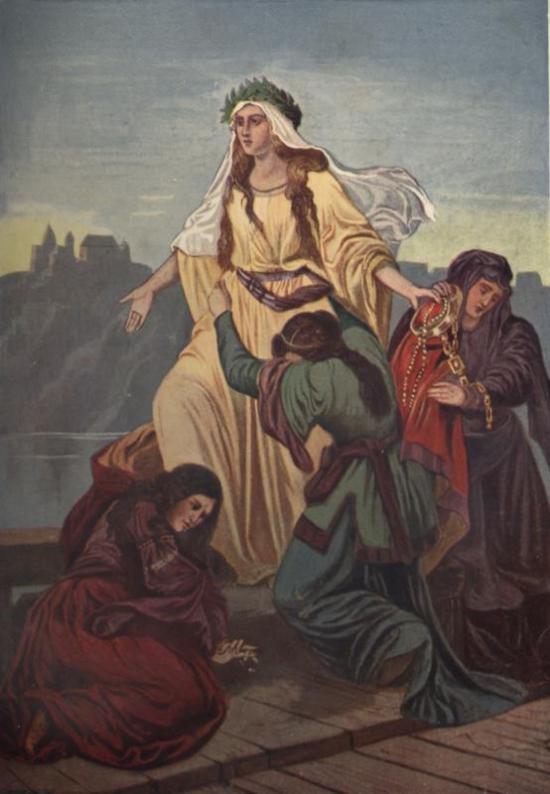
The name first appeared in a legend presented by Polish historian, Wincenty Kadlubek (12-13th century). In his version of the legend, Wanda was the daughter of a Polish king Krak, (founder of the city of Krakow), who inherited her father’s throne. An evil German prince wanted to marry her and take over the Polish lands, but the princess repelled him and drove him to suicide. The prince threw himself into the Vistula. Wanda went on to live a happy and long life, remaining a virgin and vowing to be married only to her country. The most famous account, however, is completely different. In the most beloved form of the tale, rather than have her country taken over by the German invaders, Wanda threw herself into the Vistula. In Poland, she is a symbol of the nation, representing the sacrifice and hardship of the nation of Poland throughout its history. She is a symbol of Polish independence and its victory over German imperialism.

Tradition has it that she is buried in one of the seven mounds of Krakow. Till this day, the Wanda Mound (Kopiec Wanda) rests on the outskirts of Krakow, (in what is now known as the suburb of Nowa Huta).

Wanda is probably one of the very few Polish names that became popular in the English speaking world. It was introduced via author Ouida who used it for heroine in the novel Wanda (1888). The name no longer ranks in the U.S. top 1000, but was once a fairly popular name, coming in at # 47 in 1934, the highest the name ever ranked in U.S. naming history.

Many sources list the name as being a derivative of the Ancient Germanic wend, a name for a group of people who lived near and around the Vistula, however, some Lithuanian sources have argued that it is derived from an ancient Baltic element vanduo meaning “water” while many others speculate that its true origins have been lost and that its true introduction into the world was through Kadlubek.

In Poland, a popular nickname option is Wadzia (VAHD-jah). An alternative is the Czech/Slovak, Italian and Lithuanian, Vanda. There is also the elaborated Swedish name Wendela, though it is speculated if she is truly related to Wanda or if  in fact she is a completely different name of Germanic origins. The name has experienced occasional usage in Germany, Spain, Brazil, Hungary and Russia.

Coincidentally, Vanda is the name of species of orchid indigenous to the Indian subcontinent and Indochina. In this case, Vanda is of Sanskrit origins.

Eha

Gender: Feminine
Origin: Estonian
Meaning: “afterglow; sunset.”
(AY-hah)

The name is derived from the Estonian word describing “afterglow”, “sun set”  or “dusk.” The name has been used in Estonia for centuries and it is borne by Estonian poet, Eha Lattamae (b. 1922), as well as by former Miss Estonia and runway model, Eha Urbsalu.

A variation is Ehala (AY-huh-lah).

The designated name-day in Estonia is July 1st.

Ebe

Gender: Feminine
Origin: Estonian
(EY-beh) the e is similar to the Spanish e

The name is used in Estonia and can be derived from either one of two things 1) a contraction of Eliisabet or; 2) it is derived from an Estonian word which describes the by product of cloth making, usually a velvety material.