
- Origin: Mordvin Селема
- Meaning: “elm.”
- Gender: Female
The name is derived from the Mordvin, sele (elm).
Sources
The name is derived from the Mordvin, sele (elm).
Sources

Nihara is a Sanskrit female name which comes directly from the word for “mist; dew; fog; hoarfrost; snow.”
The masculine form is Nihar.
Another female form is Nihari.
Sources

From the Old Norse word for “embers,” in Norse Mythology, this was the daughter of the jötunn known as Logi (fire), the latter who is considered the personification of fire, a long with his wife Glöð (glowing embers). He fathered another daughter Eisa (glowing ember), both of whom were said to be stunningly beautiful.
Its status as a given-name in most Scandinavian countries is a relic from the past but may appeal to parents drawn to authentic early Nordic names.
Sources

The name comes directly from the Old Norse word meaning “glowing ember.” In Norse Mythology, this is the name of one of the beautiful daughters of Logi (fire), and Glöð (glowing embers).
Later, it came to be associated as a pet form of Elizabeth or a German form of Aise (short form of any Nordic name beginning in the Egg-, Agi– element.)
Note: the name can also be an Arabic form of Jesus.
Sources
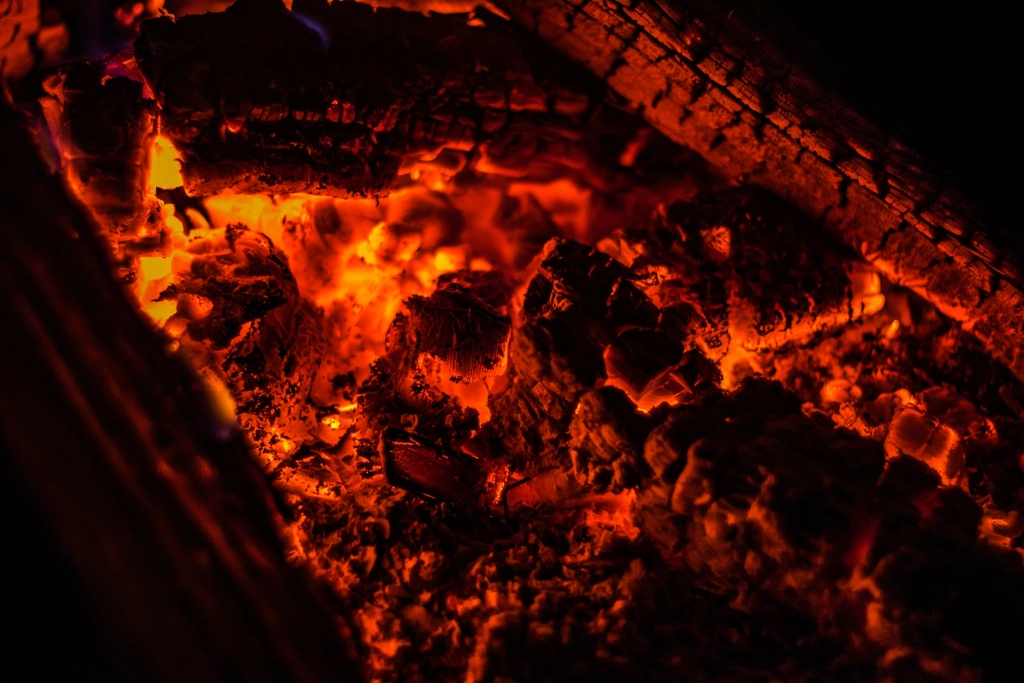
The name is a Greenlandic female name meaning, “ember.”
Aumuk is an older spelling, while Aama/Auma are unisex variations.
Source

The name comes from the Ancient Greek noun ἄνθραξ (ánthrax), meaning “ember; burning charcoal.”
Anthracia is best known from Greek myth as one of the nymphs who nursed the infant Zeus in secret to protect him from Cronus.
Source

From the Latvian adjective sārts, which has two closely related meanings, either “reddish, rosy, flushed with color” or “bonfire, blaze.”
An extremely rare traditional Latvian female name, it was first and only recorded in Zemgale (Dobele) in 1929, even though it had already appeared in the Latvian name calendar of 1879.
(Source: Kalnājiņa & Švābe, KS 285.)
A rare masculine form is Sārtis, documented only once in Riga in the 1930s.
Sārtone is another variation, which is also only been record one time in Latvia in the 1920s.
Sources

The name is composed of the Persian elements mehr / mihr / meher (مِهر) — a Persian word meaning “sun,” “affection,” “kindness,” or “love” (and often with connotations tied to the ancient Iranian / Zoroastrian deity Mithra) and māh (ماه), meaning “moon” or “month.”
The name entered wider use through Ottoman royal history, where Mihrimah Sultan (1522–1578) — the daughter of Sultan Suleiman the Magnificent and Hürrem Sultan — became one of the most powerful and educated women of her time.
A modern Persian form is Mehrmah.
An Urdu form is Meharmah and another Turkish form is Mihrümah.
Sources

The name is derived from the Latvian words, brīvs (free) and brīvība (freedom). It is ultimately derived from the Middle Low German vri, vrie (free).
It was first recorded in Riga in 1931, during a period of strong national consciousness and cultural renewal in independent Latvia.
According to Latvian population records, as of 2008, there were only three women known by this name.
Another form is Brive and its designated name-day is November 18th.
Sources

Urdze is a rare Latvian feminine given name derived from the noun urga, meaning “stream” or “brook,” and the verb urdzēt, meaning “to stir up, to move, or to urge.”
Urdze was added to the official Latvian name calendar in 1966 and was first recorded in Vidzeme (Valmiera district) in 1975. It remains exceptionally uncommon — as of 2008, records note only one bearer of the name in Latvia.
The designated name-day is November 17th.
Source