Archie

Gender: Masculine
Origin: English
(ARE-chee)

The name was originally a diminutive form of Archibald, but is now used as an independent given name.

In the United States, the name is often associated with the protagonist of the comic book series, Archie (1941).

As of 2010, Archie 24th most popular male in England/Wales. His rankings in other countries are as follows:

  • # 43 (Scotland, 2010)
  • # 47 (Australia, NSW, 2010)
  • # 91 (Northern Ireland, 2010)

Harvey

Gender: Masculine
Origin: Breton
Meaning: “battle worthy.”
Eng (HAR-vee); Fre (AIR-VEY)

Harvey is an anglicized form of the French masculine name, Hervé, which in turn is derived from a Breton name, Haerviu, which is composed of the elements, haer (battle) and viu (worthy).

The name was borne by a 6th-century Breton saint and was introduced into England after the Norman conquest. The name became quite rare by the Renaissance but was revived in the 19th-century.

It is currently the 47th most popular male name in England/Wales, (2010) and the 95th most popular in Northern Ireland (2010).

It does not appear in the U.S. top 1000.

Other forms include:

  • Haerviu (Breton)
  • Hoarvei (Breton)
  • Harvey (English)
  • Hervey (English)
  • Hervé (French)
  • Herweusz (Polish)

The designated name-day in France is June 17.

Sources

  1. http://fr.wikipedia.org/wiki/Hervé
  2. http://www.behindthename.com/php/related.php?name=harvey

Zechariah, Zachary

St. Zachary Gender: Masculine
Origin: Hebrew  זְכַרְיָה
Meaning: “God remembers.”
Eng (zek-e-RIE-ah); (ZACK-e-REE)

Zachary is an English form of the Hebrew Zechariah, a theophoric name that means “God remembers; Yahweh remembers.”

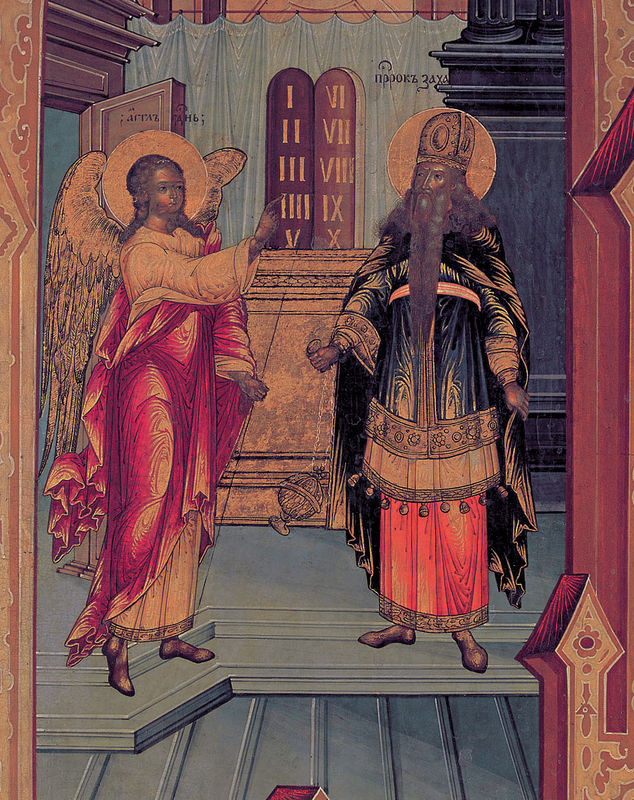
The name is borne by several characters in both the Old and New Testament. In the Old Testament, it was borne by a prophet who authored the Book of Zechariah and in the New Testament, it was borne by the father of John the Baptist.

In the Qu’ran, the father of John the Baptist is viewed as a prophet and also as the protector of Mary, the mother of Jesus.

The name also appears as Zacharias, a Greek rendition, in some versions of the New Testament.

In the English speaking world, the name has been in usage since Medieval times. In Eastern Europe, especially in Orthodox dominated countries, it has always been a common name.

Currently, Zachary is the 61st most popular male name in the United States, (2010). In 1994, he ranked as high as # 12.

In other countries, his popularity is as follows:

  • # 51 (Australia, NSW, 2010)
  • # 51 (England/Wales, 2010)
  • # 55 (Canada, BC, 2010)
  • # 331 (Zacharie, France, 2009)
  • # 446 (France, 2009)

Other forms of the name include:

  • Sagarias (Afrikaans)
  • Zakariyya زكرياء (Arabic/Assyrian/Circassian/Coptic/Ethiopian/Lebanese/Syrian)
  • Zacharij/Zachari Захари (Bulgarian)
  • Zacaries (Catalan)
  • Zekarija Закария (Chechen/Kazakh)
  • Zakaria ზაქარია (Coptic/Ethiopian/Georgian/Kurdish)
  • Zaharije Зaxapиje (Croatian/Serbian)
  • Zachariáš (Czech/Slovak)
  • Zachary (Czech/English/French/Polish)
  • Zacharias (German/Scandinavian)
  • Sakarias (Faroese/Norwegian/Swedish)
  • Sakari (Finnish: Sakke is a diminutive form)
  • Saku (Finnish)
  • Zacharie (French)
  • Sagaire/Sagairi (Gaelic)
  • Zacharias Zαχαριας (Greek)
  • Zakariás (Hungarian)
  • Zakeus (Hungarian)
  • Zekarja (Hungarian)
  • Zaccaria (Italian)
  • Zaccheo (Italian)
  • Cherian (Malayalam)
  • Sakaria (Malayalam)
  • Scaria (Malayalam)
  • Zaxaria Захарїа (Old Church Slavonic)
  • Zachariasz (Polish)
  • Zacarias (Portuguese)
  • Zaharia (Romanian)
  • Zaccaria(s) (Romansch)
  • Zachar Захар (Russian)
  • Sachairi (Scottish-Gaelic)
  • Zacarías (Spanish)
  • Zakarya (Swahili)
  • Zekeriya (Turkish)

The name is also borne by several saints as well as by one Roman Catholic pope and a Coptic pope.

Zaharina Захарина is a Bulgarian feminine form and Zara is its pet form.

Other notable bearers include an 8th-century Nubian king, a 9th-century Khazar king, and American president, Zachary Taylor (1784-1850)

Sources

  1. http://www.askoxford.com/firstnames/zachary?view=uk
  2. http://www.behindthename.com/php/find.php?name=zachary
  3. http://www.svenskanamn.se/
  4. http://bibref.hebtools.com/?book=%20Matthew&verse=23:35&src=!

Toby

Gender: Masculine
Origin: English
(TOH-bee)

The name is usually associated as being a diminutive form of Tobias, but is actually a Medieval English form of Tobias.

As of 2010, Toby was the 54th most popular male name in England/Wales. His popularity in other countries are as follows:

  • # 56 (Australia, NSW, 2010)
  • # 411 (the Netherlands, 2010)
  • # 669 (United States, 2010)

Harry

Gender: Masculine
Origin: English
(HARE-ee)

The name was originally, (and still is to a certain extent) a diminutive form of HenryIn Germany and in the United States, it was also often used as a short form of Harold.

The name has been used as an independent given name since at least the beginning of the 20th-century. This is reflected in the Norwegian slang term, harry, to describe something that is vulgar or tacky. This idiom first appeared in the early 20th-century among Norwegian elite in reference to the working class, who at that time, popularly gave their children “English” names, something which had not occurred in Scandinavia before. Its feminine cognate is doris.

In the United States, the higest this name ranked was in 1889, coming in as the 8th most popular male name. As of 2010, Harry was the 656th most popular male name.

In England/Wales, he currently comes in as the 3rd most popular male name, (2010). His rankings in other countries are as follows:

  • # 6 (Northern Ireland, 2010)
  • # 19 (Scotland, 2010)
  • # 20 (Ireland, 2010)
  • # 27 (Australia, NSW, 2010)
  • # 72 (Sweden, 2010)

Its recent resurgence in popularity in the British Isles may be due both in part to Prince Harry (full name Henry) and the Harry Potter series by J.K. Rowling.

Another famous bearer is American President, Harry S. Truman (1884-1972).


Minttu

Gender: Feminine
Origin: Finnish
Meaning: “mint.”

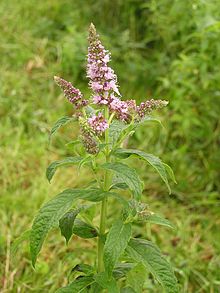
The name comes directly from the Finnish word for mint.

Its designated name-day is October 6.

The name is borne by Finnish actress Minttu Mustakaillo (b.1973). It is also the name of a popular Finnish peppermint-flavored liqueur, despite the liqueur associations, the name seems to be fairly common in Finland.

The Holidays aren’t too far off and if you due around that time and are considering a Holiday-themed name with a bit of an edge, this might be just what you are looking for.

Update: As of 2011, Minttu is the 43rd most popular female name in Finland.

Hilla

Gender: Feminine
Origin: Finnish
Meaning: “cloudberry.”
(HEEL-lah)

The name was initially used as a form of Hilda or Hilja, but became even more popular in Finland due to the fact that it translates as, “cloudberry.”

As of 2011, Hilla was the 42nd most popular female name in Finland.

Other forms of the name include:

  • Hilkka (Finnish)
  • Hillá (Sami)

Nea

Gender: Feminine
Origin: Scandinavian
Fin/Swe (NAY-ah)

The name is a Swedish contracted form of Linnea, now popularly used as an independent given name. However, the name has also been linked with the Greek word for new and with the name of a river in Norway.

As of 2011, Nea was the 39th most popular female name in Finland, while its more finnicized form of Neea came in as the 48th most popular female name.

Ilona

Gender: Feminine
Origin: Hungarian/Finnish Илона
Hung (EE-loh-naw); Fin (EE-loh-nah); Germ/Pol (ee-LOH-nah)

The name was initially a Hungarian form of Helen, but its usage has spread throughout Eastern Europe and as even appeared north as Finland.

In Finland and Estonian, its etymology has often been traced to the Finnish ilona, the essive of the word, ilo, meaning, “joy.”

In Hungarian, it is a translation of Helen, via the Slavic, Jelena, in Old Hungarian it was Jelona. However, it has been suggested that it may be derived from an old Magyar source of uncertain etymology. The name appears quite often in Hungarian folklore.

Ilona is one of the few Hungarian names that has made a name for itself in other cultures, (no pun intended). It is a common female name in Albania, Belarus, the Czech Republic, Germany, Finland, France, Estonia, Latvia, Lithuania, the Netherlands, Poland, Romania, Russia, Slovakia, Slovenia, the Ukraine, the former Yugoslavian Republics and it is occasionally used in some Spanish-speaking countries.

As of 2011, Ilona was the 37th most popular female name in Finland. Her rankings in other countries are as follows:

  • # 178 (France, 2009)
  • # 478 (the Netherlands, 2010)

A few notable bearers include Ilona Zrinyi (1643-1703), a national heroine in both Hungary and Croatia, a representative of national freedom for both nations. She is famous for opposing the advances of the Habsburg takeover.

A common Hungarian diminutive is Ilonka.

Pinja

Gender: Feminine
Origin: Estonian/Finnish
Meaning: “pine.”

The name is derived from the Finnish word for a species of pine tree known as pinus pinea. This might be the perfect autumnal name. Its designate name-day is October 6.

As of 2011, Pinja was the 35th most popular female name in Finland.