 Gender: Feminine
Origin: Lithuanian
Meaning: unknown
(SFAHL-yah)
The name of a river in Lithuania, it has been used as a female name for centuries. The sound is alluring and exotic. Its designated name day is July 27.
Gender: Feminine
Origin: Lithuanian
Meaning: unknown
(SFAHL-yah)
The name of a river in Lithuania, it has been used as a female name for centuries. The sound is alluring and exotic. Its designated name day is July 27.

Gender: Feminine
Origin: Arabic
Meaning: “seashell.”
صدف
(sah-DAHF).
The name comes directly from the Arabic word meaning “seashell.”
 Gender: Feminine

 Gender: Feminine
 Gender: Feminine
Origin: Old Norse/Icelandic
Meaning: “pitching one; pigeon; dove.”
(DOO-vah).
In old Norse the name means “pitching one.” It was the name of one of the nine daughters of the sea goddess Rán. In modern Icelandic, the name is interchangeable with the word for dove or pigeon. It is still a common female first name in Iceland.
Another offshoot of the original old Norse form is the Frisian Dufina (doo-FEE-nah) and the Dutch Dyveke.
 Gender: Feminine
Origin: Old Norse/Icelandic
Meaning: “foam fleck; comber.”
(DREUF-n)-the O is akin to the eu in Fleur.
An Old Norse name that is currently very popular in Iceland. This is another name that appears in Norse Mythology as the name of one of the nine mermaid daughters of Rán and Aegir.
In Iceland, the name is more common as a middle name than as a first name, it is currently borne by 89 women as a first name and as a middle name, it is borne by 467 women (July 2007).
 Gender: Feminine
The name was a poetic description describing the clear waters of the sea.
In Norse Mythology, it was the name of one of the nine daughters of Rán & Aegir. All nine of the sea maids were said to have motherd Heimdall via the god Odin.
Heimdall was the protector of Bifröst.
 Gender: Feminine
Origin: Old Norse/Icelandic
Meaning: “wave; billow.”
(BILG-yah)
The name is borne in Norse Mythology by one of the nine daughters of Rán and Aegir.
Bylgja represented the waves of the sea and she is the mother of Heimdall by the god Odin.
In Icelandic, it coincides with the modern word for wave.
As a first name, it is currently borne by 116 women, and as a middle name, it is borne by 19 women (July 2007).
For an English speaker considering this name, a possible nickname option is Billie.
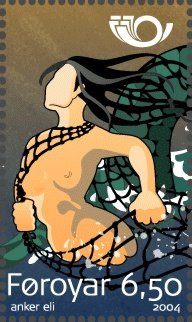 Gender: Feminine
Origin: Old Norse
Meaning: “theft; robbery.”
General Scan (RAWN); Ice (ROWN) like the word Round with the d cut off
The name is borne in Norse mythology by a sea goddess.
The goddess Rán, is the subject of several Old Norse Prose Eddas, including the Skáldskaparmál, in which a poem entitled, Lokesenna, talks of her life and exploits.
According to the Lokesenna, Rán is the wife of Aegir, and with him, she has nine daughters.
Rán is also famous for capturing unsuspecting seafearers with her fish-net. In fact, her fish-net is also recorded in the Volsunga Saga.
According to some sources, she is married to the sea.
The name is still in usage in Iceland and the Faroe Islands. In Iceland, it is often used as a one syllable filler middle name.
As of July 2007, 37 women in Iceland bore this as a first name, while 325 had it as a middle name.
The name can also be a Japanese female name, meaning “orchid” 蘭
