Lorelei, Lurley

Gender: Feminine
Origin: German
Meaning: debated
(loh-reh-LYE).

I don’t know what it may signify, that I am so sad”

begins the famous German poem written by Heinrich Heine (1824) http://www.business.uiuc.edu/vock/poetry/lorelei.html.

The Lorelei is one of Germany’s most romantic folktales. Lorenz Brentano created the legend for his novel entitled Godwi oder Das steinerne Bild der Mutter (1801). He supposedly based the myth off of Ovid’s rendition of the romantic Greek legend of Echo and Narcissus and that of the legendary Rhine Maidens from German mythology.

Later, Heinrich Heine decided to write a poem about the alluring Rhine siren. It was so popular that the poem was set to music and a famous German Rhinisch folk song was born, composed by Friedrich Silcher in 1837.

The name is infact taken from the name of a 120 meter rock on the eastern bank of the Rhine river in Germany, near St. Goarshausen. Strong currents and rocky surfaces have made it hard for boaters to navigate through the river line for centuries, causing many deaths and accidents. The tragedies were later turned into a myth by Brentano, the rock being named for a beautiful golden haired girl by the name of Lurley. She was so heart broken by a lover’s rejection that she threw herself off the giant rock only to come back and haunt the area in the form of a beautiful and alluring siren with a magnificent singing voice. Her revenge was to seduce the unsuspecting boaters to their deaths with her songs.

The actual origins of the name are debated. Some sources believe that Lorelei is composed of the Germanic elements lureln meaning “to murmur” and the Celtic ley meaning “rock,” while other sources contend that the first element might actually be derived from the proto-Germanic *lothran meaning “to call” or the Middle High German luoder meaning “to lure, to deceit or bait.” It is also very possible that our modern English verb “to lure,” is derived from the same ancient Germanic elements.

The name has also spawned such names as Lurley, and Lurlene.

The name has only recently picked up some usage in German speaking countries, but has been used in the English speaking world since the 19th century.

Ondine, Undine

Gender: Feminine
Origin: Latin
Meaning: “wave.”
(ahn-DEEN); (un-DEEN)

The name is derived from the Latin unda meaning “wave.”

In early European folklore undines were a sort of water sprite who could gain a soul if they married a mortal and bore a child, the downside was that as soon as they became mortal they would age and die.

The Swiss scientist and alchemist Paracelsus spent a considerable time writing about them.

In 1812, the German writer, Baron Friedirch de la Motte Fouque, made the legend a subject of his famous romantic novel Ondine.

In it Ondine falls in love and marries the local knight Huldebrand. She bears his child, but as soon as the baby is born, she starts to age. Huldebrand has an affair with a lowly local woman and Ondine catches her husband in the act. She lays a curse on Huldebrand that he would die in his sleep. Afterward, Ondine rushes to the town square’s fountain and disappears in the midst of the waters, never to be seen again. The same story was later adapted by E.T.A. Hoffman into an opera.

Ondine and Undine became popular first name choices in both France and Germany. Nicknames include Ondy, Ondinette and Dina.

Other forms of the name include:

  • Ondina (Asturian/Italian/Portuguese/Spanish)
  • Ondine (French)
  • Undine (German/English)
  • Undina (Icelandic)
  • Undīne (Latvian)
  • Undinė (Lithuanian)
  • Ondyna (Polish: very obscure)

Designated name-days are: April 18 (Lithuania) and November 15 (Latvia)

Itsaso

Gender: Feminine
Origin: Basque
Meaning: “sea/ocean.”
(eet-SHAH-sho)

Itsaso comes directly from the Basque word for ocean or sea.

In Basque mythology, this was the name of an evil sea spirit or a type of Siren. The itsaso would attract people to the sea so that they would drown.

It is also the name of a town in the Basque country of Spain where there is a shrine to the Virgin Mary, possibly a reason why the name was deemed usable among the Catholic Basque.

Ahti, Ahto

Gender: Masculine
Origin: Finnish
Meaning: unknown
(AH-tee); (AH-to)

The name is borne in Finnish mythology by the fierce water/sea god, Ahti. He is portrayed as a man with a beard of moss and he dwells in the under sea palace of Ahtola along with his wife Vellamo.

You can listen to Ahti’s pronunciation here: http://www.forvo.com/word/ahti/

Océane, Oceana

Gender: Feminine
Origin: Greek
Meaning: “ocean”
Fre (oh-say-AHN); Eng (o-shee-AH-nah).

Both names are derived from the Greek, masculine name Okeanos, which means “ocean.”

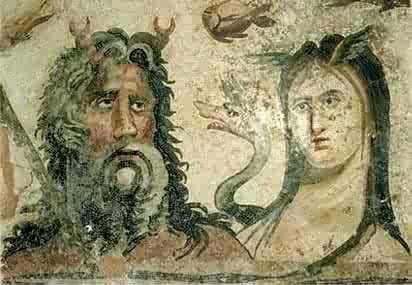
It was borne in Greek mythology by one of the pre-hellenistic Titan gods. His domain was the ocean and, a long with his sister, Tethys, he produced the Oceanid nymphs.

The name is also borne by an early Christian saint of whom very little is known.

The French form of Océane has been extremely popular in France the last 10 years. It came in at # 9 among the top 100 French female names in 2006. In Quebec, it came in at # 20.

The latinate, counterpart of Oceana, is virtually unheard of but is certainly usable.

Ronan

Gender: Masculine
Origin: Irish/Gaelic
Meaning: “little seal.”
Eng (ROH-nen); Ire (RO-nawn).

The name is derived from the Gaelic word rón meaning, “seal”.

It was borne by several early Celtic saints including a Bishop who served under St. Patrick.

He was assigned to preach in the Breton and Cornish lands.

He is currently the 504th most popular male name in the United States, elsewhere, in Ireland, he comes in as 41st most popular male name (2007).

Muriel, Muireall

Gender: Feminine
Origin: Scottish Gaelic
Meaning: “sea bright”
(MYER-eeul)

The name, in its original form, is Muireall (MOOR-all).

It has been in usage since at least the 15th century, when Muriel, who was the heiress of John Calder, was deposed from her ancestral lands by the Earl Argyll in 1498.

The name appears in history again as that of the name of the wife of Alexander Sutherland (1456). The records indicate her name as Muriella, which was probably a latinization.

The name is still fairly common in Scotland and the nickname of Molly is occasionally used.

In Irish, the name is rendered as Muirgheal. The name is used in France, more often in the Breton speaking areas, spelled Murielle. There is also an Old Norse form: Myrgjöl.

Dylan

Gender: Masculine
Origin: Welsh
Eng (DIL-en); WEL (DULL-en).

The name’s origin is up in the air. Some sources believe that it is composed of the Welsh elements dy meaning “great” and llanw meaning “tide; sea; flow,” while others contend that it is made up of the proto-Celtic elements *di meaning “away” and llanw (same as above).

It is also suggested that the name may be derived from the Welsh word dylanw meaning “influence.”

The name was borne in Welsh mythology by the god of the sea. He was the son of Aranrhod and was accidently slain by his uncle Gavannon. When he died, it was said that the waves of the sea wept.

It also was borne by Welsh poet Dylan Thomas (1914-53). The name became extremely popular outside of Wales around the 1960s.

Currently, Dylan ranked in as the 31st most popular male name in the United States. The highest he ranked was in 2004 at # 19.

His rankings in other countries are as follows:

  • # 28 (Australia, 2007)
  • # 53 (Belgium, 2006)
  • # 25 (Canada, B.C., 2008)
  • # 71 (Chile, 2006)
  • # 17 (England/Wales, 2008)
  • # 46 (France, 2006)
  • # 11 (Ireland, 2007)
  • # 27 (the Netherlands, 2008)
  • # 12 (Scotland, 2008)

Plexaure, Plexaura

Gender: Feminine
Origin: Greek
Meaning: “weaving breeze; twisting breeze”
(pleh-ZORE); (pleh-ZORE-ee)

The name was borne by an Aurai of the weaving breeze. Some sources state she was the daughter of Oceanus & Tethys, while others say she was the daughter of Doris & Nereus.

It is also the name of a genus of orchid and coral.