Capheira

Gender: Feminine
Origin: Greek
Meaning: “stormy breath.”
(kah-FEER-uh)
Kafeira

The name is borne in Greek Mythology by an Oceanid nymph of the Island of Rhodes. She supposedly nursed the god Poseidon in his infancy. She may have also been a minor goddess of storm clouds.

In Greek the name is rendered as Kapheira.

Its also the name of a species of sea cucumber.

Matuta

Gender: Feminine
Origin: unknown
(mah-TOO-tuh)

    The name is possibly of Etruscan origin and its meaning has been lost to history.

    Mater Matuta was a pre-Roman (Etruscan) goddess of grain who later became associated with Aurora, the goddess of the dawn. She was the patron goddess of newborn babies, the sea and of harbors.

    Her festival was held on June 11th. Known as the Matralia only women who were in their first marriage were allowed to attend the festival.

    Sædís

    Gender: Feminine
    Origin: Icelandic
    Meaning: “sea goddess”
    (SY-dees)

    The name is made up of the Norse elements sae meaning “sea” and dis meaning “goddess.”

    As of 2008, approximately 147 women in Iceland bore this as a first name, and 33 had it as a middle name.

    The name is also in usage on the Faroe Islands.

    Callirhoë

    Gender: Female
    Origin: Greek
    Meaning: “beautifully flowing.”
    Καλλιρρόη
    (KAL-lih-ROW-ee)

      Callirhoe, the sister of Castalia, was a naiad nymph who lived in a fountain in the town of Acarnarnia. She was the daughter of a minor river god, Achelaeus, and wife to the argive prophet, Alcmeon.

      Callirhoe talked her husband into stealing the peplus and necklace of the goddess Harmonia. Alcmeon was struck down by the goddess’ guards after he was caught stealing.

      To avenge his death, Callirhoe, pleaded with Zeus to induce her infant sons to be transformed into men so that they might avenge their father’s death, which Zeus granted.

      The name is also the scientific designation for the Prairie Poppy Mallow.

      Other forms of the name include:

      • Callirrhoé/Callirhoé (French)
      • Kalirojė (Lithuanian)

      Nicknames include: Cal, Callie, and Roe.

      Pontus

      Gender: Male
      Origin: Greek
      Meaning: “sea.”
      Πόντος
      (PAHNtus)

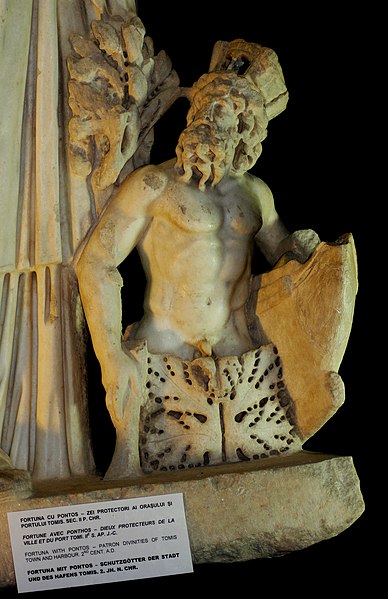
      The name is borne in Greek mythology by a pre-Olympian god of the sea. His mother was Gaia, who conceived Pontus without sex. He is the father of Nereus, Phorcys, and Ceto, and with his consort Thalassa, he fathered the fish and the crustaceans.

      The name is derived from the Greek pontos, meaning “sea.”

      In the classical era, he was superseded by the god Poseidon.

      It is also the name of a former Greek kingdom which was situated on coasts of the black sea, in what is now Turkey.

      The name has recently become extremely popular in Sweden, it recently came in at # 76 in the 2007 top 100 names in Sweden.

      Another form is Pontos.

      Other forms include:

      • Pont (Croatian/Slovene: rare)
      • Pontosz (Hungarian: rare)
      • Pontas (Lithuanian)
      • Ponto (Spanish/Italian/Portuguese: rare)

      Actaea

      Gender: Feminine
      Origin: Greek
      Meaning: “sea shore.”
      Ἀκταία
      (ahk-TAY-ah)

        In Greek mythology, the name is borne by both a Nereid, (known as the Nereid of the sea shore) and is also borne by a Danaid, a daughter of Danaus and Pereia. She became the wife of Periphas.

        It is also the name of a flower.

        Another form is the Lithuanian Aktaja.

        Thoosa

        Gender: Female
        Origin: Greek
        Meaning “swift.”
        Eng (THOO-sah); Grk (thoh-OO-sah)

        Rendered in Greek as Thoösa Θόωσα, it is borne by a sea nymph in Greek mythology. She was the daughter of Phorcys and Ceto and beloved by the god Poseidon. She was associated with currents and swiftness. By Poseidon she bore the cyclops, Polypemus. She was also the sister of Echidna, and Scylla and was often depicted as a mermaid-like creature.

        In recent years, it is the name of an English brand of womens’ running wear, founded in 2006 by CEO Caroline MacNally.

        The name is rendered in Spanish as Toosa, (not by any means a common name), and in Lithuanian as Teosa (also very obscure).

        Rhode/Rhoda

        Gender: Female
        Origin: Greek
        Meaning “rose.”
        (RO-dee); (ROH-dah)

        The name of a sea nymph and also possibly an ancient primordial sea goddess, according to Greek mythology, Rhode was one of the oldest of the Oceanid nymphs and was said to be the daughter of Poseidon/Oceanus and Tethys. She is sometimes claimed to be the daughter of Halia and Poseidon, Amphitrite and Poseidon or the daughter of Aphrodite.

        It is even suggested by some scholars that Rhode, Halia and Amphitrite might have been one and the same sea goddess who was later replaced by the Olympic pantheon and relegated to a sea nymph.

        Rhode’s cult was especially popular on the Isle of Rhodes where it was believed she was the wife of the sun-god, Helios and one and the same with the goddess Athena. She was the mother of the Curetes of Crete. It is also suggested that the Island of Rhodes gets its names from her.

        There is also the more modern Biblical form of Rhoda, (RO-dah).

        In the New Testament it was the name of a maid who lived in the house of Mary, mother of John Mark. In the English speaking world, Rhoda came into usage in the 17th century, she has not ranked in the U.S. Top 1000 since 1975 when she came in at # 777. The highest she ever ranked in U.S. naming history was # 159 in 1881. In the 1970s Rhoda was the name of a character in the popular sitcom of the same name.

        Halia, Leucothea

        Gender: Female
        Origin: Greek
        Meaning “briny.”
        (HAHL-yah; HAY-lee-ah); (loo-KO-thee-uh)

        The name is found in Greek mythology as the name of a sea nymph native to the Isle of Rhodes, sometimes believed to be one of the original Telchines (indigenous Rhodian gods).

        According to Olympic-Rhodian legend, Halia was the favorite of Poseidon and was believed to be the personification of sea salt. She had six sons and one daughter: Rhode.

        Her six sons’ forbade the goddess, Aphrodite, from landing on their island. In retaliation, Aphrodite drove the six boys into such madness that they raped their own mother. Halia committed suicide by throwing herself into the sea. Her sons were buried in the deep sea caves beneath the island, and it was believed by the Rhodians that Halia was reincarnated as the goddess Leucothea, who they worshipped with great honour.

        Leucothea means “white goddess.” It believed that Leucothea was a title given to various sea nymphs who were later transformed as goddesses.

        Coincidentally, hali’a, a Hawaiian word turned given name, is from the Hawaiian verb meaning “to remember one fondly.” Or if spelled halia, it is a past imperfect verb of hali meaning “to carry”, or “to bear.”

        Other forms of Leucothea include the original Greek Leukothea (Λευκοθέα), the Spanish Leucótea (very obscure) and the Lithuanian Leukotėja (also very obscure).