Naenia, Nenia

  • Origin: Latin
  • Meaning: “dirge, incantation; funeral lament; lullaby.”
  • Gender: Female
  • Naenia (nye-NEE-ah); More Common Nenia (nay-NEE-ah)

Naenia (also spelled Nenia) comes from the Latin word naenia, meaning “funeral song, dirge, lament.” In everyday Latin, naenia could simply mean a lullaby or simple song, but in a religious context it carried the specific sense of a funeral lament.

In Roman religion Naenia Dea was the personification—and later minor goddess—of funerary rites. She presided over the chants sung at funerals and was believed to ease the soul’s passage to the underworld. Varro (1st c. BCE) and later Christian authors such as Augustine mention her as a distinct deity. There was even a modest sacellum Naeniae (small shrine) outside the Porta Viminalis in Rome, emphasizing her association with burial grounds beyond the city walls.

Sources

Rubab

  • Origin: Arabic رباب
  • Gender: Female

The name comes directly from the Arabic word رباب for a type of stringed instrument.

It was also the name of Rubāb bint Imraʾ al-Qays (b. 7th-century C.E). The wife of Husayn ibn Ali.

It is borne by Pakistani Olympic Swimmer, Rubab Raza (b. 1991).

Another transciption is Rabab.

Other forms include:

  • Rübabə (Azeri)
  • Robabeh ربابه (Persian)
  • Robab رباب (Persian)
  • Rübab (Turkish)

The name is used throughout the Islamic World.

Sources

Aarohi

Photo by Jure u0160iriu0107 on Pexels.com
  • Origin: Sanskrit
  • Meaning: ascending; rising; crescendo.”
  • Gender: feminine
  • Pronunciation: AH-roh-hee

The name comes from the Sanskrit root आरोहण (arohana) meaning “ascending; ladder; rising.” It also refers to a crescendo in music.

It is also sometimes transliterated as Arohi.

A notable bearer is Indian actress, Aarohi Patel (b. 1994).

Sources

Ezgi

  • Origin: Turkish
  • Meaning: “song; melody; tune.”
  • Gender: feminine
  • Pronunciation: EZ-ghee

The name comes directly from the Turkish word for a song, tune or melody. The name appeard in the Top 100 Most Popular Female names in Turkey between 1989-2011, and peaked at #46 in 1992.

Sources

Megha

  • Origin: Sanskrit मेघ, Hindi मेघपुंज
  • Meaning: “cloud.”
  • Gender: feminine
  • MAY-gah

The name comes directly from the Sanskrit word for “cloud.”

It is also the name of a raga in the Hindustani classical music tradition.

Sources

Swara, Svara

Swara, SvaraOrigin: Sanskrit
Meaning: “noise; sound; accent; musical note”
Gender: Feminine
(SWUH-ruh; SVUH-ruh)

The name is derived from the Sanskrit स्वर (svara) meaning “noise; sound; accent; musical note.”

In Classical Indian music, svara is used to denote the concept of musical pitch.

Sources

Tala

Follow my blog with Bloglovin

This name is one of the ultimate cross-cultural names, it has various meanings and legitimate origins from Europe, to Asia and to the Middle East.

The name has been recorded in use in Northern Europe since Medieval Times, possibly being a contracted form of Adalheidis, its offshoots of Talea and Talina have experienced minor recent resurgence in Germany. Tala also been used in most Scandinavian countries, though today, it is considered very archaic.

Tala appears in a 14th-century Swedish folk ballad Herr Holger (which is the subject of a 1996 song by the Swedish band, Gamarna). The ballad recounts the exploits of a greedy tax official who steals tax money for himself. He is caught by King Christian and beheaded. He is condemned to hell, but is able to return to warn his wife, Fru Tala (Lady Tala). He pleads with Tala to return all the wealth she inherited from him, (which in turn was the result of his stolen money), to its rightful owner or else she will experience a similar fate. Tala refuses, as she would rather condemn herself to hell than give up her wealth.

Its Finnish and Estonian form is Taala and Taali, and a Scandinavian  masculine version is Tale.

Tala is also the name of a Tagalog goddess of the morning and evening star. In one legend, she is the daughter of the sun god Arao and the moon goddess, Buan. Arao and Buan had a large number of star-children, the eldest being Tala. Arao was afraid his heat would burn up his star-children, so he and Buan decided to destroy them, but Buan reneged on her promise and hid her children behind clouds. Arao got wind of Buan’s secret and, according to legend, continues to try and destroy her, which explains the phenomenon of eclipses. Each morning, Buan runs to hide her children behind the clouds, her eldest Tala being the lookout before dawn, being the personification of the morning star.

In another Tagalog legend, Tala is the daughter of the god Bathala. She is the sister of Hanan (the goddess of the morning) and Mayari, another moon goddess.

In Tagalog, tala means “star; planet; celestial body.”

Tala was recently a hit song by Filipina singer, Sarah Geronimo (2016).

In Indian classical music, Tala is the term used to describe musical meter and rhythm. It literally means “clapping; tapping.”

Tala can also be Arabic تالة (Tala) meaning “Turmeric tree; turmeric spice” or a “small potted palm.”

In Amazigh, one of the languages of the Berber people, Tala means “source; spring or fountain.”

Tala is also Farsi and means “gold.”

In Italy and Romania, Tala is used as a diminutive form of Natalia, a la Romanian actress, Tala Birell (1907-1958).

Tala is the name of a type of decidous tree native to tropical and subtropical South America. Its scientific name is celtis tala.

Other meanings include:

  • It is the Azeri word for “glade.”
  • tālā is the Samoan currency and is believed to be a phonetic corruption of the English word dollar.
  • In Polish, it is a feminine form of the Greek, Thales, though it is seldom used, it does appear on the nameday calendar.
  • In Pashtun, Təla/Tala means “weighing scale” and is the name of the seventh month of the Afghan Calendar, its meaning referring to the Zodiac sign of Libra.
  • It is the name of a minor Chadic language in Nigeria.

What the name is not:

Many baby name sources have dubiously listed this name as meaning “wolf” in “Native American,” (which is not a language by the way), while other sources have listed this as being Cherokee or Iroquois for “wolf hunter,” but there are no legitimate Cherokee or Iroquois sources collaborating this information. In fact, Native Languages of the Americas has written a fabulous list pertaining to faux Native American baby names and Tala made the list.

As a closing to this post, I recommend this blog post written by a mother explaining the reason why she chose this name for her daughter. It is from 2006, but still a wonderful read D-Log: The Many Meanings of Tala.

Sources

Lyra

Cygnus, LyraOrigin: Greek
Meaning: “lyre.”
Gender: Feminine
Pronunciation: LIE-rah

The name comes from the Greek meaning “lyre.” It is the name of a constellation which was named for the lyre of Orpheus, which was said to quell the voices of sirens.

Lyra is also the name of a type of ancient Musical instrument.

The name first came into use in the English-speaking world in the 19th-century. It first appeared in the U.S. Top 1000’s Most Popular Female names in 2015. As of 2016, it was the 932nd most popular female name. It’s recent appearance may be influenced by Philip Pullman’s popular trilogy, His Dark Materials (1995), in which it is the name of one of the main characters, Lyra Belacqua.

The lovely Breton, Lourenn (loo-RENN) would also make a wonderful alternative.

Other forms include:

Lourenn (Breton)
Lira (Catalan/Italian/Latvian/Occitanian/Romanian/Polish/Slovenian)
Lüüra (Estonian)
Lyra (English/Portuguese/Spanish)
Lyyra (Finnish)
Lyre (French)

Sources

https://www.behindthename.com/name/lyra
https://www.ssa.gov
https://www.familysearch.org
https://en.wikipedia.org/wiki/Lyra

Calliope

Origin: Greek
Meaning: beautiful voiced
Gender: Female
Pronunciation: kuh-LIE-uh-pee

The name is composed of the Greek elements, καλλος (kallos) “beauty” and οψ (ops) “voice.” It is borne in Greek mythology by the muse of epic poetry and eloquence. She was said to be the mother of Orpheus and was said to be the chief among the muses by Hesiod and Ovid.

The name is also borne by a Catholic and Christian Orthodox saint who was tortured and martyred for refusing a suitor who wanted her hand in marriage as well as for her to renounce her faith.

It is also the name of a type of musical instrument as well as genus of hummingbird.

In recent years, it is the full name of a fictional character on the popular tv series, Grey’s Anatomy, Callie Torres, portrayed by Sara Ramirez.

In the English-speaking world, the name first came into use in the early 18th-century.

The name recently entered the U.S. Top 1000 Female Names, coming in as the 939th most popular female name.

A common short form is: Callie.

Other forms include:
Kalliope Կալլիոպե(Armenian/Danish/Dutch/Finnish/German/Estonian/Norwegian/Polish/Romanian/Swedish)
Kalіё́pa Каліё́па(Belarusian)
Kaliopa Калиопа(Bulgarian/Serbo-Croatian/Slovenian)
Cal·líope (Catalan)
Kalliopé (Czech/Hungarian/Slovak)
Calliope (French/English/Italian)
K’aliop’e კალიოპე (Georgian)
Kalliόph Καλλιόπη (Modern Greek)
Kallíópa (Icelandic)
Kaliopė (Lithuanian)
Calíope (Portuguese/Spanish)
Kalliopa Каллиопа(Russian/Ukrainian)

Sources

https://en.wikipedia.org/wiki/Calliope
https://www.behindthename.com
https://www.familysearch.org
https://www.ssa.gov
http://www.theoi.com

Thaïs

Gender: Feminine
Origin: Greek Θαις
Meaning: “headband; band.”
Eng (tye-YEES); Fre (tah-YEEZ); Por (TAH-ees)

The name is derived from the Greek root for a band worn around the head. It was borne by a 3rd-century B.C.E. Greek hetaera who was credited as being the burner of Persopolis. She is sometimes believed to have been a lover of Alexander the Great, but there is no conclusive evidence that the two were ever together, what is known for sure is that she was the courtesan of Ptolomy Soter I, Alexander’s general. Her character later inspired other characters of the same name in both Classical Roman and post-Classical literature. She appears in Terence’s Eunuchas, her lines were later quoted by Cicero and a Thaïs is mentioned in Dante’s Inferno. In more recent history, she was the inspiration of Ivan Eframov’s novel, Thaïs of Athens (1975).

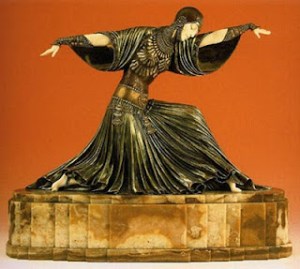
The name was also borne by a legendary Egyptian Christian saint who was believed to have originally been a prostitute. She was converted by St. Paphnutius who had disguised himself as a “customer.” Thaïs became a fervent Christian, abandoning her comfortable life as a high-end prostitute and spending three years in repentance eventually dying in peace as a hermit in the Egyptian desert. Her story is the inspiration behind the Anatole France novel Thaïs (1890) which was later adapted into an opera of the same name. Demetre Chiparus famous sculpture, Thaïs, was in turn inspired by the Opera.
Due to the cult of St. Thaïs of Egypt, the name remained in use throughout the former Byzantine Empire. She was used to a certain extent on the continent and in 18th-century England during the Romantic Period.

As of 2010, Thaïs was the 97th most popular female name in France. Her Slovene form of Tajda was the 74th most popular female name in Slovenia, (2010), while Taja came in as the 23rd most popular female name in Slovenia, (2010).

Other forms of the name include:

  • Taisija/Taisiya (Bulgarian/Macedonian/Serbian/Russian/Ukrainian)
  • Taís (Catalan/Spanish)
  • Tayys تاييس (Coptic/Lebanese/Syrian)
  • Thaïs (English/French/German/Greek)
  • Thaisia (German)
  • Thaisis (German)
  • Taide (Italian)
  • Taisia (Italian)
  • Taida (Polish)
  • Tais (Polish)
  • Taisja (Polish)
  • Tesja (Polish)
  • Thaís (Portuguese)
  • Taja (Slovene)
  • Tajana (Slovene)
  • Tajda (Slovene)
  • Tajka (Slovene)
  • Tajša (Slovene)