Derived from the ancient Greek male name Πτολεμαῖος (Ptolemaios), which in turn comes from πτόλεμος (ptólemos), meaning “war” or “battle.”
The word ptólemos is an older Aeolic dialectal form of πόλεμος (pólemos), the standard Classical Greek word for “war,” sharing the same root with the English word, “polemic.”
Ptolemy I Soter (367–283 BCE) was a general of Alexander the Great and later became Pharaoh of Egypt, founding the Ptolemaic Dynasty (323–30 BCE). This dynasty ruled Egypt for nearly three centuries and ended with Cleopatra VII, the most famous bearer of the family’s legacy.
Claudius Ptolemaeus (Ptolemy) (2nd century CE) was the famed Greek astronomer, mathematician, and geographer of Alexandria, whose Almagest shaped Western astronomy for over a millennium.
According to the Book of 1 Maccabees (135/4 BC), Ptolemy of Jericho betrayed his father-in-law, Simon the High Priest, by murdering him and his two sons while they slept as guests under his roof. This act of treachery is used in Dante Alighieri’s The Inferno, in which the ninth circle of Hell is called Ptolomea after him, a frozen realm reserved for those who betray their guests.
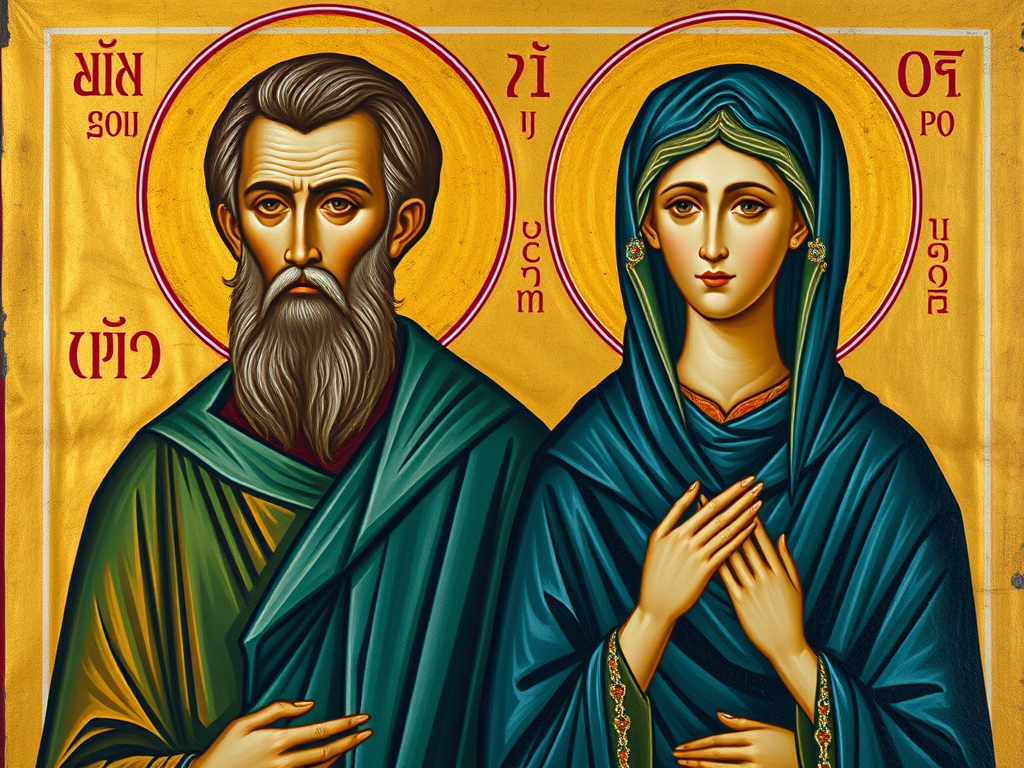
Ptolomy is also the name of an early Christian saint.
In the English-speaking world, Ptolomy has been used on and off since the 18th-century. It appeared in the U.K’s top 500 boys’ names in 2004, ranking in at #906.
A modern bearer is American author, Ptolemy Tompkins. Celebrity couple Gretchen Mol and Tod Williams bestowed this on their son in 2007.
Common English short forms include: Tollie, Tolly, and Tal.
Chariton is an ancient Greek masculine name derived from χάρις (charis), meaning “grace, kindness, favor.”
The name was borne by Saint Chariton the Confessor (4th century), a revered Christian monk and founder of several monasteries in the Judaean Desert. His feast day is observed in the Eastern Orthodox Church on September 28.
Chariton also appears in classical Greek literature as a personal name. It was the name of a 1st-century Greek writer.
The feminine form of Charitine (Χαριτίνη) is the feminine counterpart, and it was latinized as Charitina. An English pronuncitation would be KARE-e-TEE-nee (Grk), and KARE-e-TEE-nah or KARE-e-TIE-nuh).
Saint Charitine of Rome (also known as Charitina, 4th century) is a virgin martyr honored in the Eastern Orthodox Church and Catholic Churches. The feast day and designated name-day is October 8th.
Charitina was later borne by a Medieval Russian Orthodox saint of Lithuania. Very little is known of her hagiography other than her being an indigenous Lithuanian woman who was born pagan but later converted to Christianity.
Female International Variations
Haritina خاريتينا / حاريتينا (Arabic, mainly used among Arab-speaking Christians)
Zenobia is composed of the Greek elements, Zeus (Zeus) and bios (life). It was notably borne by a 1st-century Armenian queen of Georgian descent and later a 3rd-Century Queen of Palmyra who tried to expand into Roman territory but was defeated by Emperor Aurelian.
Zenobia of Palmyra’s name might have been a Hellenized form of her birth name, Bat-Zabbai, which is from the Aramaic meaning “daughter of Zabbai.” Zabbai itself is an Aramaic male name. It seems to be a theophoric name, meaning “gift of–.” The latter part refers to an unknown deity. It may have actually been an Aramaic form of the Hebrew female name, Bathsheba.
Speculation has also linked it with the Arabic female name Zaynab, which can either mean “father’s beauty” or be from the name of a type of flowering tree.
It was borne by the 3rd-century martyrs, Ss. Zenobia and Zenobius, two early Christians who were siblings and beheaded under Emperor Diocletian. Their feast and name-day is October 30.
In the English-speaking world, it is first recorded in Cornwall and Devon, England in the 16th-century. Early English forms of Synibie, Sinobie, Senobie, Cenobie, and Cenoby (Sen-e-bee; SIN-e-bee), would make interesting revivals in the spirit of Sydney and Willoughby. A common English diminutive was Nobby.
Zenobia appeared in the U.S. Top 1000 Most Popular Female names between 1881-1925, peaking at #669 in 1909.
Zenobia is no stranger to English literature, it is the name of a character in Nathaniel Hawthorn’s The Blithedale Romance (1852); Edith Wharton’s Ethan Frome (1911); and is even used by Anne Rice in her the eighth book of her vampire series, Blood and Gold (2001).
Zenobia “Nobby” Hawthorne appears as a character in the P.G. Wodehouse series, Jeeves.
Tina Fey used this as the middle name of daughter, Alice Zenobia.
S.L. Uckelman. “Zenobia”. In S.L. Uckelman, ed. The Dictionary of Medieval Names from European Sources, Edition 2023, no. 1. http://dmnes.org/2023/1/name/Zenobia.
S.L. Uckelman. “Zenobius”. In S.L. Uckelman, ed. The Dictionary of Medieval Names from European Sources, Edition 2023, no. 1. http://dmnes.org/2023/1/name/Zenobius.
Both come from the Greek, θεός (theos) meaning “god” and δόσις (dosis) meaning “giving.” Both the male and female form were borne by several Christian saints and Medieval rulers. In the English-speaking world, a notable bearer was Theodosia Alston Burr (1783-1813), the daughter of Aaron Burr and an American socialite who mysteriously disappeared in a ship-wreck. Her fate has been a source of speculation for two centuries, but she most likely died in the wreck. She is also the subject of the Broadway opera song from Hamilton, My Theodosia.
It’s female version has experienced usage in the English-speaking world since the 15th-century. It has spun off several diminutive off-shoots, which later became independent names, such as Docie/Dosey, Doshie, Dosha, Docia and Theda.
Theodosia appeared in the U.S. Top 1000 Most Popular Female Names between 1880-1895, it peaked at number #547 in 1880. It’s offshoot of Doshie appeared in the U.S. Top 1000 between 1880-1905 and peaked at #640 in 1884 whereas Doshia peaked at #582 in 1881 and Docia at #317 in 1880.
Theda (THEE-dah) was the name of silent film actress, Theda Bara (born Theodosia Burr Goodman, 1885-1955). Theda appeared in the U.S. Top 1000 between 1880-1948 and peaked at #350 in 1916. Theda Bara may have helped sustain the usage of the name in the United States, but it seems to have been common enough long before she graced the silver screen.
In the 1988 movie For Keeps, starring Molly Ringwald, a teen couple are faced with an unexpected pregnancy, in which they name their daughter Theodosia, short form Thea, it is a last minute decision decided by the father who gets the name from his deceased grandmother of the same name.
It is the name of the main character of the R. L. LaFevers 2007 children’s novel, Theodosia and the Serpents of Chaos, which spun off a tv series.
Its pronunciation in the English-speaking world fluctuates depending on the region and personal preference, from THEE-oh-DOH-see-uh, to THEE-oh-DOH-shuh and THEE-oh-DOH-zhuh, the sky’s the limits.
Its masculine form has always been prevalent in eastern Christian countries but did not pick up the same momentum in the English-speaking world as its feminine counterpart did.
Female forms
Tayodosiya ታዮዶሲዮስ (Amharic)
Thudusya ثيودوسيا (Arabic, used by Arab Christians)
Spyridon is a Byzantine Greek male name which comes directly from the Greek word σπυρίδιον (spyridion), meaning “basket.” Other sources suggest it is a hellenised form of the Latin Spiritus (spirit). It was popularized by a 4th-century Greek saint who played a key role in the Council of Nicaea. He is revered as the patron saint of Corfu and of potters.
His feast day is December 12.
Spiro & Spyros are its short forms, while Spyridoula is the femininine form.
Spiro was borne by the 39th vice president of the United States, Spiro Agnew (1918-1996).
It was borne by Spyridon Louis, the first modern Olympic Gold medalist in the 1896 Summer Olympics.
Stylianos Στυλιανός is derived from the Greek στῦλος (stylos) meaning, “pillar.” St. Stylian was a 6th-century Byzantine saint who was a hermit, known for his love of children, hence he is considered the patron saint of children.
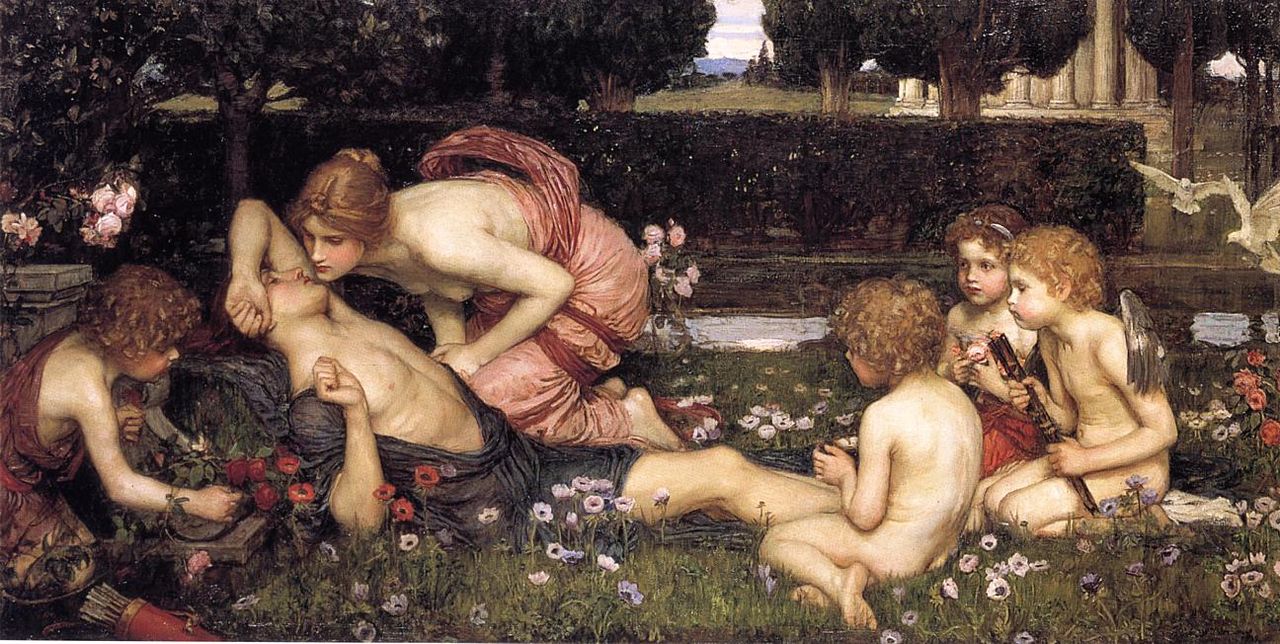
The Awakening of Adonis (1899-1900) by John William Waterhouse
Adonis is borne in Greek mythology by the god of beauty and desire. According to the most popular myth, he was born of the incestuous union of Theias and his daughter Myrrha. Myrrha had tricked her own father into having sex with her. The gods transformed Myrrha into a myrrh tree after Theias attempted to kill her whilst pregnant with Adonis. Adonis was beloved of Aphrodite and mothered by Persephone, but he was subsequently killed by a boar when Artemis, or in some versions, Ares, sent a boar to kill Adonis out of jealousy. When Adonis died, Aphrodite cried tears which mingled with Adonis’ blood, producing the Anemone flower. Aphrodite instituted the Adonia festival in his commemoration, whereby all women had a mass mock funeral of Adonis by growing plants in potsherds on their rooftops and performing a mass funeral ritual as soon as the plants sprouted.
It is likely Adonis was imported by the Greeks from the Phoenicians, the latter being the descendants of the Sumerians, Mesopotamians & Babylonians. It is believed by most scholars that Adonis is an adaptation of the Sumerian story of Dumuzid & Inanna (later Tammuz & Ishtar), in which a ritual funeral rite was also performed by women across the former Babylonian empire. Adonis itself is a Hellenized form of the Canaanite, adon, which means “lord” and was often used as an appellation by the Canaanites for the god Tammuz. The Jews adopted this appellation for Yahweh in the form of Adonai (my lord).
Adonis is borne by an 8th-century French saint of Vienne. He is also listed asAdon & Ado. Adonis has sporadically been used as a given-name in Greece, anglophone, francophone & hispanophone countries. The French feminine off-shoots, though rare these days, are Adonise (AH-do-NEEZ) and Adonie, and were actually prevalent in 18th-centurry Quebec & New Orleans. An obscure Italian feminine form is Adonella.
There is the male Biblical Hebrew name, Adonijah meaning (my lord is Yahweh). It is borne by a son of King David and was Hellenized in the Septuagint as Adonias.
Other forms include:
Adonies (Catalan)
Adonia (Dutch, Italian, Swedish)
AdonijaАдония (French, German, Russian)
Adonias Αδωνίας (French, Greek, Portuguese)
Adonías (Galician)
Adonja (Norwegian)
Adoniasz (Polish)
Adonías (Spanish)
Adoniya Адонія (Ukrainian)
Currently, Adonis is the 242nd most popular male name in the United States and the 461st most popular in France.