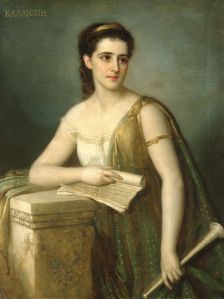
 Origin: Greek
Meaning: beautiful voiced
Gender: Female
Pronunciation: kuh-LIE-uh-pee
The name is composed of the Greek elements, καλλος (kallos) “beauty” and οψ (ops) “voice.” It is borne in Greek mythology by the muse of epic poetry and eloquence. She was said to be the mother of Orpheus and was said to be the chief among the muses by Hesiod and Ovid.
The name is also borne by a Catholic and Christian Orthodox saint who was tortured and martyred for refusing a suitor who wanted her hand in marriage as well as for her to renounce her faith.
It is also the name of a type of musical instrument as well as genus of hummingbird.
In recent years, it is the full name of a fictional character on the popular tv series, Grey’s Anatomy, Callie Torres, portrayed by Sara Ramirez.
In the English-speaking world, the name first came into use in the early 18th-century.
The name recently entered the U.S. Top 1000 Female Names, coming in as the 939th most popular female name.
A common short form is: Callie.
Other forms include:
Kalliope Կալլիոպե(Armenian/Danish/Dutch/Finnish/German/Estonian/Norwegian/Polish/Romanian/Swedish)
Kalіё́pa Каліё́па(Belarusian)
Kaliopa Калиопа(Bulgarian/Serbo-Croatian/Slovenian)
Cal·líope (Catalan)
Kalliopé (Czech/Hungarian/Slovak)
Calliope (French/English/Italian)
K’aliop’e კალიოპე (Georgian)
Kalliόph Καλλιόπη (Modern Greek)
Kallíópa (Icelandic)
Kaliopė (Lithuanian)
Calíope (Portuguese/Spanish)
Kalliopa Каллиопа(Russian/Ukrainian)
Sources
https://en.wikipedia.org/wiki/Calliope
https://www.behindthename.com
https://www.familysearch.org
https://www.ssa.gov
http://www.theoi.com
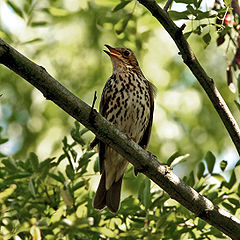 The name is derived from a poetic English term for the song thrush, which is the name of a type of bird found in various breeds across Eurasia and Europe, especially England. The song thrush is known for its distinctive vocals and was kept as a house pet in 19th-century Europe. The word itself first entered the English language about 1400 and is ultimately from the Old French mauvis, which itself is possibly of Breton or Spanish origins. In modern French, this bird is now known as La Grive musicienne.
 Gender: Masculine
 Gender: Feminine
 In Estonian, the name has a completely different etymology and history. It appears in the Estonian national epic, the Kalevipoeg, where it is the name of the protagonist’s mother. In this case, the name is most likely derived from the Estonian word lind, meaning “bird.”
 Gender: Feminine
 Gender: Masculine
 Gender: Feminine
 Gender: Masculine
 Gender: Masculine
 Gender: Feminine