Latif, Latifa

  • Origin: Arabic لَطِيْف
  • Meaning: “gentle; kind; benevolent.”

Latif is a masculine given-name which comes directly from the Arabic word لَطِيف (gentle; kind; benevolent). In Islam, Al-Latif لطيف, (the Kind; the Benevolent) is one of the 99 names of Allah (God). It’s feminine form is Latifa.

Latif & Latifa are commonly used throughout the Islamic world.

A notable American bearer is actress & singer, Queen Latifah.

Other forms include:

  • Latıif (m), Latıifa (f) (Avar)
  • Lətif (m), Lətife (f) (Azeri)
  • Latheef, Latheefa (Dhivehi)
  • Latifah (f) (Indonesian, Malaysian)
  • Letîf (m), Letîfe (f) (Kurdish)
  • Lәtyjif (m), Lәtyjifә (f) (Tatar)
  • Letife (f) (Turkish)
  • Lateef لطیف, Lateefa(h) (Urdu)

Sources

Fuad

  • Origin: Arabic فُؤاد
  • Meaning: “heart.”
  • Gender: masculine
  • Pronunciation: foo-AD

The name comes directly from the Arabic word for heart. It is used equally among Arab- Muslims & Christians. Among Christians, particularly Palestinians, Chaldeans and Lebanese Christians who profess Roman Catholicism, it is used in reference to the Sacred Heart of Jesus or the Immaculate Heart of Mary, in the same way the Spanish name Corazón is used in the Spanish-speaking world, though in the Arabic case, the name is strictly masculine.

Among Muslims, the term fu’ad is used at least 5 times in the Quran. The name is used throughout the Islamic world.

It is even used among Non-Arab groups in the Middle East, such as Mizrachi Jews.

The name was borne by two Egyptian kings.

Other forms include:

  • Fuad (Amharic, Azeri, Bosnian, Indonesian)
  • Fouad (Maghrebi)
  • Fuat (Turkish)
  • Fawad (Urdu)

A feminine form is Fuada(h).

Sources

Sariyah – meaning, origin & history of the first name

  • Origin: Arabic سارية
  • Urdu: سریا
  • Hindi:  सरिया
  • Bengla: সারিয়া
  • Meaning: “clouds at night.”
  • Gender: Female

Sariyah سارية is from an Arabic word that means “clouds at night.”

It is derived from the Arabic root S-R-A, and can be associated with “night rain” or “night travel.”

Saria and Sarya is the Urdu transliteration and is popular in Pakistan and India among Muslims.

Other forms include:

  • Sarija Сария (Abkhazian, Albanian, Azeri, Bashkir, Bosnian, Chechen, Circassian, Dagestani, Kazakh, Ossetian, Tajik)
  • Sәrija Сәрия (Tatar)

Sources

Sawda

Sawdah

By Omaislam – Own work, CC BY-SA 4.0, https://commons.wikimedia.org/w/index.php?curid=41784804


  • Origin: Arabic سودة
  • Meaning: uncertain
  • Gender: feminine
  • (SOW-dah)

The name is of uncertain meaning but is believed to be from the Arabic root S-W-D which can mean “blackness” or “large number of palm trees.”

The name was borne by one of the wives of the Prophet Muhammed known as Sawda bint Zama, considered one of the Mothers of Believers. Sawda bint Zama was a widow who married Prophet Muhammed at around the age of 50 to help care for his children.


Other transliterations are Sauda & Saudah.

Other forms include:

  • Seuda (Albanian)
  • Säüdä, Säüzä, Savda Сәүҙә (Bashkir)
  • Sevda (Bosnian)
  • Sawda Савда (Avar)
  • Sawdat Савдат (Chechen)
  • Saudah (Indonesian, Malaysian)
  • Sauda Сауда (Kazakh)
  • Sevde (Turkish)

Sources

Adhan, Azaan

429px-Jean-Léon_Gérôme_010


The name is derived from the Arabic root ʾadhina أَذِنَ meaning “to listen, to hear, be informed about,” or ʾudhun (أُذُن), meaning “ear.” The Adhan, sometimes romanized as Azaan, is the name of the Islamic call to prayer, which is rung 5 time a day.

Currently, Azaan is the 406th Most Popular Male Name in England & Wales, (2018). Other transliterated forms include: Adaan, Adan, Adhaan, Athan, Edan & Edhaan.

Other forms include:

  • Ezani (Albanian)
  • Ezan Езан (Albanian, Bosnian, Bulgarian, Kurdish, Turkish)
  • Azan Азан (Azeri, Kazakh, Kyrgyz, Malay, Tatar)
  • Azán Аза́н (Chechen)
  • Adan (Javanese)
  • Aadaan (Somali)
  • Azon Азон (Tajik)
  • Ezane (Zazaki)

Sources

Hashim

The name is most likely derived from the Arabic root H26-SH-M  meaning “breaker or pulverizer.” This was a sobriquet for Hāshim ibn ‘Abd Manāf (circ. 5th-century C.E.) who was the great-grandfather of the Prophet Muhammad and found of the Banu Hashim tribe. Borne ‘Amr al-‘Ulā, ot is said he took this name because he used to break up his bread to share in a broth among pilgrims to Mecca and he is also said to have saved the poeple of Mecca from a famine by breaking up his bread into tiny crumbs.

Another transliteration is Hasheem

Currently, Hashim is the 436th Most Popular Male Name in England & Wales (2018).

Other forms include:

  • HIashim ХӀашим (Chechen)
  • Haysim (Indonesian)
  • Hashem هاشم (Persian)
  • Haşim (Turkish)

Sources

Israa, Isra

  • Origin: Arabic
  • Meaning: “night journey”
  • Gender: Female
  • Pronunciation: is-RAH

The name is derived from the Arabic سرى (sara) meaning “to travel at night.” In Islam, it is the the name of the 17th Chapter of the Quran, which outlines the journey the Prophet Muhammad took between Mecca and Jerusalem.

Isra is currently the 181st Most Popular Female name in the Netherlands & the 351st Most Popular in France, while its other transliterated form of Israa is the 433rd Most Popular Female Name in France (2018).

Isra is used throughout the Islamic world, while Israa is usually used in mainly, Arabic-speaking Muslim countries. Another transliteration is Isra’

Other forms include:

  • Isrá (Bashkir)
  • Îsra (Kurdish)
  • İsra (Turkish)

Sources

Dunya, Dounia

download

The name is derived from the Arabic dunyā (دُنْيَا) meaning “world, kingdom, universe.”

It is a concept in Islam used to describe worldly concerns, and it is also used to describe anything that is close or near.

Its Maghrebi form of Dounia is currently the 445th most popular female name in France.

Other forms include:

  • Dynja (Albanian)
  • Dünya (Azeri/Turkish)
  • Donja Донъя (Bashkir)
  • Dunja (Bosnian)
  • Djunjà/ дюня̀/Dunjà дуня̀ (Bulgarian)
  • Denya (Egyptian-Arabic)
  • Donya  دنیا (Egyptian-Arabic/Javanese/Persian)
  • Duniya (Hausa)
  • Ddunit (Kabyle)
  • Dünïe дүние (Kazakh)
  • Dinya (Kurdish)
  • Düynö (Kyrgyz)
  • Dunia (Malay/Indonesian/Swahili)
  • Dinja (Maltese)
  • Dunida (Somali)
  • Dunyo дунё (Tajik/Uzbek)
  • Dön’ya дөнья (Tatar)
  • Dünyä (Turkmen)
  • Duniyâ دنیا (Urdu)

Sources

Hakim, Hakeem

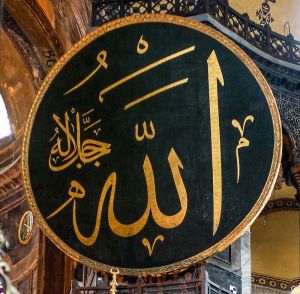
Istanbul,_Hagia_Sophia,_AllahThe name is derived from an Arabic honorific title حكيم that can have several different meanings. The name roughly translates as “sage” or “wise” but it can also mean “physician” or “philosopher” and is often used to denote a doctor, judge or someone highly educated in a particular scientific field in the Arabic world.

It is also used as a given name in most of the Islamic world,as in Islam, Al-Hakim is one of the 99 names of Allah.

As of 2016, Hakeem 905th most popular male name. Hakeem first entered the U.S. top 1000 in 1989 when it peaked at its highest in popularity, coming in as the 586th most popular male name. Hakim has only appeared in the U.S. Top 1000 one time in 1976, when it was the 881st most popular male name.

In France, Hakim appeared in the Top 1000 between 1961 and 2008 and peaked in popularity in 1981 when it was the 161st most popular male name in France.

Another form is

  • Hakimi ჰაქიმი (Georgian)

Sources


Gabriel, Gabriella

Origin: Hebrew גַבְרִיאֵל  Γαβριηλ
Meaning: “strong man of God.”
Eng (GABE-ree-el); (gah-bree-EL-ah); Fre (gah-bree-EL); Germ (GAHP-ree-el); Pol (GAHP-ryel)

The name is derived from the Biblical Hebrew, גַבְרִיאֵל (Gavri-el) meaning, “strong man of God.”

In Judeo-Christian religions, it is the name of a powerful archangel, who is often viewed as a messenger of God. He appears several times in the Old and New Testaments.

Among Christians, one of his most important messages was relayed to the Virgin Mary that she would be the mother of Jesus. Islamic tradition also believes the same, and in Islam, it was the angel Gabriel who revealed the Qu’ran, (through God), to Mohammed.

In Mormon theology, Gabriel is believed to be the embodiment of Noah in the afterlife.

Gabriel is a fairly common name among Christians, Jews and Muslims, making him an extremely cross-cultural portable name.

Currently, in the United States, his popularity has been rising. He is the 24th most popular male name, (2011). In other countries, his rankings in all his various forms are as follows:

  • # 2 (Gabriel(e), Liechtenstein, 2010)
  • # 3 (Brazil, 2011)
  • # 4 (Romania, 2009)
  • # 6 (Gabriele, Italy, 2009)
  • # 7 (France, 2010)
  • # 9 (Quebec, Canada, 2011)
  • # 19 (Croatia, 2009)
  • # 26 (Belgium, 2008)
  • # 28 (Canada, BC, 2010)
  • # 28 (Mexico, 2010)
  • # 29 (Austria, 2010)
  • # 35 (Spain, 2010)
  • # 40 (Poland, 2009)
  • # 47 (Sweden, 2011)
  • # 48 (Norway, 2011)
  • # 52 (Catalonia, 2010)
  • # 78 (England/Wales, 2010)
  • # 95 (Australia, NSW, 2011)
  • # 124 (Scotland, 2010)
  • # 189 (Djibril, France, 2010)
  • # 313 (Jibril, France, 2010)

Other forms of the name include:

  • Jibrail/Jibrīl جبرائيل ጂብሪል (Arabic/Ethiopian)
  • Gabriel გაბრიელი ገብርኤል
    (Armenian/Catalan/Coptic/Czech/Danish/English/Ethiopian/Finnish/French/Georgian/German/Norwegian/Polish/Portuguese/Romanian/Romansch/Spanish/Swedish)
  • Gavrik (Armenian)
  • Cəbrayıl/Cibril (Azeri)
  • Gawryil Гаўрыіл (Belarusian)
  • Džibril/Džebrail (Bosnian)
  • Gavrail Гавраил (Bulgarian)
  • Zheberejil Жәбірейіл (Central Asian)
  • Gabrijel (Croatian/Maltese/Serbian)
  • Gabriël (Dutch)
  • Gaabriel (Estonian)
  • Gabrel (Ethiopian)
  • Kaapo/Kaapro (Finnish)
  • Gabriél Γαβριήλ (Greek)
  • Gavril Γαβριηλ (Greek)
  • Gavriel גַּבְרִיאֵל (Hebrew)
  • Gábriel (Hungarian)
  • Gábor (Hungarian)
  • Gabríel (Icelandic)
  • Jibril (Indonesian)
  • Gaibriéil (Irish-Gaelic)
  • Gabo/Gabbo (Italian)
  • Gabriele (Italian: more common form)
  • Gabriellino (Italian)
  • Gabriello (Italian)
  • Gabrio (Italian)
  • Cibrayîl (Kurdish)
  • Gabrielus (Latin)
  • Gabriels (Latvian)
  • Gabrielius (Lithuanian)
  • Jibrail (Malaysian)
  • Gavriilu Гаврїилъ (Old Church Slavonic)
  • Khabbriele (Puglian)
  • Gabin (Provençal)
  • Gavril Гавриил (Romanian/Russian)
  • Crabiele/Gabilele/Gabriello (Sardinian)
  • Cabbrieli (Sicilian)
  • Gabri’el ܠܒܪܝܐܝܠ (Syrian)
  • Gebrael (Syrian)
  • Cebrâîl (Turkish)
  • Gavrel גַאבְֿרֶעל (Yiddish)

English short form is Gabe.

Its feminine form of Gabriella/Gabriela is also rising in popularity. Currently, Gabriella is the 34th most popular female name in the United States, (2011). Her rankings in other countries are as follows:

  • # 3 (Gabriela, Bulgaria, 2009)
  • # 5 (Gabrielė, Lithuania, 2011)
  • # 5 (Gabrielle, Philippines, 2011)
  • # 7 (Gabriela, Columbia, 2011)
  • # 8 (Gabriela, Romania, 2009)
  • # 9 (Gabriela, Puerto Rico, 2011)
  • # 10 (Gabriela, Brazil, 2010)
  • # 13 (Gabriela, Poland, Warsaw, 2010)
  • # 19 (Gabriela, Poland, 2009)
  • # 28 (Gabrijela, Croatia, 2009)
  • # 30 (Gabriela, Mexico, 2010)
  • # 30 (Gabrielly, Brazil, 2010)
  • # 36 (Gabriela, Croatia, 2009)
  • # 38 (Gabriela, Chile, 2010)
  • # 64 (Australia, NSW, 2011)
  • # 64 (Gabriela, Spain, 2010)
  • # 67 (Gabrielle, France, 2010)
  • # 72 (Canada, BC, 2010)
  • # 94 (Gabrielle, Canada, BC, 2010)
  • # 119 (Gabrielle, United States, 2011)
  • # 466 (France, 2010)

Other feminine forms include:

  • Gebre’elwa ገብርኤሏ (Amharic/Ethiopian)
  • Gabriela (Bulgarian/Croatian/Czech/German/Polish/Portuguese/Romanian/Scandinavian/Slovak/Spanish)
  • Brielle (Cajun: abbreviated form of Gabrielle)
  • Gabrijela (Croatian/Serbian)
  • Gabriëlle (Dutch)
  • Briella/Briela (English)
  • Gabrielle (French/English)
  • Gabria (Italian)
  • Gabrielina (Italian)
  • Gabriella (Italian/English/Hungarian/Scandinavian: more common form in Italy)
  • Gabrielė (Lithuanian)
  • Gavriila Гавриила (Russian)

Czech diminutives are: Gába, Gabika, Gábina, Gabrina and Gabby.

A Polish diminutive is Gabrysia (gah-BRIH-shah).

English short forms are: Gabby and Ella.

Designated name-days are: February 10/27 (Poland), February 19 (Sweden), March 24 (Czech/Finland/Poland/Slovakia/Sweden), September 29 (France/Germany), December 12 (Hungary)