The name comes from the Arabic الشفاء (al-Shifaa), meaning, “cure, remedy, healing.”
Al-Shifaa bint Abdullah, nee Layla, was a companion of the prophet Muhammed. She was known as a healer, which is how she ended up with the sobriquet, Al-Shifaa, and is said to have taught literacy to the population of Medina.
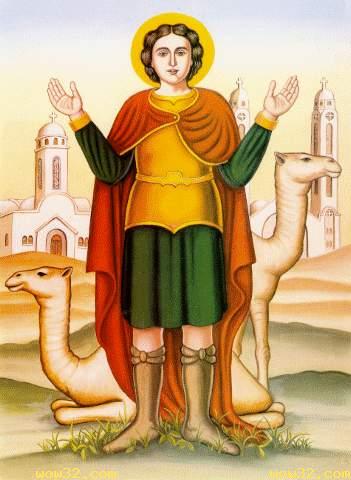
Menas is a popular male name among Eastern Christians, it is of uncertain meaning, it may derive from the Greek μήνη (mene) meaning, “moon,” or the ancient Egyptian Menes, which is the name of a 3rd-century BCE Egyptian pharaoh, in which case, the name derives from the ancient Egyptian, mnj (he who endures). It may also be related to the ancient Egyptian divinity name, Min, which is of uncertain meaning. However, according to Coptic tradition, the name means “amen.”
It is the name of a popular 2nd-century Coptic saint and martyr, known as Ⲁⲃⲃⲁ Ⲙⲏⲛⲁ (Abba Mina). According to legend, St. Menas’ parents were devout Christians who were having a hard time having children. His mother prayed to the Virgin Mary for a child, and she heard a response saying “amen,” this is where the name Menas supposedly derives from. It is speculated by some that the Western St. Christopher and the Eastern St. Menas are one and the same person. It is also borne by an Ethiopian saint of the 6th-century (CE) and a 16th-century CE Ethiopian emperor.
It was the name of 1st-century CE Roman admiral who features in Shakespeares, Antony & Cleopatra.
The name comes directly from the Arabic word for the storax tree. This is an old poetic name, it appears in a 7th-century Arabic love poem, Lubna & Qays.
It was also reportedly borne by Lubna of Córdoba, a 10th-century Andalusian poet.
The name is from the Arabic word meaning “innocent; sinless.” It was the sobriquet of a Shia Muslim saint by the name of Fatimah bint Musa, known as Fatimah al-Masumah (circ. 7th-century CE). She was the daughter of the seventh Twelver Shi’a Imam, Musa al-Kadhim and the sister of the eight Twelver Shia Imam, Ali al-Rida. Her shrine, which is located in Qom, Iran, is an important point of pilgrimage for many Shi’a Muslims.
The name was also borne by Masuma Sultan Begun (d. 1509), the Queen Consort of the Ferghana Valley & Samarkand & the fourth wife of Emperor Babur, founder of the Mughul Dynasty.
The name comes directly from the Arabic word لبابة meaning, “pearl.” It is the name of a famous mosque in Cairo, Egypt, built during the Fatimid Caliphate in the 10th-century, CE.
Other transliterated forms include: Lulua, Lu’lu’ah, Louloua & Lolua.
Rawdah روضة comes directly from the Arabic word for a “garden” or “meadow.” It is likely used by non-Arab Muslim parents in reference to Rawḍah ash-Sharifah (Arabic: روضة الشريفة, lit. ‘The Noble Garden’), which is a place located between the minbar and burial chamber of the Prophet Muhammed in Mecca.
The word itself is not used as a given-name in Arabic-speaking countries, but is used in non-Arabic Islamic countries, such as Southeast Asia and Turkey.
Its Turkish form of Ravza is currently the 78th most popular female name in Turkey. This form is also used among Bosnians & Albanians.