Mieczysław

Gender: Masculine
Origin: Polish
Meaning: debated
(mye-chih-SWAHF)

The name is of debated meanings, it is obviously composed of the Slavonic element slav meaning “glory” but the prefix of mieczy has always been a subject of debate.

Some theories that have interpreted the first element are:

  • miecz from the Polish meaning “sword”
  • mieć from the Polish verb meaning “to have.”
  • miecić from the Polish verb meaning “to fling; to throw.”

The third is most likely, since Mieczysław is believed to be an erroneous corruption of the earlier Miecisław.

The designated name-day in Poland is January 1st.

Common diminutive forms are Miecio, Mieczyś, Mieteczek and Mietek.

Historically, the name was often anglicized to Mitchell by first generation Polish Americans. Mitchell has no etymological relation to Mieczysław other than sharing similar sonority.

Other, more archaic, Polish forms are MasławMiecławMiecisławMiecysław and Miesław.

Other forms of the name include:

  • Mečislav (Czech)
  • Miecislas (French: very rare)
  • Miecsiszláv/Miciszsláv (Hungarian)
  • Menceslao (Italian: very rare)
  • Mecislaus (Latin)
  • Mecislavas/Mecislovas (Lithuanian)
  • Mechyslav (Russian/Ukrainian)

A feminine forms are Masława and Mieczysława.
Mieszko

Gender: Masculine
Origin: Polish
Meaning: debated
(MYESH-ko)

The name is often believed to be a contraction of the Slavic, Mieczysław, but other sources tend to disagree and claim that it may be related to an archaic Polish source, being a derivative of mieżka which means “blind”, related to the Polish verb mżeć meaning “to keep one’s eyes closed” or meaning “to be blind.”

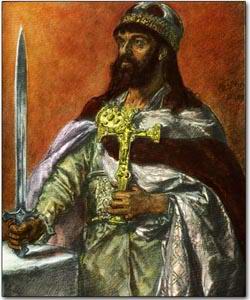
The name was borne by a legendary Polish king, Mieszko I (920-942), he is credited as being the first historical ruler of Poland and is also considered the creator of the Polish State.

His adoption of Christianity in 966 is also considered the date when Poland officially became a Christian nation.

The name was borne by several other Polish kings, particularly ones from the Piast Dynesty.

In Poland, its designated name-day is January 1.

Another masculine form is Mieszka.

Other forms of the name:

  • Mješko (Croatian)
  • Měšek (Czech)
  • Mesco (Latinized version: archaic)
  • Mieško (Lithuanian)
  • Meško (Slovak)

Nadezhda

Gender: Feminine
Origin: Russian/Bulgarian
Meaning: “hope.”
(nah-DYEZH-dah)
Надежда

The name come directly from the Russian, meaning “hope.” Other forms include:

  • Nada (Croatian/Serbian/Slovene)
  • Naděžda (Czech)
  • Nadège (French: nah-DEZH)
  • Nagyezsda (Hungarian)
  • Nadzieja (Polish: nah-JAY-ah)
  • Nadežda (Slovakian)

In modern Russian history, the name was most notably borne by the wife of Josef Stalin, Nadezhda Alliluyeva (1901-1932).

Russian diminutive forms are: Nada and Nadya. Czech diminutive forms is Naďa. Name-days are September 17 (Czech Republic/Russia), September 30 (Bulgaria), December 23 (Slovakia).

Dagmar

Gender: Feminine
Origin: Old Norse
Meaning: “day maiden; bright day.”

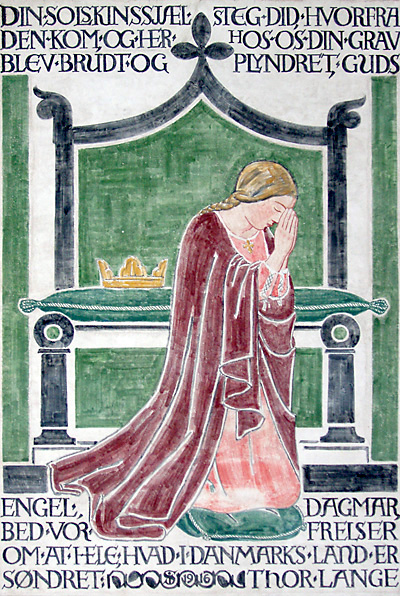
Dagmar is from the Old Norse elements dag meaning “day” and maer meaning “maid.” Some modern Danish folk etymology link the name to dag meaning day and meri meaning “bright.” It has also been linked to the old Slavonic name, Dragomir meaning “dear peace, beloved peace.”

The name was borne by Dagmar of Denmark (1186-1212), also known as Markéta of Bohemia, Princess Dagmar of Denmark (1890-1961), Maria Federovna, also known as Dagmar of Denmark (1847-1928), Empress Consort of Russia.

Dagmar is also used in Iceland, Finland, Estonia, the Netherlands, Sweden, Norway, Germany and the Czech Republic.

Other forms of the name include:

  • Dagmara (Czech/Lithuanian/Polish/Slovak/Slovene)
  • Dakmari/Dakmar (Finnish)
  • Takmar/Takmari (Finnish)
  • Dagmár (Old Norse)
  • Dagmey (Old Norse)
  • Dagmor (Old Norse)
  • Dammei (Norwegian: dialectical form from Austlandt)
  • Dargmara (Vendish)

Diminutive forms are Dagmaruška, Dáša, Daška, Dašenka, Dašička (Czech), Dagmarka (Czech/Polish), Didi (Scandinavian), Dada and Dadka (Slovakian).

Designated name-days are:

May 24 (Germany), September 27 (Denmark, Norway and Sweden), November 26 (Estonia), December 12 (Poland), December 20 (Czech Republic),

Svatoslav

Gender: masculine
Origin: Old Slavonic
Meaning: “blessed glory.”

The name is composed of the Old Slavonic elements svyanto meaning “blessed, holy, bright” and slav meaning “glory.” In the Czech Republic, its designated name-day is December 3rd. A common Czech diminutive form is Svatoš.

Other forms of the name are:

  • Světoslav (Czech)
  • Svyatoslav Святослав (Bulgarian/Russian/Ukrainian)
  • Swietosław (Polish)
  • Svätoslav/Svetislav (Slovakian)
  • Svetislav/Svetoslav (Serbo-Croatian)

Svante, Svätopluk, Svatopluk, Świętopełk

Gender: Masculine
Origin: Old Slavonic
Meaning: “mighty army; mighty regiment.”

An old Slavonic name most notably borne by a 9th-century Moravian prince, Svätopluk, (the Slovakian rendition), appears on the Slovakian name-day calender for November 15. Though today it is a very rare name in Slovakia, it did rank in as the 95th most popular male name, (in the form of Svatopluk), in it neighbor country, the Czech Republic, for 2006. In the Czech Republic, its designated name-day is February 23rd. Its Polish form of Świętopełk, is also extremely unusual today, though it does boast two name days, June 1 and September 25.Slovakian diminutives are, Sväto, Svaťo, Svätoš, Sväťo.

There is a popular folklore attributed to Svatopluk I of Moravia. When the king knew he was about to die, he gave each of his three sons a twig and had them break it, which was easy for all of them to do, but then Svatopluk asked his sons to break the twigs a second time, and this proved to be even more difficult. The king was trying to prove to his sons that it is difficult, yet necessary to keep a kingdom united.

Other forms of the name include:

  • Svend (Danish)
  • Vante (Finnish)
  • Sventopolcus/Sventopelcus (Late Latin)
  • Światopełek/Świętopałk/Świętopełek/Wszetopełk (Polish)
  • Svjatopolk/Svyatopólk (Russian/Ukrainian)
  • Svante/Svantepolk (Swedish/Norwegian/Danish: name-day in Sweden is December 5. Svante was the 97th most popular male name in Sweden for 2007)
  • Swante (Swedish)

Notable Czech bearers are:

  • Svatopluk I, Great Prince of Moravia (c. 894)
  • Svatopluk II, Prince of Nitra (c. 9-10 centuries)
  • Svatopluk of Bohemia (1107-1109)
  • Svatopluk Inneman, Czech director (1896-1945)
  • Svatopluk Benes, Czech actor (1918-2007)
  • Svatopluk Havelka, Czech composer (1925-2009)
  • Svatopluk Skopal, Czech actor (b.1952)

Famous Polish bearers include:

  • Prince Świętopełk of Poznań (979-992)
  • Świętopełk II the Great, Duke of Gdańsk Pomerania (1220-1266)
  • Świętopełk Karpiński, Polish poet and satirist (1909-1940)

It was also borne by one Kievan duke, Svyatopolk I of Kiev.


Engelbert

Origin: German
Gender: Masculine
Meaning: “bright angel; bright Angle.”

The name is either derived from the ancient Germanic elements engel meaning “angel” or angil meaning “Angil”, (an ancient Germanic tribe later known as the Anglos,) and the Germanic beraht meaning “bright.” The name was borne by a medieval German saint, an archbishop of cologne, who was martyred. Other famous bearers of the name include: Count Engelbert 1 of Berg (1160-1189), Engelbert Humberdinck (1892-1934) a German composer best known for his opera Hänsel und Gretel. Engelbert Humberdinck (b.1936) is a British pop singer born Gerry Dorsey, who took the stage name of Engelbert Humberdinck in honour of the German composer.

The name has experienced usage in Slovakia, the Czech Republic, Poland, (particularly in the region of Silesia), and Hungary. However, today, the name is extremely rare in all the above mentioned countries, especially in Germany where the name is considered very dated.

Other forms include the older German forms of Angilberct and Engelbrecht.

The designate name-day is November 7.


Renata, Renatus, René, Renée

Origin: Latin
Meaning: “rebirth.”

The origins of René and Renée can be traced back to the Late Latin male name Renatus, meaning “rebirth; born again.” The name is borne by several saints in both its Latin masculine form and feminine Latin form. The French forms have experienced usage in the Netherlands, Slovenia, Slovakia, the Czech Republic as well as Anglo-phone countries.

Renée enjoyed a short spout of popularity in the United States during the late 60s and early 70s, the highest it peaked was in 1967 coming in at # 62. As of 2008, she came in at # 734. Surprisingly, its masculine version ranked in higher in the top 1000, coming in as the 561st most popular male name in 2008. René is still somewhat prevalent among the Cajun and Creole communities of Louisiana.

In 2005, he was the 57th most popular male name in Slovenia.

Renata has experienced usage from South America to Eastern Europe, she is a common choice in Poland, Germany, Italy and Brazil. In 2006, she was the 34th most popular female name in Chile and the 68th most popular female name in Hungary.

Other forms of the name include:

  • Renata (Czech, Croatian, German, Italian, Lithuanian, Polish, Portuguese, Spanish. Polish diminutive forms are: Rena, Renatka and Renia. Spanish diminutive form is Renita, often used as an independent given name)
  • Renate (Dutch/German)
  • Renáta (Hungarian/Czech/Slovak)

Masculine forms include:

  • René (French, Czech, Dutch, German, Hungarian, Slovakian, Slovenian)
  • Renát (Hungarian/Slovakian)
  • Röné (Hungarian)
  • Renato (Italian/Spanish)
  • Renatus (Late Latin)
  • Renáto (Slovakian)
  • Renátus (Slovakian)

The designated name-day is November 6 in Slovakia, October 19 in France, November 12 in Poland and Lithuania, November 28 in the Czech Republic (Renata is October 13); October 6 in Hungary and January 23 in Estonia.

The name is borne by French mathematician and philosopher René Descartes and French painter René Magritte and American actress Renée Zellweger.

Vojmír

Gender: Masculine
Origin: Czecho-Slovak
Meaning: debated
(vooy-MEER)

The name is of Old Slavonic origins and is either derived from the elements voj meaning “warrior” and mir meaning “peace” or it might be another form of Volimir which is composed of the elements voli meaning “to want” and mir meaning “peace.” In Slovakia its designated name-day is October 25. A feminine form is Vojmíra, the Polish form is Wojmir.

Blandina, Blandine

St. Blandine

St. Blandine

Gender: Feminine
Origin: Latin
Meaning: “charming; flattering; friendly”

Both names come from an early Roman name, a feminine form of Blandinus, which is a derivative of the cognomen, Blandus, meaning “charming; flattering” or “friendly” in Latin.

The name was popularized, in France, in the form of Blandine.

It was the name of an early Christian martyr who had been killed in Lyons in the first-century C.E.

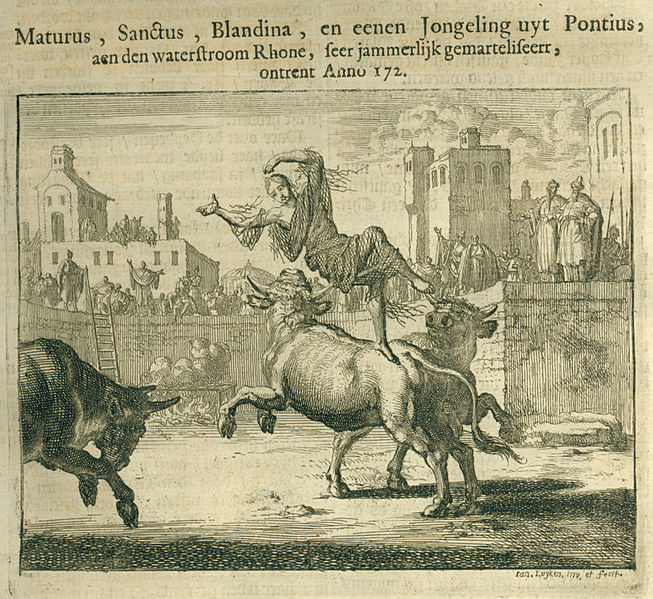
According to legend, she was a slave and Christian of frail health and when an edict against Christians in the area was produced, she and her master were tried and executed.

Allegedly, Blandina was tied to a stake in the local arena where wild animals were set loose upon her, the animals did not harm her, afterwards, she was scourged, placed on a burning grate and then thrown before a wild bull. She still didn’t die. She was finally executed with a dagger.

In France the name-day is June 2nd, while in Germany it is October 22.

The name has also had some usage in Italy , Spanish-speaking countries and in the Romantsch speaking cantons of Switzerland.

The Polish forms are Blandyna and the masculine, but very unusual form, of Blandyn.