Eira, Eirwen, Gwyneira

Gender: Feminine
Origins: Welsh/Old Norse
Meaning: “snow; snow white; white as snow; or “protection; mercy; help.”
(Ay-rah South Wales; I-rah North Wales; AYR-wen South Wales; IRE-wen North Wales. Swedish/Finnish I-rah)

Eira can be of two different etymologies and origins, in Welsh, it is related to the word eir, meaning “snow”, the offshoot of Eirwen is composed of the elements eir and gwen, (which either means fair, blessed or white), in which case, Eirwen would roughly translate as “white as snow”, “snow white” or “white snow.” A reverse of Eirwen, is Gwyneira, which virtually means the same thing, pronounced (gwyn-AY-rah) South Wales, and (gwyn-EYE-rah) North Wales.

Eira can also be connected to an Old Norse element. It is believed to be a variation of the Old Norse female name, Eir, which was the name of the Norse goddess of healing. Eir means, “protection; mercy; help.”

It is also the name of a neighborhood in Helsinki which its name from a hospital. Its designated name-day in all Scandinavian countries, including Finland, is August 9. Other forms of this version include

  • Eiri (Faroese)
  • Eira (Finnish/Norwegian/Swedish)
  • Eir (Old Norse: used in Iceland and on the Faroe Islands)
  • Eirin (Norwegian: possibly also a Norwegian phonetic spelling of the English pronunciation for Irene).

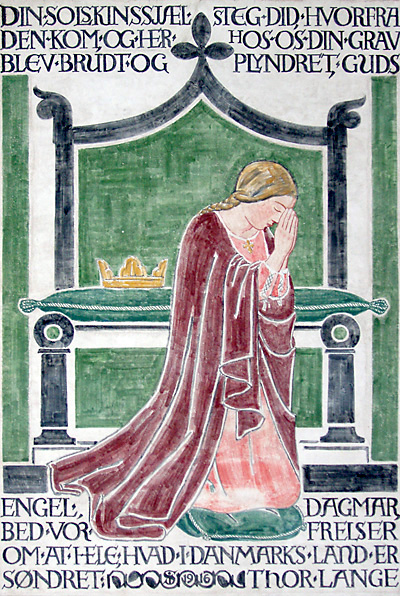
Dagmar

Gender: Feminine
Origin: Old Norse
Meaning: “day maiden; bright day.”

Dagmar is from the Old Norse elements dag meaning “day” and maer meaning “maid.” Some modern Danish folk etymology link the name to dag meaning day and meri meaning “bright.” It has also been linked to the old Slavonic name, Dragomir meaning “dear peace, beloved peace.”

The name was borne by Dagmar of Denmark (1186-1212), also known as Markéta of Bohemia, Princess Dagmar of Denmark (1890-1961), Maria Federovna, also known as Dagmar of Denmark (1847-1928), Empress Consort of Russia.

Dagmar is also used in Iceland, Finland, Estonia, the Netherlands, Sweden, Norway, Germany and the Czech Republic.

Other forms of the name include:

  • Dagmara (Czech/Lithuanian/Polish/Slovak/Slovene)
  • Dakmari/Dakmar (Finnish)
  • Takmar/Takmari (Finnish)
  • Dagmár (Old Norse)
  • Dagmey (Old Norse)
  • Dagmor (Old Norse)
  • Dammei (Norwegian: dialectical form from Austlandt)
  • Dargmara (Vendish)

Diminutive forms are Dagmaruška, Dáša, Daška, Dašenka, Dašička (Czech), Dagmarka (Czech/Polish), Didi (Scandinavian), Dada and Dadka (Slovakian).

Designated name-days are:

May 24 (Germany), September 27 (Denmark, Norway and Sweden), November 26 (Estonia), December 12 (Poland), December 20 (Czech Republic),

Sverker

Sverker I of Sweden

Gender: Masculine
Origin: Old Norse
Meaning: “black spear.”

The name is a modern form of the Old Norse Svartgeirr, which is composed of the elements svart meaning “black; dark” and geirr meaning “spear.” The name appears on a rune stone which dates back to the last millenium, in Fröberg, Södermanland, Sweden, which translates as follows: “Vighjälm and Ödmund erected this stone in honour of their dear brother, Sverker.”

As of December 31, 2008, there were approximately 1,872 registered persons in Sweden with the name Sverker. Its designated name-day is November 4.

The name was borne by two Swedish kings, Sverker I (1130-1156) and Sverker II, (1196-1208).

Another form is Sverkir.

Tone

Gender: Feminine
Origin: Norwegian
Meaning: “new Thor; young Thor.”
(TOH-neh).

The name is a more modern Norwegian form of then Old Norse female name Torný, which is composed of the elements Tor (Thor, which means “thunder” but in this case the name was most likely created in reference to the god) and meaning “new; young.” Other Norwegian forms include Todne, Todni, Torny, Tønni (a Norwegian dialectal form from Numedal in Buskerud) and Tonni. Swedish forms are Tona, Toni and Tony. Faroese forms are Tóna and Torný and the Icelandic form is Þórný.

The designated name-day in Norway is November 2.

Vetle

Gender: Masculine
Origin: Norwegian/Old Norse
Meaning: “one winter old bear.”
(VET-leh)

The name is derived from the Old Norse Veturliði which is composed of the elements vetr meaning “winter” and liði meaning “one who fares.” Veturliði is still in use in Iceland and the Faroe Islands. Other forms include the Old Norse Vetreliðr and Vetreliði, other Norwegian dialectical forms include Velle (Rogaland) and Vete/Vette (Östfeld).

In modern Norwegian the word Vetle coincides with the word for small. In this case it is the name of one of Norway’s highest mountain peaks known as the Vetle Skagastølstinden or the Vesle Skagastølstind.

The designated name-day in Norway is November 1.

Viking

vikingGender: Masculine
Origin: Old Norse/Swedish/Norwegian
Meaning: “sea fearer; sea expedition.”
Scan (VEE-king); Eng (VYE-king).

You must be wondering why I’d post a name like this, just last week, we were barraged in the news by a little boy named Falcon who seemingly took flight on a hot air balloon. Viking has a similar  feel, and yet, you must be asking, is this really legit?

Viking has been used as a male first name on and off in Scandinavia since the middle ages. It even boasts its own name-day in the Swedish-Finnish name-day calendar: October 19. In modern society, the term is used in reference to a particular culture and group of people who existed in Scandinavia in the early Middle Ages, however, this is a modern term and the Vikings themselves never referred to themselves as “Vikings” in a cultural sense or in reference to a distinct group of individuals. In Old Norse víkingr is a verb used to describe a sea-fearing expedition while víking is a noun that refers to someone who takes part in these expeditions. The term is found on several rune stones throughout Scandinavia. In Anglo-Saxon the word was wicing and appears in the 9th-century Anglo-Saxon poem Widsith in which it is used to refer to a pirate. Adam of Bremen also uses it to describe a pirate in his writings. The term disappeared from the English lexicon by the end of the Middle Ages and was revived in the 18th century as Viking, this time referring to a distinct group of people, culture and period in history. In modern Scandinavian languages, the term Viking is used more as a term to describe specific people within the Norse culture who went out on sea expeditions, and not necessarily a term to describe a particular culture or group of people.

Other forms of the name include the Icelandic Vikingur.

Flemming

solitude-in-brugesGender: Masculine
Origin: Danish/Norwegian
Meaning: “from Flanders.”
(FLEM-ming).

He has a modern surname appeal but is actually derived from the Old Norse male name Flaemingr meaning “from Flanders.” In recent years, it has remained a staple in Denmark and is occasionally used in the other Scandinavia countries, though rather sparsely. Other forms of the name include Fleming and the Icelandic Flemmingur. Its designated name-day is October 16. The name is borne by Danish news journalist Flemming Rose (b. 1958) who sparked controversy in 2005 when he commissioned drawings of the prophet Muhammad in the Danish newspaper Jyllands-Posten.

Sigrid, Siri

  • Gender: Feminine
  • Origin: Old Norse
  • Meaning: “beautiful victory”

SigridaStoradaThe name is composed of the Old Norse elements sigr meaning victory and fríðr meaning “beautiful; fair.”  The name appears in Danish and Swedish royalty. It is notably borne by the illusive Sigrid the Haughty, also known as Sigrid Storråda, a Slavic princess who married Svein Forkbeard, mother of Canute the Great and Harald II of Denmark. However, historians argue if she ever really existed or if the Medieval chroniclers actually mixed her up with Świętosława, the daughter of Mieszko I.  Świętosława later changed her name to Gunhild when she married the above mentioned Danish king.  She is mentioned quite a few times in the Sagas as Sigrid, hence the historical confusion. Another Scandinavian princess to bear this name was Sigrid Eiriksdotter Vasa of Sweden.Sigrid_Eriksdotter_VasaSigrid’s usage is also quite prevalent in German speaking countries. Other forms of the name include the Norwegian diminutive form: Siri. The usage of Siri in Norway has mostly switched over as an independent given name.  Other diminutives forms include Sigga, Siggan and Sickan. Sigrid’s designated name-day in both Sweden and Norway is September 15. In 2007, Siri ranked as the sixtieth most popular female name in Sweden and according to the Central Bureau of Norwegian Statistics, there were approximately 8,208 women who had Siri as their first name. The formal Sigrid ranked in at # 100 in Sweden’s top female names of 2007, while Sigrid came in higher in Norway, coming in at # 52. Non-Scandinavian alternatives include the Latvian, Polish and Estonian Sigrida.

Tyra, Týr


  • Gender: Feminine
  • Origin: Old Norse
  • Meaning: debated; theorized
  • Eng (TYE-ruh); Swe/Nor (TUEW-rah).

Surely you must think of the beautiful runway model, Tyra Banks, host of the Tyra Banks Show and America’s Next Top Model. When in Sweden or Norway, where the name is prevalent, an anglophone would not recognize the name by ear. Pronounced something like Teuw-rah, the name is actually of very ancient origins, a survivor of the original Indo-European language, Tyra is a feminine form of Tyr. Tyr itself, is a derivative of the ancient Germanic Tiwaz*.


In Norse Mythology, Tyr was the one handed god who got his hand bit off by the Fenrir wolf. He was revered as the god of single handed combat, victory, glory and honesty. According to the Icelandic Prose Eddas and the Poetic Eddas, he is either the son of Odin or Hymir. In the language of Old Norse, the word tyr was possibly synonymous with the word god, as tyr is found in many Norse poems and kennings as a poetic term for a god, referring either to Odin or Thor.
Scholars tend to believe that Tyr/Tiwas was a far more important god than he is portrayed in ancient Norse religion. Before the Migration Age, he was possibly the head of an Indo-European pantheon. In fact, it is suggested by archaeologists and anthropologists that his original name was*Dyeus. It is theorized that he later evolved into the Germanic Tiwas or Tyr, the Greek Zeus, and the Latin word for a god in general, Deus. Lingusts suggest that *Dyeus is related to a Pre-Indic root, deywos, which possibly means: “celestial being.” Even more fascinating is that the Sankrit word deva: “god” is closely related. After the varying Indo-European tribes separated and became more distinct from each other, Tiwas or Tyr became relegated in power under both Odin/Wodin and Thor. In other Germanic religions, he appears as Tiw, Tuisto, Teiws and Ziu. In the ancient Rune alphabet, the t-rune, named by modern scholars as the Tiwaz rune, is believed to have been associated with the above mentioned god. The rune looks very much like an arrow pointing upward.
He even survives in modern English lexicon. Our very own name of the week: Tuesday is from the Anglo-Saxon meaning “Tiu’s Day” Tiu being the Anglo-Saxon form of Tyr. The name also survives in many modern English, Swedish, Norwegian, Danish, German and Icelandic place names.

While Tyr has fallen out of usage, its feminine counterpart, Tyra, is still quite common in Sweden. She ranked in at # 43 in Sweden Top 100 Female Names of 2007. Meanwhile, in the States, despite the recognition of Tyra Banks, she was last seen in 2007, where she ranked in at a measly 939. As of last year of 2008, she completely fell out of the top 1000. In Sweden, the designated name day is September 12th.
So before you think of American Pop Culture when hearing the name Tyra, think twice, as the name actually has a primordial and colourful past.

Trygve, Trygg

  • Gender: Masculine
  • Origin: Old Norse
  • Meaning: “trusty; true; safe;
  • Nor (TRIG-veh); (TRIGG)

pictured: Trygve Lie

Whatever your personal political views, many were a bit baffled when former Republican VP candidate and former governor of Alaska, Sarah Palin, chose the name Trig for her youngest son. When I first heard the name, I knew I heard the name somewhere before, but I couldn’t remember where. I racked my brain, then I suddenly remembered where. In college, I was a Scandinavian Studies major, I concentrated in Viking Mythology and Scandinavian languages. As a result, I ended up living in Sweden. That is where I remembered hearing the name. I remember meeting a few Norwegian fellows named Trygve and an older Swedish man named Trygg. Sarah Palin claimed herself that her son’s name was Old Norse for “true.” She is not entirely wrong, though the spelling she chose is wrong. Trygg is derived from the Old Norse tryggr meaning “trusty; true or safe.” Trygve itself is just another form of the name, though a more popular version in Norway. The name appears in the Heimskringla, as the name of Tryggve Olafsson (d.963), a ruthless viking who was known for ravaging the spoils and countryside of Ireland and Scotland. He himself eventually met a bloody death when he was killed by Harald Greyhide.

Trygve, Tryggve and Tryggvi have also been borne by the following: Tryggve Anderson, a Norwegian author and story teller (1866-1920). Tryggve Gran, a Norwegian explorer, aviator and author (1889-1980). Trygve Lie (1896-1968) the first elected general of the United Nations. Tryggvi Þórhallsson, prime minister of Iceland (1889-1935). As for the name Trygg itself, it doesn’t seem to have been as popular, although, it seems to be a common surname in Sweden, derived from a patronymic. It is also the name of a popular comic book series: Trygg the Sorcerer, and a type of torpedo boat constructed by the Norwegian navy in the early 20th-century. Other forms of both names include Trygge (that extra e is pronounced); the Finnish Rykve, the Faroese Trygvi, the Icelandic Tryggvi and the Swedish/Norwegian Tryggve. There are a few Icelandic feminine forms: Tryggva and Tryggvína.

Its name day in Norway is September 9th. Trygve is still a relatively common name in Norway. According to the Central Bureau of Norwegian Stastics, approximately 6,086 men bore the name Trygve as of 2008. To hear how Trygve is pronounced in Norwegian, you can go here: http://www.forvo.com/search/Trygve/