Flemming

solitude-in-brugesGender: Masculine
Origin: Danish/Norwegian
Meaning: “from Flanders.”
(FLEM-ming).

He has a modern surname appeal but is actually derived from the Old Norse male name Flaemingr meaning “from Flanders.” In recent years, it has remained a staple in Denmark and is occasionally used in the other Scandinavia countries, though rather sparsely. Other forms of the name include Fleming and the Icelandic Flemmingur. Its designated name-day is October 16. The name is borne by Danish news journalist Flemming Rose (b. 1958) who sparked controversy in 2005 when he commissioned drawings of the prophet Muhammad in the Danish newspaper Jyllands-Posten.

Jarl

Gender: Masculine
Origin: Swedish/Norwegian/Icelandic
Meaning: “chief, nobleman, earl.”
(YAHRL)

The name comes from the Old Norse word for chief, it shares an etymological relation with the English word and given name Earl. In Norse mythology, it is borne by the son of the god Ríg and Modir. His father taught him how to read, magic and to understand the language of birds. Jarl is considered the progenitor of the warrior race. Its designated name-day is October 11.

Dagny

  • Gender: Feminine
  • Origin: Old Norse
  • Meaning: “new day.”
  • Nor/Swe (DAHG-nee); Dan (DOWN).

The name is composed of the Old Norse elements dag meaning day and meaning “new.” Its designated name-day throughout Scandinavia is September 11th. The name is far more prevalent in Denmark than in any of the other Scandinvian countries. In American literature, the name is found in Ayn Rand’s novel Atlas Shrugged as the name of a character. In Norwegian and Swedish, the name has the more pleasant pronounciation of (DAHG-nee) while in Danish, it rhymes and sounds like the English word “down.” To hear how the names are pronounced in both languages, consult this site: http://www.forvo.com/search/Dagny/da/ There is a Sami version: Dávdna

Alfhild, Alvilde

Gender: Feminine
Origin: Old Norse
Meaning: “elf battle.”

The name comes from the Old Norse elements alf meaning elf and hildr meaning “battle.” In Norse Mythology, it is the name of a beautiful maiden who was guarded by two deadly dragons. Any suitor who approached the dragons were instantly killed, except for King Alf. Alfhild ran away from Alf and disguised herself as a male warrior. Alf eventually found her while fighting her in battle, when he knocked her helmet off, he realized who it was. Alfhild eventually married Alf. Other forms include the Icelandic Alfhildr, the Danish Alvilda, and the Norwegian Alvilde.

Currently, Alvilde (ahl-VEEL-deh) comes in as the eleventh most popular female name in Norway. In Sweden, Alfhild’s designated name-day is September 3rd, but is very rare in Sweden.

Vidar

Gender: Masculine
Origin: Old Norse
Meaning: “forest warrior or; wide or large warrior.”
(VEE-dahr)

The name is derived from the Old Norse male name Víðarr, which is composed of the elements víðr which can either mean “forest” or “wide; large” and arr meaning “warrior.” In Norse Mythology the name is borne by the son of Odin and the giantess Grid. He is fated to avenge his father’s death at the time of Ragnarök (the end of the world in Norse Mythology). Odin is fated to die by being devoured by the wolf. Vidar appears in both the Poetic Edda and the Prose Edda and is also a subject featured on the carvings of the Gosforth Cross in England. Traditionally, it is believed that Vidar will kill the wolf by pulling his jaws apart. Ouch! After the great battle of Ragnarök is to pass, Vidar will survive and rule his own hall in the Viking netherworld, upon the remains of Asgard. He is said to don a powerfully made leather shoe, which will help him kill the wolf in the future. He is said to be extremely powerful. Other forms of the name include Vithar and Vitharr. The name is currently popular in Norway where it came in as the 9th most popular male name of 2008. Its designated name day in Sweden is August 31, while in Norway it is on December 29.

Kólga, Kolka

  • Gender: Feminine
  • Origin: Old Norse/Icelandic
  • Meaning: “the cool; cool wave; heavy clouds.”
  • Swe/Nor. (KOOL-gah); O.N. (KOLE-gah); Ice. (KULL-kah)

The name is borne in Norse Mythology by one of the nine sea maidens born of the goddess Ran. In modern Iceland, the name has evolved into Kolka, its older rendition often used as a horse name and literally meaning heavy clouds, or overcast in modern Icelandic. The term Kólga was often used in Norse poems to describe the waves. It was a favorite term in kennings. With the revival of Old Norse names in Sweden and Norway, it is possible that Kolga could catch on. The other 3 sisters of whom I will not go into anymore detail are Hefring (Riser); Blodguhadda (Bloody-hair) and Udr (frothing wave) which in Modern Icelandic is Unnur (UN-nur). Hefring and Blodguhadda were never used as names outside the myths.

Dúfa

Gender: Feminine
Origin: Old Norse/Icelandic
Meaning: “pitching one; pigeon; dove.”
(DOO-vah).

In old Norse the name means “pitching one.” It was the name of one of the nine daughters of the sea goddess Rán. In modern Icelandic, the name is interchangeable with the word for dove or pigeon. It is still a common female first name in Iceland.

Another offshoot of the original old Norse form is the Frisian Dufina (doo-FEE-nah) and the Dutch Dyveke.

Dröfn

Gender: Feminine
Origin: Old Norse/Icelandic
Meaning: “foam fleck; comber.”
(DREUF-n)-the O is akin to the eu in Fleur.

An Old Norse name that is currently very popular in Iceland. This is another name that appears in Norse Mythology as the name of one of the nine mermaid daughters of Rán and Aegir.

In Iceland, the name is more common as a middle name than as a first name, it is currently borne by 89 women as a first name and as a middle name, it is borne by 467 women (July 2007).


Bylgja

Gender: Feminine
Origin: Old Norse/Icelandic
Meaning: “wave; billow.”
(BILG-yah)

    The name is borne in Norse Mythology by one of the nine daughters of Rán and Aegir.

    Bylgja represented the waves of the sea and she is the mother of Heimdall by the god Odin.

    In Icelandic, it coincides with the modern word for wave.

    As a first name, it is currently borne by 116 women, and as a middle name, it is borne by 19 women (July 2007).

    For an English speaker considering this name, a possible nickname option is Billie.

    Rán

    Gender: Feminine
    Origin: Old Norse
    Meaning: “theft; robbery.”
    General Scan (RAWN); Ice (ROWN) like the word Round with the d cut off

    The name is borne in Norse mythology by a sea goddess.

    The goddess Rán, is the subject of several Old Norse Prose Eddas, including the Skáldskaparmál, in which a poem entitled, Lokesenna, talks of her life and exploits.

    According to the Lokesenna, Rán is the wife of Aegir, and with him, she has nine daughters.

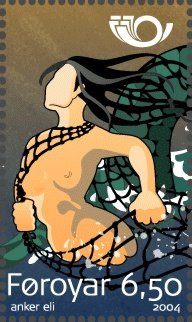
    Rán is also famous for capturing unsuspecting seafearers with her fish-net. In fact, her fish-net is also recorded in the Volsunga Saga.

    According to some sources, she is married to the sea.

    The name is still in usage in Iceland and the Faroe Islands. In Iceland, it is often used as a one syllable filler middle name.

    As of July 2007, 37 women in Iceland bore this as a first name, while 325 had it as a middle name.

    The name can also be a Japanese female name,  meaning “orchid”