Philomena

Gender: Feminine
Origin: Greek
Meaning: debated
Eng (FIL-uh-MEE-nah); It (FEE-lo-MAY-nah); Fre (fee-loh-MEN)

The name is of debated meaning, though most definitely of Greek origin. It first came to the spotlight in the 19th-century when an excavation of a tomb in Rome on the Via Salerna revealed the remains of an early Christian martyr.

Some sources believe it is composed of the Greek elements, philo, meaning, “lover” and menos, meaning ,”strength.”

Others believe that it may be derived from the Greek word, philomene, meaning, “loved.” While others contend that it is a mixture of the Greek, philo (lover) and of the Latin, lumen, meaning, “light.”

When the tomb of St. Philomena was first discovered, the name was spelled Philumina, hence the reason why it is sometimes believed to mean “lover of light,” vs “lover of strength” or “loved.”

The story behind the saint is both interesting and controversial. In 1802 a tomb was discovered bearing the remains of a thirteen year old girl, her name, and symbols on the tomb indicating that she died a martyr.

There was virtually nothing known of her story. The saint’s relics were catalogued and put in storage in the Vatican archives till, in 1805, a priest from Mugnano Sicily ran into the relics while visiting the archives. He was suddenly struck with a weird sensation when he encountered the bones and requested that he take the bones back to his parish in Mugnano to enshrine them. After taking the relics back to his village, reports of miraculous cures of cancer and other diseases became attributed to the bones of the saint.

A young French woman who was stricken with a horrible cancer, by the name of Venerable Pauline Jaricot, in a desperate last attempt, made a pilgramage to the saint’s shrine. After visiting the bones of the saint, Jaricot was miraculously cured and lived to an old age.

The controversy comes in here: a nun by the name of Sister Maria Luisa di Gesù, claimed she had a dream concerning the saint’s life.

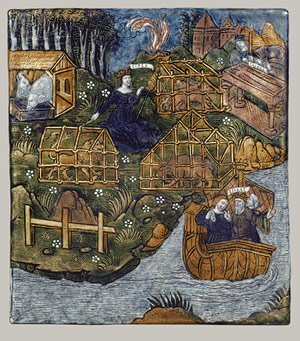
According to her dream, Philomena was a girl of Greek nobility. Her parents took her on a business trip to Rome and while there, they were invited to one of the Emperor Diocletian’s lavish parties. There the young girl caught the attention of the greedy old emperor. Diocletian was known for his persecutions of the Christians and when he asked for Philomena’s hand in marriage, the girl refused, stating that she was a Christian and would not marry such a horrible man.

Philomena was sentenced to death and the nun claimed that in her dream she saw the saint with an anchor tied around her neck and before being thrown into the Tiber.

According to some sources, the saint was removed from the Calender after Vatican II, which lead to a huge misunderstanding that the Church no longer recognized her veneration. The Church still recognizes her cult as a saint, it was confirmed however, that the Church could never prove if she ever really existed. For more information of this strange tale, you can read the story here: http://www.philomena.us/.

I will not go into many more details of the story of the illusive saint, but I would like to point out that on the above website, there is an animated gallery of some really cool renditions of the saint. She is the only saint whose life is unknown yet who was canonized based on the numerous miracles attributed to her bones.

On some calenders, her feast is celebrated on July 5th, while others, September 9th.

The name is very popular in Southern Italy and Sicily where the name is rendered as Filumena. In France, her cause was imported, thanks to the devotion of St. John Vianney and there she was known as Philomène (FEE-loh-MEHN). In the 50s, the name was somewhat popular in Ireland.

As of 2010, Philomène was the 449th most popular female name in France.

Other forms of the name include:

  • Philomena (English)
  • Philomène (French)
  • Philoumène (French)
  • Filoména (Hungarian/Slovakian)
  • Filena (Italian)
  • Filomena (Italian/Polish/Portuguese/Spanish)
  • Filumena (Latin/Neopolitan)

A masculine Italian form is, Filomeno.

Halima

Gender: Feminine
Origin: Arabic حليمة
Meaning: “patient.”
(huh-LEE-muh)

The name is derived from the Arabic, حليم (haliem) meaning, “patient.”

The name was borne by a 6th-century Ghassian princess, (the Ghassians were a group of Hellenized Arabs).

As of 2010, Halima was the 455th most popular female name in France.

As West African form is Halimat.

Masculine form is Halim.

Shaima

Gender: Feminine
Origin: Arabic
Meaning: “beeswax.”
(shah-EE-mah)

The name is derived from the Arabic,  شمع (shem), meaning, “beeswax.”

As of 2010, Shaïma was the 472nd most popular female name in France.

Ibtissam

Gender: Feminine
Origin: Arabic  إبتسام
Meaning: “smile.”

The name comes directly from the Arabic meaning, “to smile.”

As of 2010, its variant form of Ibtissem was the 479th most popular female name in France.

It is also sometimes transliterated as Ibtisam.

Gaétan


Gender: Masculine
Origin: German/Polish/Italian/French
Meaning: “from Caieta.”
It (guy-TAH-no); Fre (GAH-eh-TAWn); Pol/Germ (KYE-eh-TAHN)

The name is derived from the Latin place name, Caietanus, meaning,  “from Caieta”. Caieta is now known as Gaeta.

In ancient Greece, this was a town where prisoners were taken to be executed. The town probably got its name from the wet nurse of Zeus in Greek myth.

It was borne by a 16th-century Italian saint, which spurred the popularity of the name throughout Europe. It has been in usage in German speaking countries as well as in Poland in the form of Kajetan and Cajetan, the name Kaj was later spun off from this name, now being more popular than its formal form in Sweden and Denmark.

As of 2010, its French form of Gaétan was the 122nd most popular male name in France.

Other forms of the name include:

  • Caitanu (Asturian)
  • Kaitan (Basque)
  • Gaietà (Catalan)
  • Gaitanu (Corsican)
  • Kajetán (Czech/Hungarian/Slovak)
  • Cajetaan (Dutch)
  • Gaétan (French)
  • Gaëtan (French)
  • Gaetano (Galician/Italian)
  • Kayetan (German)
  • Kajetan (German/Polish/Scandinavian)
  • Gaïtános Γαϊτάνος (Greek)
  • Caietanus (Latin)
  • Kajetonas (Lithuanian)
  • Aitano (Neopolitan)
  • Gaitano (Neopolitan)
  • Caetano (Portuguese)
  • Caetan (Romanian)
  • Cajetan (Romansch)
  • Kaetan Каетан (Russian)
  • Gajetànu (Sardinian)
  • Cayetano (Spanish)

Feminine forms are:

  • Gaetana (Italian)
  • Gaétane (French)
  • Gaëtane (French)
  • Kajetana (German/Polish)
  • Kaia (German)
  • Kaja (German/Polish)
  • Caietana (Latin)

Its designated name day is August 7.

Mahé

Gender: Masculine
Origin: Breton
(MAH-ay)

The name is a Breton short form of Matthew, now used as an independent given name. Bertrand-François Mahé de La Bourdonnais (1699 –1753) gave his name to the main island of the Seychelles.

The name is borne by New Zealand Olympic rower, Mahé Drysdale (b.1978) who was named for the island.

As of 2010, Mahé was the 141st most popular male name in France.

Aurelian

Gender: Masculine
Origin: Latin
Meaning: “golden one.”
Eng (aw-RIL-lee-yen) Fre (Pronunciation)

The name is derived from the Latin cognomen, Aurelianus, which means, “golden one.”

The name was borne by a 3rd-century Roman Emperor.

As of 2010, its French form of Aurélien was the 150th most popular male name in France. Other forms of the name include:

  • Aureliani (Albanian)
  • Aurelián (Aragonese/Czech)
  • Awrelijan Аўрэліян (Belarusian)
  • Avrelian Аврелиан (Bulgarian/Russian/Ukrainian)
  • Aurelià (Catalan)
  • Aurelijan Аурелијан (Croatian/Macedonian/Serbian)
  • Aurelian (English/German/Lombard/Polish/Romanian)
  • Aurélien (French)
  • Aureliano (Galician/Italian/Portuguese/Spanish)
  • Avreliane ავრელიანე (Georgian)
  • Aurelianus (Latin)
  • Aureliāns (Latvian)
  • Aurelianas (Lithuanian)
  • Aurilianu (Sicilian)
A feminine form is Aureliana (Italian/Latin/Portuguese/Spanish)

Ezio

Gender: Masculine
Origin: Latin
Meaning: “eagle.”
(E-tsyo)

The name is derived from the Latin cognomen, Aetius, which is possibly derived from the Greek, aetos (eagle).

The name was borne by several people, including Flavius Aetius, the Roman general noted for defeating Attila the Hun.

Ezio is the Italian form.

As of 2010, Ezio was the 365th most popular male name in France.

Ambrose

Gender: Masculine
Origin: Greek
Meaning: “immortal.”
Eng (AM-broze); Fre (ahm-BWAHZ)

Ambrose is an English version of the Late Latin, Ambrosius, which is a form of the Greek male name Αμβροσιος (Ambrosios), meaning, “immortal.”

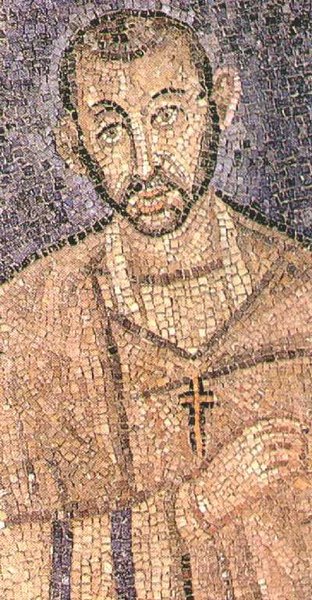
The name was borne by a 4th-century Christian saint, a contemporary of St. Augustine of Hippo. He is considered a Doctor of the Church and the patron saint of Milan.

As of 2010, its French form of Ambroise was the 391st most popular male name in France.

The designated name-day is December 7.

There is a feminine version as well, Ambrosia, and in Greek mythology, it is borne by the daughter of Atlas and Pleione. It was also the name of the food of the gods eaten on Mount Olympos.

Other forms of the name include:

  • Ambrozi (Albanian)
  • Ambrosiu (Asturian)
  • Anbortsi (Basque)
  • Ambroaz (Breton)
  • Amvrosij Амвросий (Bulgarian/Russian/Ukrainian)
  • Ambròs (Catalan)
  • Ambrosgiu (Corsican)
  • Ambrozije (Croatian)
  • Ambrož (Czech/Slovene)
  • Ambroos (Dutch)
  • Broos (Dutch/Limburgish)
  • Ambroise (French)
  • Ambros (German/Romansch)
  • Ambrosios Αμβροσιος (Greek)
  • אמברוזיוס Ambrwzyws (Hebrew)
  • Ambrus (Hungarian)
  • Ambrósíus (Icelandic)
  • Ambróis (Irish)
  • Bosone (Italian: obscure)
  • Ambrogio/Ambrogino (Italian: more common forms)
  • Ambrosino (Italian: obscure)
  • Ambrosi (Kiswahili)
  • Ambrosius (Late Latin/Danish/Dutch/Finnish/German/Estonian/Norwegian/Swedish)
  • Ambrozijs (Latvian)
  • Ambraziejus (Lithuanian)
  • Ambroeus (Lombard)
  • Ambroży (Polish)
  • Ambrósio (Portuguese)
  • Ambrozie (Romanian)
  • Ambrosi(Romansch)
  • Ambròsu (Sardinian)
  • Ambroggiu (Sicilian)
  • Ambróz (Slovakian)
  • Ambrosio (Spanish/Galician/Italian/Venetian)
  • Emrys (Welsh)

Feminine forms include:

  • Ambroisine/Ambrosine (French)
  • Ambrogia/Ambrogina (Italian)
  • Ambrosina (Italian)
  • Ambrosia (Greek/Italian)
  • Ambrozja (Polish)
  • Ambrozija (Slovene)

Celestine

Gender: Masculine (English); Feminine (French)
Origin: Latin
Meaning: ” of the sky; of the heavens.”
Eng (sel-es-TINE; SEL-es-tin); Fre Masc (say-les-TEN); Fre Fem (say-les-TEEN)

The name is derived from the Late Latin male name, Caelestinus, meaning, “of the sky; of the heavens.”

In English, the name was anglicized to Celestine while in French, Célestine was always strictly the feminine form, the French masculine form being, Célestin.

The name was borne by five popes.

In the English-speaking world, Celestine was seldom used, if it was ever used it was usually used for females being a borrowing from the French, though Celestine is a common male name among Nigerian Catholics.

As of 2010, Célestin was the 415th most popular male name in France, while its feminine form of Célestine was the 419th most popular female name in France.

Other forms of the name include:

  • Celestin Целестин Целестин (Asturian/Bulgarian/Romanian/Romansch/Russian/Scandinavian/Serbian/Ukrainian)
  • Celestí (Catalan)
  • Celestýn (Czech)
  • Celestijn (Dutch)
  • Celestinus (Dutch)
  • Celestine (English)
  • Célestin (French)
  • Celestino (Galician/Italian/Portuguese/Spanish)
  • Coelestin (German)
  • Cölestin (German)
  • Zölestin (German)
  • Kelestínos Κελεστίνος (Greek)
  • Celesztin (Hungarian)
  • Caelestinus (Late Latin)
  • Celestinas (Lithuanian)
  • Celestyn (Polish)
  • Celestìnu (Sardinian)
  • Celestín (Slovene)
A famous female bearer was Célestine Galli-Marié (1840–1905), a French mezzo-soprano who created the title role in the opera Carmen
La Celestina, a 15th-century literary piece written by Fernando de Rojas, is considered one of Spain’s greatest pieces of literature.
Celestina is also the name of an 18th-century literary piece written by poet, Charlotte Turner Smith.
Other feminine forms include:
  • Celestina Целестина (Czech/English/Italian/Lithuanian/Portuguese/Romanian/Romansch/Russian/Slovak/Spanish)
  • Célestine (French)
  • Cölestina (German)
  • Zölestina (German)
  • Celesztina (Hungarian)
  • Celestyna (Polish)
  • Kolestina Колестина (Russian)

Celestine is also the name of an order of Benedictine monks and it is also the name of a type of mineral.