Rhys

220px-Rice_ap_Gryffydd,_Prince_of_Wales

Rhys ap Gruffydd


A classic masculine Welsh name, it was borne by 2 early Welsh rulers, Rhys ap Tewdwr who died in the battle of Brecon (1040-1093) and his grandson Rhys ap Gruffydd (1132-1197), who fought against the invading Normans.

The name is derived from the Old Welsh rīs which means “passion, ardor, fiery, enthusiasm.”

The name is borne by several other historical Welsh personages and has spun the surnames of Price (son of Rhys) and Rice. It is sometimes anglicized as Reece or Reese.

Rhys is currently the 464th Most Popular Male Name in the United States (2018) and the 196th Most Popular in England & Wales (2018).

Its anglicized offshoot of Reece currently ranks in as the 599th Most Popular Male Name in the United States (2018) and the 326th Most Popular Male Name in England & Wales (2018), whereas Reese is the 659th Most Popular Male Name.

The name is currently borne by British actor, Rhys Ifans.

Sources

Minnie


320px-MinnieDriverJan2011


The name is a diminutive offshoot of any name beginning or containing the -min element, though it is mostly popular linked with Wilhelmina, Minna & Minerva. It was one of the most popular female names at the turn of the 20th-century, appeared in the Top 10 Most Popular Female Names in the United States between 1880-1891, peaking at #5 between 1880-1886. The name finally fell off the charts in 1971 and has not been seen since.


In the U.K, it is currently climbing the charts, Minnie is currently the 285th Most Popular Female Name in England & Wales (2018).


The name was also common in other Germanic & Northern European countries during the turn of the 20th-century.


It’s popularity may have dropped after the introduction of the Disney Character, Minnie Mouse in 1928.


Other forms include:

  • Minni (Finnish)
  • Minný (Icelandic)

A notable modern bearer is Minnie Driver (b. 1970).


Sources

Zahava, Zehava,

Gustave Klimt

  • Origin: Hebrew זֶהָבָה
  • Meaning: “gold”
  • Gender: Female

The name is derived from the Hebrew word זָהָב zahav, meaning “gold.” The name was created in the 1940s after the creation of the State of Israel. The older Yiddish traditional female name of Golda may have been an inspiration.

Another form is Zahavit.


Sources

Rufus, Rufina

220px-William_II_of_England

King William II


The name comes directly from the Latin word meaning “red-headed.” It was a common Roman cognomen and was borne by a man who is referenced in Romans 16:13 and another who is referenced in Mark 15:21. According to Eastern Orthodox tradition, the aforementioned are one and the same person and is venerated as one of the Seventy Disciples mentioned in the Gospel of Luke. He is also popularly believed to be the son of Simon of Cyrene.

The name is borne by several other saints.

It was the nickname of King William II of England, known as William Rufus III on account of his red-hair.

The name appeared in the U.S. Top 100 2 times, in 1880 & 1882, peaking at #88 in 1880. It remained in the Top 1000 1988.

In England & Wales, the name was the 264th Most Popular Male Name in 2018.

Rufus is used in Dutch, Czech, English, Finnish, German, Latvian, Polish & the Scandinavian languages.

Other forms include:

  • Rufit (Albanian)
  • R’owp’osy Ռուփոսյ (Armenian)
  • Rufess (Bavarian)
  • Ruf Руф (Bulgarian, Catalan, French, Romanian, Russian, Serbian, Ukrainian)
  • Roufaous (Coptic)
  • Rufinus (Dutch, German, Latin, Scandinavian)
  • Ruffe (Finnish)
  • Ruuhva, Ruuhvus (Finnish)
  • Ryffe, Ryyfys (Finnish)
  • Rufin (French, German, Polish)
  • Rhouphon Ροῦφον (Greek)
  • Rúfusz (Hungarian)
  • Ruffo (Italian)
  • Rufillo, Ruffillo (Italian)
  • Rufino (Italian, Portuguese, Spanish)
  • Rufo (Italian, Portuguese, Spanish)
  • Rufinus (Latin)
  • Rufas (Lithuanian)
  • Rupuha (Maori)
  • Rúfus (Slovak)

150px-Santa_RufinaIts feminine form of Rufina was borne by a couple of early saints, one of whom was from Seville, she was a pottery maker who refused to sell her wares for a pagan festival.


Feminine forms include

  • Roufina (Coptic)
  • Rufe (French)
  • Rufine (French)
  • Rufina Руфина (Dutch, English, German, Hungarian, Italian, Polish, Portuguese, Romanian, Russian, Ukrainian, Scandinavian, Spanish)
  • Rufa (Italian)
  • Rufilla (Italian)

Sources

Jemima, Jemimah

800px-Job_and_His_Daughters_Butts_set

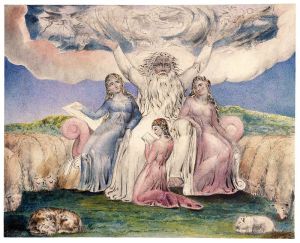
Job & his 3 Daughters by William Blake


The name is mentioned in Job 43:14 as the name of the eldest daughter of Job after his tribulations. It derives from the Hebrew יְמִימָה‎, (Yemimah), meaning “dove.”

As a given-name, it came into popular use after the Protestant Reformation, especially in England, though it appears in occasional use by the 19th-century in Finland, Scandinavia & Protestant parts of Germany and the Netherlands.

Among Jews, this name was never used, though the Yiddish Taube and Toybe (dove) does exist. It is not certain if the latter is used in reference to Jemimah, Jonah or an earlier Medieval German female name that fell out of use among Christians but remained common among Ashkenazi Jews. It should be noted that in some German translations of the Bible, Jemimah is merely referred to as Täubchen (turtledove; also a term of endearment).

It is the same case in other languages where the passage in which the name appears is translated literally as Columba (Italian), Touterelle (French), Dies (Vulgate Latin translation) & Täuberl (Bavarian).

The name was quite common in England and Colonial America in the 18th-century. It was borne by the daughter of Daniel Boone, who is famous for being captured by Native Americans in 1776. Other early notable bearers include Jemima Yorke, 2nd Marchioness Grey and Countess of Hardwicke (1723-1797); Scottish painter, Jemima Blackburn (1823-1901); and Irish writer, Baroness Jemima von Tautphoeus (1807-1893). It was the birth name of the non-binary Quaker preacher known as the Public Universal Friend (1752-1819) https://en.wikipedia.org/wiki/Public_Universal_Friend (interesting story).

Today, in the United States the name has somewhat loaded racial connotations, due to its associations with ‘Aunt Jemima’ (see https://en.wikipedia.org/wiki/Old_Aunt_Jemima)

However, in England, the name has remained a posh favourite. It is currently borne by British actress, Jemima Kirke (b. 1985).

The name is also a common favorite in many African countries.

Currently, Jemima is 297th Most Popular Female Name in England & Wales.

Common English short forms are Mima, Mimi, Jem, Jemmy.


Other forms include:

  • Emima Емима (Bulgarian, Russian)
  • Jemima (Czech, Dutch, English, German, Scandinavian)
  • Jemimah (English)
  • Mima (English)
  • Jemina (German, Finnish, Polish, Scandinavian, Spanish)
  • Jémina (French)
  • Gemima (Italian)
  • Jémima (Hungarian, Icelandic)
  • Jamima (Lithuanian)
  • Hemaima (Maori)
  • Yemima יְמִימָה (Modern Hebrew)
  • Iemima (Romanian)
  • Jamina (Scandinavian)
  • Jemine (Scandinavian)
  • Jemi (Scandinavian)

Sources

Zikra

download


  • Origin: Arabic ذكرى
  • Meaning: “memory; recollection; thoughts of the past; remembrance.”
  • Gender: feminine
  • (ZEEK-ruh, THEEK-rah)

The name can either be pronounced with a z or th sound depending on the dialect of Arabic. It is sometimes used in reference to al-Dikr, (remembrance of Allah), which is mentioned by the Islamic scholar Ibn Hajar al-Askalani as being the name of one of the seven gates of Jannah.

The name was borne by Tunisian pop-singer, Thekra (1966-2003).


Other forms and transliterations include:

  • Dekra, Dhikra, Dikra
  • Zaakirah (ZAH-kee-ruh)
  • Zekra
  • Zikraa (zee-KRAH)
  • Thikra, Thekra

Sources

Cathasach

Tara_stone

Tara Stone


  • Origin: Irish-Gaelic
  • Meaning: “vigilant.”
  • Gender: Masculine
  • Pronunciation: KATH-e-Sakh

The name is derived from the Gaelic word for “vigilant,” and was a relatively common name in Medieval Ireland. It was borne by a 7th-century Irish king of Ulster. It is sometimes spelled as Cathassach. Today it is very rare but its legacy has been left behind in the surname of Casey (meaning descendant of Cathesach), which is also sometimes used as a unisex given-name in the English-speaking world, though it is not recommended.


Sources

Rudy, Rudolph, Rolf

200px-Rudolf_IV


  • Origin: German
  • Meaning: “famous wolf.”
  • Gender: Masculine

The name is derived from the Germanic Hrodulf, which is composed of the elements hrod (fame) and wulf (wolf). The name was borne by several European rulers.

In England, it has been in use since Anglo-Saxon times, its Anglo-Saxon form of Hroðulf was usurped by the Norman Rudolph and Rodolph in the 11th-century.

In the English-speaking world, the name has come to be associated with the Christmas folk hero, Rudolph the Red-nosed Reindeer, based on a children’s book written by Robert L. May in 1939.

Rudolf appeared in the U.S. Top 1000 between 1887-1932, and peaked at # 715 in 1916. He appeared 3 times in the French Top 1000 in 1914, 1931 and again in 1933, peaking at #454 in 1934. He was in the German Top 20 between 1893 and 1936, peaking at #11 in 1899 and in 1916.

In France, it’s native form of Rodolphe appeared in the Top 1000 between 1900 and 2001 and peaked at #79 in 1970.

Its contracted form of Rolf has been in occasional use in England since the 11th-century. It was a favorite in German-speaking countries in the 1920s-50s, peaking at #11 in 1947. In Norway, it peaked at #14 in 1945. Rolf has also appeared in the American and French charts, though not very high. Rolf peaked at #210 in France in 1943 and #772 in 1960 in the U.S.

It his diminutive form of Rudy, often used as an independent given-name, is the one which has gained some traction in recent years. Rudy appeared in the French Top 100 between 1979-1984, and peaked at #76 in 1980. Rudy’s current rankings in the popularity charts are as follows:

  • #271 (England & Wales, 2018)
  • #822 (U.S.A., 2018)

Rudolf is used in Albanian, Armenian, Czech-Slovak, Dutch, Hungarian, Icelandic, Polish, Serbo-Croatian, Slovene, the Scandinavian languages and Russian.

Other forms include:

  • Hroðulf, Hrothulf (Anglo-Saxon)
  • Roel, Roelof, Ruud (Dutch)
  • Rodolf (Catalan)
  • Rolph (English)
  • Rudo, Ruudo, Ruudolf (Estonian)
  • Róðolvur (Faroese)
  • Ruuto, Ruutolffi, Ruutolhvi, Ruutolppi (Finnish)
  • Rodolphe (French)
  • Roele, Roelef, Roelf, Rolef, Rolof, Roloff, Roluf, Roolof (Frisian)
  • Rudolp რუდოლფ (Georgian)
  • Roff (German)
  • Rudi (German, Hungarian, Serbo-Croatian, Slovenian)
  • Rudo (German)
  • Rul (German)
  • Rûtulfe, Ruutuulfi (Greenlandic)
  • Rhodólphos Ροδόλφος (Greek)
  • Rúdólf (Icelandic)
  • Rodolfino (Italian)
  • Rodolfo (Italian, Portuguese, Spanish)
  • Ridolfo (Italian)
  • Rudolphus (Latin)
  • Rūdolfs, Rūdis (Latvian)
  • Rudolfas, Rudas (Lithuanian)
  • Doffen (Norwegian)
  • Roffe (Norwegian, Swedish)
  • Hróðólfr, Hrólfr (Old Norse)
  • Rudulf (Polish, archaic)
  • Duff, Dusch, Riedi, Ruosch (Romansch)
  • Ruedi (Swiss-German, diminutive form, occasionally used as an independent form)

Feminine forms include:

  • Rudolfia (Danish, Norwegian)
  • Rodolphine (French)
  • Rudolfine (German, Scandinavian)
  • Rodolfa, Rodolfina (Italian, Spanish)
  • Rodolfetta (Italian)
  • Rudolfa (Polish, Scandinavian)
  • Rudolfina (Hungarian, Polish, Scandinavian)

Sources

Liyana

220px-Liyana_film_poster


The name can be derived from the Arabic root L-Y-N لَيِّن meaning “softness, tenderness.” لِيانَةٌ is pronounced the same as Liana, which sounds the same but is not related, though it may sometimes be transliterated as such. It is essentially a variation of Layyan. Other transliterations include: Liyanna, Liyane, Liyanah, Liyyana, and Liyyanah.

The name is also Zulu and means “it’s raining.” It was recently the subject of a 2017 documentary recounting the struggles of several Swazi orphans, one of whom is a girl named Liyana. The name is usually given to girls born while it is raining.

Liyana can also be Erzya meaning, “unique, different, not like the others,” or derive from the Erzya word, liyaanaz (flax).

Currently, Liyana is the 298th Most Popular Female Name in England & Wales & the 227th Most Popular in the Netherlands (2018).


Sources