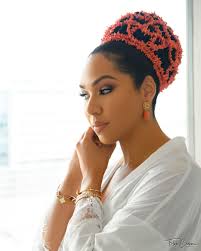
Uzma

Model-Uzma-Khan-Biography-and-Pictures-12

Uzma Khan, Pakistani Model & Actress


  • Origin: Arabic عظمیٰ
  • Meaning: “Greatest; supreme; more magnificent; more glorious.”
  • (OOZ-mah)

The name is Arabic and means “the greatest; supreme; more magnificent; more glorious.” It is a relatively popular name among Indian Muslims and Pakistanis.

The name is borne by Pakistani model and actress, Uzma Khan (b.1987).

Sources


Penny, Pennie

Pennies


The name can either be a diminutive offshoot of Penelope or Pernille. The name was already in use as an independent female name in England by the 1640s. Its use may have been influenced by the currency.

Currently, Penny is 198th most popular female name in England & Wales & the 754th most popular in the U.S.A (2018). In the U.S., Penny peaked at #86 in 1963. She appeared in the Swedish top 100 between 2016-2017, peaking at #81 in 2016.

The name has also been in use in Scandinavian countries and Finland since the 19th-century. A Faroese form is Penný.

The name is borne by British model Penny, Lady Stewart Landcaster (b. 1971); and American actress and director, Penny Marshall (1943-2018).

Sources

Vaia, Vayia, Vaios

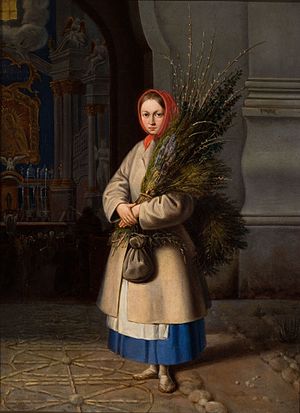
Lithuanian_Girl_with_Palm_Sunday_Fronds.jpeg

  • Origin: Greek Βάια, Βάγια, Βάιος
  • Meaning: “palm branch.”
  • VYE-ah, VYE-ose

The names are derived from the Greek βάϊς (vais) “palm leaf.”

Vaia, Vayia Vaïa and sometimes even transliterated as Vagia, is a Greek female name used on babies born on Palm Sunday. It’s masculine form is Vaios.

Sources

Primrose

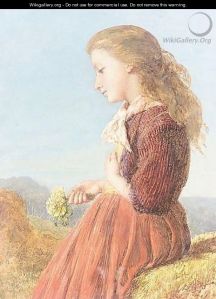
painting1

Primroses by Henry Le Jeune


From the common name of the flowering plant known as the Primula vulgaris, it derives from the Latin prima rosa (first rose) due to the fact the plant is known to flower very early in the spring.

Primroses are endemic across Western Europe and it is said to be the favorite flower of British statesman, Benjamin Disraeli, hence Primrose Day on April 19th. It is also the county flower of Devon, England.

As a given-name, the earliest record I could find was a christening record for a Primrose Barsten of Gloucester, England in 1624. There are 3 other records found for Primroses in 1628, 1631 and in 1676. There are also a few records for male Primroses, both as a middle name and first, between the 1700s-1800s. In the latter case, it was probably used in reference to the surname of the Earls of Rosebery in Scotland. Sir Archibald Primrose, 1st Earl of Rosebery (1664-1723) was a Scottish politician and 1st Earl of Rosebery to be inducted into the Peerage of Scotland in 1700. In this case, the surname is most likely derived from the Welsh elements pren (tree) & rhos (moore).

By the 1800s, there are numerous records for Primroses, most commonly as a middle name, among females christened in London.

The name is not unheard of among British upper classes, in England & Wales, it is currently the 213th most popular female name in 2018.


Sources

Rex

a-little-prince-likely-in-time-to-bless-a-royal-throne-edmund-blair-leighton (1)

A Little Prince Likely In Time To Bless A Royal Throne by Edmund Blair Leighton


The name was traditionally a diminutive form of Reginald until the turn of the 20th-century when it spun-off as an independent given name in the English-speaking world. Its use was inspired by the Latin word rex (king).

It has been in the U.S. Top 1000 since 1880 and peaked #194 in 1933, it is currently the 637th most popular male name in the United States (2018) and ranks even higher in England & Wales, coming in as the 158th most popular male name (2018).

Notable bearer include American playwright & novelist, Rex Beach (1877-1949) British actor, Rex Harrison (nee Reginald), 1909-1990 & 69th Secretary of State, Rex Tillerson (b. 1959).


Sources

Vala

Velléda_contemplant_la_demeure_d'Eudore,_29_March_2016

Detail of a sculpture of the Germanic seeress Veleda, Hippolyte Maindron, 1844

  • Origin: Old Norse
  • Gender: feminine

The name is Old Norse and can either be derived from the Old Norse vǫlva meaning “fortune-teller, prophet,” or a short form of any Norse name beginning in the Valr element, which might relate to valr “slain” as in Valhalla (hall of the slain) or the Old High Germanic, walah meaning foreigner; stranger”; later “Welsh.”

The name’s use was first recorded in Sweden in 1876, but may have been used in Norse times as well.

Another form is Valva.


Sources

Bodhi

800px-A_small_temple_beneath_the_Bodhi_tree,_Bodh_Gaya,_c._1810

18th-Century Depiction of the Bodhi Tree, Courtesy of the British Museum


The name is a traditional unisex name used in India and  is also a unisex name used among Buddhists in general. It is from the Sanskrit word बोधि (bodhi) meaning, “enlightenment.” It ultimately derives from the verbal root budh- meaning “to awaken.”

In India, the Bodhi tree is an ancient fig tree that is traditionally believed to be the place under which Siddhartha Gautama obtained enlightenment.

In the Western world, the name recently came into popular use, mainly among boys. It has become commonplace among non-Buddhist families of non-Asian descent. Its usage is most likely influenced by its similarity to other similar sounding surnames-turned-first names, such as Body and Brody; the popularity and interest in Eastern religions; and also due to it being used as the name of a character in the Star Wars franchise, Bodhi Rock.


Currently, Bodhi is the 69th Most Popular Male Name in Canada (B.C.) in 2018. His rankings in other countries are as follows:

  • #75 (New Zealand, 2018)
  • #93 (Australia, NSW, 2018)
  • #188 (England & Wales, 2018)
  • #213 (the Netherlands, 2018)
  • #314 (USA, 2018)

Sources

Barnabas, Barnaby, Barney

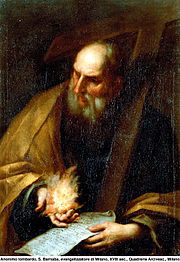
180px-San_Barnaba


The name is borne by St. Barnabas, a companion of St. Paul who was instrumental in converting gentiles to the new Christian faith. St. Barnabas was believed to be a Cypriot Jew whose true name was Joseph but he is referred to as Barnabas in Acts 4:36, which describes the name to mean “son of consolation,” possibly being linked with the Aramaic בר נחמה, bar neḥmā of the same meaning. Many linguists contradict this meaning and claim that the latter part of the name might actually be derived from the Hebrew nabī נביא meaning “prophet.”

St. Barnabas is considered an early apostle and the founder of the Christian Church in Cyprus who was eventually stoned to death by an angry mob in Syria. He is considered the patron saint of Cyprus and his feast day is June 11th.

As a given-name, Barnaby has been the preferred form in England since medieval times. Its usage spread to the rest of the English-speaking world through colonialism. It spawned the diminutive off-shoot of Barney, which has been used as an independent given-name in its own right.

To millennials, Barney is often associated with the beloved purple dinosaur of their childhood. However, he appeared in the U.S. Top 1000 between 1880-1976. Never a huge hit, the highest he ever ranked in the U.S. Charts was #201 in 1887. He hasn’t been seen in the charts since 1976, but in England & Wales he currently ranks in as the #492nd Most Popular Males Name (2018).

Barnaby is currently the 251st Most Popular Male Name in England & Wales (2018). Whereas Barnabás is currently the 32nd Most Popular Male Name in Hungary (2018).


Other forms include:

  • Barnabana برنابا (Arabic, Persian)
  • Barnabas Բառնաբաս ബർണബാസ് (Armenian, Coptic, Dutch, English, Finnish, Frisian, German, Greek, Icelandic, Latvian, Lithuanian, Malayalam, Scandinavian, Syriac, Welsh)
  • Bernaba (Basque)
  • Varnáva Варна́ва (Bulgarian)
  • Bernabé (Catalan, Portuguese, Spanish)
  • Barnaba ბარნაბა (Croatian, Georgian, Italian, Polish, Romanian, Slovenian)
  • Barnabáš (Czech/Slovak)
  • Barnaby (English, Plattdeutsch)
  • Barnabé (French)
  • Balló (Hungarian)
  • Barna (Hungarian)
  • Barnabás (Hungarian)
  • Barnabà (Lombard)
  • Varnava Варнава (Macedonian, Serbian, Russian, Ukrainian)

An obscure Spanish feminine form is Bernabea.

Sources

Wuraola

Waraola


  • Origin: Yoruba
  • Maning: “gold wealth.”
  • Gender: feminine

The name is composed of the Yoruba elements wúrà (gold) and öröôlá (wealth). The name was borne by Nigerian feminist and politician, Waraola Esan (1909-1985).

Sources

Marcus, Mark

Il_Pordenone_-_San_Marco_-_Budapest


From one of the most common Roman praenomen, its origin and meaning is uncertain. A popular etymology is that it relates to Mars, others suggest it may be from the Etruscan Marce, which may come from mar (to harvest). It is said the name was originally bestowed on those who were born in March.

Marcellus and the name of the month of March likely shares the same etymological root.

It was borne by several notable Romans, including Mark Antony, Marcus Aurelius & Cicero.

It was the name of one of the Evangelists who authored the eponymous Gospel, known as St. Mark in the Christian world, he is revered as the founder of Christianity in Africa and is traditionally believed to have founded the Church in Alexandria. Coptic Christians hold him in high regard. His bones were smuggled out of Egypt in a barrel of pork fat by Venetian merchants from Alexandria when Egypt fell under Islamic rule and were transported back to Venice where they were eventually installed and dedicated in the Basilica of San Marco.

The name was borne by a 2nd-century pope as well.


Marcus, Mark and Marc have been quite popular in several countries. Marcus was in the U.S. Top 100 between 1970-2000, Sweden’s between 1998-2008, New Zealand’s between 2008-2014, England & Wales between 1996-2003, and in Denmark’s between 1994-2006. Currently, his rankings in other countries are as follows:

  • #54 (Canada, BC, 2018)
  • #87 (Australia, 2018)
  • #100 (Norway, 2018)
  • #209 (United States, 2018)
  • #213 (France, 2018)
  • #236 (England & Wales, 2018)
  • #406 (Netherlands, 2018)

Its latinate form of Marco, which started off as a mainly Italian form, became widespread across the continent. His rankings in the following countries are as follows:

  • #11 (Galicia, Spain, 2018)
  • #16 (Spain, 2018_
  • #23 (Italy, 2018)
  • #65 (Catalonia, Spain, 2018)
  • #81 (Portugal, 2018)
  • #358 (United States, 2018)
  • #436 (England & Wales, 2018)
  • #446 (France, 2018)

It’s English form of Mark appears in the legend of Tristan & Isolde as the name of the King of Cornwall, supposedly the name was not common in the English-speaking world until the 19th-century, but became a hit by the Mid-1900s. Mark appeared in the U.S. Top 100 between 1944-2002, which is quite a long stretch. Mark peaked the highest in popularity between 1955-1970, peaking at #6, six years in a row between 1959-1964.  Marks’s rankings in other countries are as follows:

  • #5 (Slovenia, 2018)
  • #6 (Moscow, Russia, 2018)
  • #21 (Hungary, 2018)
  • #83 (Ireland, 2018)
  • #210 (U.S., 2018)
  • #253 (England & Wales, 2018)
  • #298 (the Netherlands, 2018)

Marc is the French, Catalan & Welsh form and has been popularly used in the English-speaking world, it is currently the most popular male name in Catalonia, 2018 and between 1968-1976 it was in the U.S. Top 100. Marc’s rankings in the popularity charts are as follows

  • #26 (Spain, 2018)
  • #313 (France, 2018)
  • #825 (US, 2018)

Other forms of the name include:

  • Mark Марк (Albanian, Belarusian, Breton, Dutch, English, Maltese, Russian, Ukrainian)
  • Marḳos ማርቆስ (Amharic)
  • Marqus مَرْقُس‎ (Arabic, mainly used among Arab-Christians)
  • Marghos (Armenian)
  • Marko (Basque)
  • Marko Марко (Bosnian, Bulgarian, Croatian, Finnish, Macedonian, Serbian, Slovene, Ukrainian)
  • Markos Μαρκος Ⲙⲁⲣⲕⲟⲥ (Coptic, Greek)
  • Margh (Cornish)
  • Marcu (Corsican, Romanian)
  • Mokus (Croatian, Serbian)
  • Marek (Czech, Polish, Slovak)
  • Marco (Catalan, Dutch, Galician, German, Italian, Portuguese, Spanish)
  • Marc (Catalan, French, Occitanian, Welsh)
  • Marcus (Dutch, English, German, French, Scandinavian)
  • Markus (Dutch, Estonian, Faroese, Finnish, Frisian, German, Scandinavian)
  • Marghus (Estonian)
  • Markko, Markku (Finnish)
  • Marke (Finnish)
  • Marcas (Gaelic)
  • Marx (German, archaic)
  • Maleko (Hawaiian)
  • Márk (Hungarian)
  • Markús (Icelandic)
  • Marchino (Italian)
  • Marcolino (Italian)
  • Marcuccio (Italian)
  • Mareks (Latvian)
  • Marks (Latvian)
  • Markuss (Latvian)
  • Markas, Morkus (Lithuanian)
  • March (Lombard)
  • Markys (Manx)
  • Marquét (Poitvin, diminutive form)
  • Marcos (Portuguese, Spanish)
  • Kusi (Swiss-German diminutive form)
  • Marqōs ܡܪܩܘܣ‎ (Syriac)
  • Mår (Walloon)

It’s feminine forms include Marca but and sometimes Marcia was used as a feminine form, though it is more the feminine equivalent of Marcius.

Other feminine forms include:

  • Markusine (German, obscure)
  • Marchina (Italian)
  • Marcolina (Italian)
  • Marcuccia (Italian)

Sources