Adonis, Adonija, Adonise

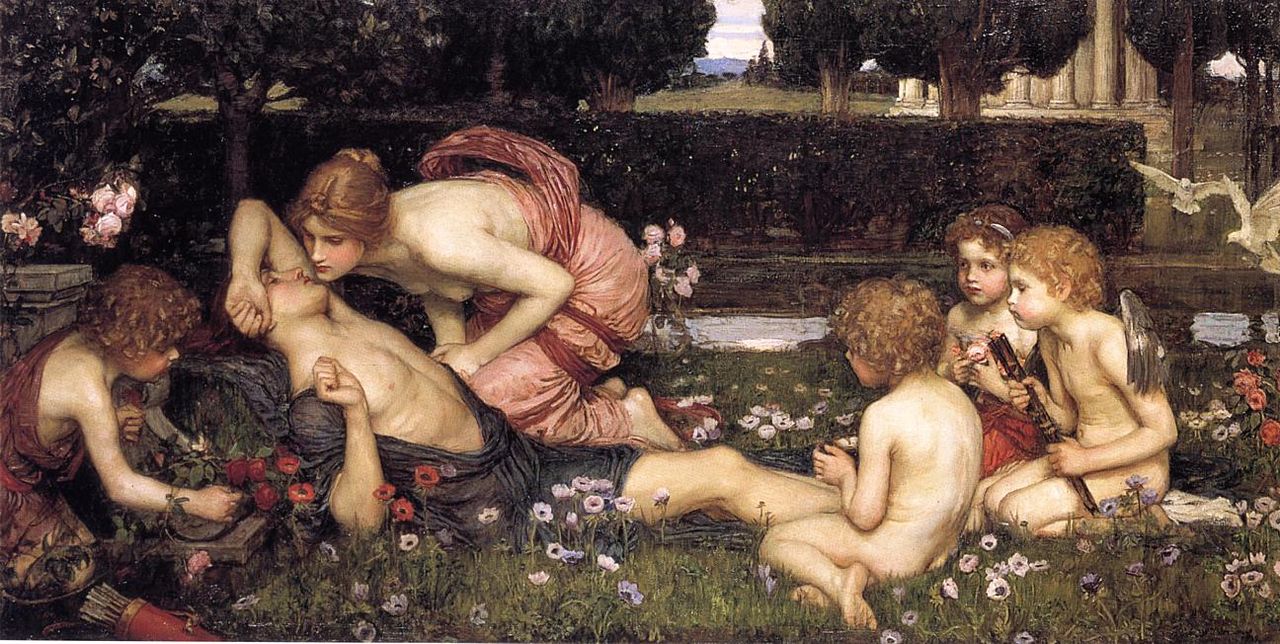
Adonis is borne in Greek mythology by the god of beauty and desire. According to the most popular myth, he was born of the incestuous union of Theias and his daughter Myrrha. Myrrha had tricked her own father into having sex with her. The gods transformed Myrrha into a myrrh tree after Theias attempted to kill her whilst pregnant with Adonis. Adonis was beloved of Aphrodite and mothered by Persephone, but he was subsequently killed by a boar when Artemis, or in some versions, Ares, sent a boar to kill Adonis out of jealousy. When Adonis died, Aphrodite cried tears which mingled with Adonis’ blood, producing the Anemone flower. Aphrodite instituted the Adonia festival in his commemoration, whereby all women had a mass mock funeral of Adonis by growing plants in potsherds on their rooftops and performing a mass funeral ritual as soon as the plants sprouted.

It is likely Adonis was imported by the Greeks from the Phoenicians, the latter being the descendants of the Sumerians, Mesopotamians & Babylonians. It is believed by most scholars that Adonis is an adaptation of the Sumerian story of Dumuzid & Inanna (later Tammuz & Ishtar), in which a ritual funeral rite was also performed by women across the former Babylonian empire. Adonis itself is a Hellenized form of the Canaanite, adon, which means “lord” and was often used as an appellation by the Canaanites for the god Tammuz. The Jews adopted this appellation for Yahweh in the form of Adonai (my lord).

Adonis is borne by an 8th-century French saint of Vienne. He is also listed as Adon & Ado. Adonis has sporadically been used as a given-name in Greece, anglophone, francophone & hispanophone countries. The French feminine off-shoots, though rare these days, are Adonise (AH-do-NEEZ) and Adonie, and were actually prevalent in 18th-centurry Quebec & New Orleans. An obscure Italian feminine form is Adonella.

There is the male Biblical Hebrew name, Adonijah meaning (my lord is Yahweh). It is borne by a son of King David and was Hellenized in the Septuagint as Adonias.

Other forms include:

  • Adonies (Catalan)
  • Adonia (Dutch, Italian, Swedish)
  • Adonija Адония (French, German, Russian)
  • Adonias Αδωνίας (French, Greek, Portuguese)
  • Adonías (Galician)
  • Adonja (Norwegian)
  • Adoniasz (Polish)
  • Adonías (Spanish)
  • Adoniya Адонія (Ukrainian)

Currently, Adonis is the 242nd most popular male name in the United States and the 461st most popular in France.

Other forms include:

  • Adonisi ადონისი (Albanian, Georgian)
  • Adonis Адонис Адоніс Άδωνις Ադոնիս (Armenian, Bosnian, Bulgarian, Croatian, Dutch, English, Estonian, French, Macedonian, German, Greek, Polish, Romanian, Russian, Ukrainian, Scandinavian, Serbian, Slovene, Spanish, Turkish)
  • Adónis Адо́ніс (Belarusian, Continental-Portuguese, Czech, Slovak)
  • Adó (Catalan)
  • Adónisz (Hungarian)
  • Adone, Adon (Italian)
  • Adônis (Brazilian-Portuguese)
  • Adón (Spanish)

Sources

Javid, Javed

  • Origin: Persian جاوید
  • Urdu: جاوید
  • Punjabi: : ਜਾਵੇਦ)
  • Meaning: “eternal; immortal.”
  • Gender: masculine

The name is derived from the Persian جاود (Javid), meaning “eternal, immortal.”

The name was borne by Azerbaijani poet and playwrite, Huseyn Javid (Hüseyn Cavid) 1882-1941.

Other forms include:

  • Cavid (Azeri/Turkish)
  • Dzhavid Джавид (Chuvash)
  • Javidi ჯავიდი (Georgian)
  • Yavid (Spanish)
  • Javaid جاوید (Urdu)
  • Jawed جاوید (Urdu)

Sources

Masuma

  • Origin: Arabic معصومة
  • Meaning: “innocent; sinless.”
  • Gender: feminine
  • Pronunciation: MAH-soo-mah

The name is from the Arabic word meaning “innocent; sinless.” It was the sobriquet of a Shia Muslim saint by the name of Fatimah bint Musa, known as Fatimah al-Masumah (circ. 7th-century CE). She was the daughter of the seventh Twelver Shi’a Imam, Musa al-Kadhim and the sister of the eight Twelver Shia Imam, Ali al-Rida. Her shrine, which is located in Qom, Iran, is an important point of pilgrimage for many Shi’a Muslims.

The name was also borne by Masuma Sultan Begun (d. 1509), the Queen Consort of the Ferghana Valley & Samarkand & the fourth wife of Emperor Babur, founder of the Mughul Dynasty.

A variant transliteration is Massouma.

Other forms of the name include:

  • Məsumə (Azeri)
  • Masoumeh معصومه (Persian)
  • Masume (Turkish)

Sources

Rawda(h), Ravza

Photo by Brianna Martinez on Pexels.com
  • Origin: Arabic روضة
  • Meaning: “garden; meadow.”
  • Gender: Feminine
  • Pronunciation: ROW-dah; Turk (ROW-zah)

Rawdah روضة comes directly from the Arabic word for a “garden” or “meadow.” It is likely used by non-Arab Muslim parents in reference to Rawḍah ash-Sharifah (Arabic: روضة الشريفة‎, lit. ‘The Noble Garden’), which is a place located between the minbar and burial chamber of the Prophet Muhammed in Mecca.

The word itself is not used as a given-name in Arabic-speaking countries, but is used in non-Arabic Islamic countries, such as Southeast Asia and Turkey.

Its Turkish form of Ravza is currently the 78th most popular female name in Turkey. This form is also used among Bosnians & Albanians.

Sources

Rumaysah, Romaïssa

رُمَيْسَة
Photo by Rhyan Stark on Pexels.com

The name seems to be of disputed etymology, but is Arabic in origin. It was the name of Rumaysah bint Milhan known as Umm Sulaym, one of the first women to convert to Islam. Her son was Anas ibn Malik who was one of the companions of the Prophet Muhammed.

The name itself seems to have several meanings attached to it, according to QuranicNames.com, it possibly derives from رُمَيْسَة and mean “wind that scatters like dust.” If spelled رُمَيْثَة (transliterated as Rumaithah) it is the name of a place. It may also be linked with the Arabic root R-M-TH, which can mean “increasing.” Another association is that it is a feminine form of the Arabic male name Rams/Ramth meaning, “raft.”

Other sources have listed it as meaning “bouquet,” but I could not verify this information. If anyone has anymore information regarding the etymology of this name, it would be much appreciated.

Romaïssa (hro-MY-sah) is a North African variation that has been very popular in the Maghreb and in the Maghrebi Diaspora. 

It’s Turkish form of Rümeysa is the 94th most popular female name in Turkey (2019)/

Other transliterated forms include:

  • Romaysa(h)
  • Romeysa
  • Rumaila
  • Rumaisa(h)
  • Rumaitha
  • Rumaysah

Other forms include:

  • Rumejsa (Albanian/Bosnian)
  • Rusejma (Bosnian)
  • Rümeysa (Turkish)
  • Rumeysa (Turkish)
  • Romeesa (Urdu)

Sources

  1. https://quranicnames.com/rumaisah-
  2. https://www.behindthename.com/name/romaissa/submitted
  3. https://www.babynames.co.uk/names/rumaysa/
  4. https://en.wikipedia.org/wiki/Umm_Sulaym_bint_Milhan
  5. https://www.names.org/n/rumaisah/about#pronunciation
  6. https://muslimnames.com/rumaisah
  7. https://hamariweb.com/names/muslim/arabic/girl/rumaisa-meaning_5822
  8. https://de.wikipedia.org/wiki/Umm_Sulaim_bint_Milh%C4%81n
  9. https://www.knjigaimena.com/?znacenje-imena-Rumejsa
  10. http://www.turkstat.gov.tr/PreTablo.do?alt_id=1059

Savaş

220px-Kool_Savas_2010

Kool Savas, German rapper

  • Origin: Turkish
  • Meaning: “war.”
  • Gender: masculine
  • (SAH-vash)

The name comes directly from the Turkish word for war.

In 1991, this was the 67th most popular male name in Turkey.

The name is borne by German rapper, Kool Savas (nee Savaş Yurderi).

Sources

Safwan, Safwana

photo-1507832321772-e86cc0452e9c


Safwan is an Arabic male name which is derived from the Arabic صَفْوَانٍ meaning “rock.” It is used in Quran verse 2:264: Such men are like a rock covered with earth: a shower falls upon it and leaves it hard and bare. (Quran 2:264). It also shares the same root with ‏ صاف؛ (cloudless).


The name was borne by 2 companions (sahabas) of the Prophet Muhammed, Safwan ibn Umayyah صفوان بن أمية‎) (died 661) and Ṣafwān ibn al-Muʿaṭṭal al-Sulamī (صفوان بن المعطل السلمي‎) (d. 638 or 679), the latter is attributed to founding the city of Safwan in Iraq.


A Turkish form is Safvan (Turkish) and it is sometimes transliterated as Safuan.

The feminine form is Safwana.


Sources

Sawda

Sawdah

By Omaislam – Own work, CC BY-SA 4.0, https://commons.wikimedia.org/w/index.php?curid=41784804


  • Origin: Arabic سودة
  • Meaning: uncertain
  • Gender: feminine
  • (SOW-dah)

The name is of uncertain meaning but is believed to be from the Arabic root S-W-D which can mean “blackness” or “large number of palm trees.”

The name was borne by one of the wives of the Prophet Muhammed known as Sawda bint Zama, considered one of the Mothers of Believers. Sawda bint Zama was a widow who married Prophet Muhammed at around the age of 50 to help care for his children.


Other transliterations are Sauda & Saudah.

Other forms include:

  • Seuda (Albanian)
  • Säüdä, Säüzä, Savda Сәүҙә (Bashkir)
  • Sevda (Bosnian)
  • Sawda Савда (Avar)
  • Sawdat Савдат (Chechen)
  • Saudah (Indonesian, Malaysian)
  • Sauda Сауда (Kazakh)
  • Sevde (Turkish)

Sources

Soner

MEV-11989216 - © - Mary Evans Picture Library


  • Origin: Turkish
  • Meaning: “the end; the last.”
  • Gender: masculine
  • (SOH-ner)

The name is derived from the Turkish element son (the end, the last), it was originally used in reference to a last born child. The name was quite popular in Turkey between 1980 & 1996, appearing in the Turkish most popular male names, it peaked at #59 in 1983.

Another form is Sonalp.


Sources

Wafi, Wafiya

The bathing boy painting


Wafi وَافِي is derived from the Arabic root W-F-Y meaning “faithful; loyal.”

In the Ismaili branch of Islam, it was borne by Ahmad al-Wafi, the 8th Ismaili Iman (766-822 CE).

Another form is the Turkish Vâfî.

Wafia and Wafiyaوفيّة  is the feminine form.


Sources