Zuleika, Zuleikha

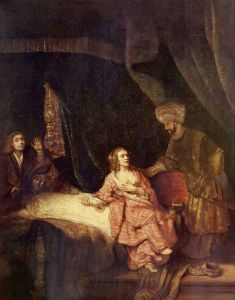
800px-Rembrandt_Harmensz._van_Rijn_065


  • Origin/Meaning: unknown زُلَيْخا זוליכה‎
  • Gender: female
  • (zoo-LAY-kah)
  • Usage: Arabic, Armenian, English, German, Italian, Ladino, Persian, Portuguese – Brazilian, Spanish

The name is of uncertain origin or meaning, since it appears in Muslim and Medieval Jewish tradition as the name of the wife of Potiphar (who is unnamed in the Old Testament), it is often suspected to be of Coptic origin, though the name is not traditionally used among contemporary Copts.

The wife of Potiphar is mentioned in the Bible as trying to seduce Joseph and later falsely claiming he tried to rape her, which leads to Joseph’s unjust imprisonment. In Medieval Islamic tradition, the story was reinterpreted as a popular love story, the subject of much poetry, she is named Zuleikha and her love for Joseph was interpreted by Sufi poets, especially Rumi and Hafez, to represent the longing the soul has for God. Zuleika is also attributed to be her name in the Sefer haYashar, also known as the Book of Jasher, a Jewish midrash of unknown authorship.

In the English-speaking world, the name first came into use in the early 19th-century, it was most likely popularized by Byron’s 1813 poem, The Bride of Abydos, in which it is the name of the heroine. It was also used by the German poet Goethe for his 1810 poem entitled, Book of Zuleika, in his collection of Eastern inspired poems called West–östlicher Divan. It is the name of the eponymous character in the 1911 novel, Zuleika Dobson by Max Beerbohn, which was later adapted into a musical.

The name is also used in Spanish-speaking countries and Brazil.


Other forms include:

  • Zulejka (Albanian, Bosnian)
  • Züleyxa (Azeri)
  • Zuleica (Catalan, Portuguese, Spanish)
  • Zulejha, Zulejka Зуле́йха, Зулейка (Chechen, Russian)
  • Zelikah (Dutch)
  • Zouleïkha (French)
  • Züleyha (Turkish)
  • Zulayho (Uzbek)

Other Arabic transliterations include: Zulaykha and Zulekha.

Spanish diminutives include: Zula & Zuzu.


Sources

Sondos, Sundus

Persian_Silk_Brocade_-_IRI_logo_with_Selvage_-_Pictorial_Brocade,_Picture_Brocade,_Brocade_Tableau_-_Seyyed_Hossein_Mozhgani_-_1981


  • Origin: Arabic سُنْدُس
  • Meaning: “fine silk; fine brocade.”
  • Gender: feminine
  • (SOON-doos; SOHN-dohs)

The name comes directly from the Arabic word for fine silk or a fine brocade.

Others transliterations include Sundes & Sundos.

A Turkish form is Sündüs.


Sources

Yasir, Yasira, Yashira

800px-Jetta_(Bedouin_child)._(Taken_during_the_1904_World's_Fair)


Yasir is a male Arabic name which is derived from the Arabic root y-s-r meaning “ease” or “right-handed.” The name was borne by Yasir ibn Amir (d. 615 C. E.), who is said to be the second martyr in Islam according to Islamic tradition.

Other transliterations include: Yassir & Yasser (Persian) & Yaser (Turkish).

It’s feminine form is Yasira and the Spanish off-shoot of Yashira has been popular in the Caribbean & Latin America since the 1980s. It is unknown how the name evolved and became popular in the Spanish-speaking world.

Other feminine transliterations include: Yacerah, Yacirah, Yacireh, Yaseira & Yassira.


Sources

Tooba, Tuba, Tuğba

320px-Tuba_Tree_-_Carpet_Board_-_Mashhad_Museum


  • Origin: Arabic طُوْبَى
  • Meaning: “bliss; blessedness.”
  • Gender: feminine
  • (TOO-bah)

The name is derived from the Arabic root T-Y-B meaning “bliss; blessedness.” According to an Islamic hadith, this is a tree that grows in paradise.

Another form is Toba.

The city of Touba in Senegal gets its name from the legendary tree.

Other forms include:

  • Touba (Maghrebi-Arabic)
  • Tuğba (Turkish)
  • Tooba (Urdu)

Sources

Adhan, Azaan

429px-Jean-Léon_Gérôme_010


The name is derived from the Arabic root ʾadhina أَذِنَ meaning “to listen, to hear, be informed about,” or ʾudhun (أُذُن), meaning “ear.” The Adhan, sometimes romanized as Azaan, is the name of the Islamic call to prayer, which is rung 5 time a day.

Currently, Azaan is the 406th Most Popular Male Name in England & Wales, (2018). Other transliterated forms include: Adaan, Adan, Adhaan, Athan, Edan & Edhaan.

Other forms include:

  • Ezani (Albanian)
  • Ezan Езан (Albanian, Bosnian, Bulgarian, Kurdish, Turkish)
  • Azan Азан (Azeri, Kazakh, Kyrgyz, Malay, Tatar)
  • Azán Аза́н (Chechen)
  • Adan (Javanese)
  • Aadaan (Somali)
  • Azon Азон (Tajik)
  • Ezane (Zazaki)

Sources

Hashim

The name is most likely derived from the Arabic root H26-SH-M  meaning “breaker or pulverizer.” This was a sobriquet for Hāshim ibn ‘Abd Manāf (circ. 5th-century C.E.) who was the great-grandfather of the Prophet Muhammad and found of the Banu Hashim tribe. Borne ‘Amr al-‘Ulā, ot is said he took this name because he used to break up his bread to share in a broth among pilgrims to Mecca and he is also said to have saved the poeple of Mecca from a famine by breaking up his bread into tiny crumbs.

Another transliteration is Hasheem

Currently, Hashim is the 436th Most Popular Male Name in England & Wales (2018).

Other forms include:

  • HIashim ХӀашим (Chechen)
  • Haysim (Indonesian)
  • Hashem هاشم (Persian)
  • Haşim (Turkish)

Sources

Haidar

  • Gender: Masculine
  • Origin: Arabic
  • Meaning: Lion
  • Pronunciation: (HIE-dar; HAY-der)

From the Arabic حيدر‎; (lion), this was a nickname for the cousin and son-in-law of the Prophet Muhammed, Ali.

Currently, Haider is the 475th Most Popular Male Name in England & Wales (2018).

Variant transcriptions include: Hayder & Hyder.

Other forms include:

  • Hajdar (Albanian/Bosnian)
  • Heydər (Azeri)
  • Heydarحیدر (Persian)
  • Haydar (Turkish)

Sources

Raheem, Rahim

From the Arabic root R-H-M meaning “kind; merciful; compassionate.” The name is used in reference to الرحيم (al-Rahim), which is one of the 99 Names in Islam used to refer to Allah.

Another transcription is Roheem.

Raheem is currently the 465th Most Popular Male Name in England & Wales.

Rəhim is the Azeri form.

Sources

Nora, Nour

1024px-Dawn._Buryatia,_Russia


This multicultural name has recently experienced a revival. In European countries, the name stems from any name ending in the -nora element, such as Honora & Eleanora. In Arabic, Nora is a variant transliteration of Nurah, which is a strictly feminine version of the unisex Arabic name, Nur (light). Nur is used as one of the 99 attributes of Allah, al-Nur (the light).

The name was used by Henrik Ibsen for his main character in his play, A Doll’s House (1878).

Outside of East Asia, there isn’t a counry where Nora is unhead of or is not in use. Nora has been in out of the U.S. Top 100 since 1880! She currently ranks in as the 30th Most Popular Female Name in the United States. Her rankings in other countries are as follows:

  • #2 (Norway, 2018)
  • #10 (Netherlands, 2018)
  • #11 (Hungary, 2018)
  • #14 (Switzerland, 2018)
  • #15 (Denmark, 2018)
  • #20 (Belgium, 2018)
  • #23 (Austria, 2018)
  • #26 (Catalonia, Spain, 2018)
  • #28 (Sweden, 2018)
  • #38 (Canada, BC, 2018)
  • #47 (Spain, 2018)
  • #64 (Norah, Netherlands, 2018)
  • #79 (Bosnia & Herzegovina, 2018)
  • #84 (Norah, Canada, BC, 2018)
  • #85 (Italy, 2018)
  • #119 (France, 2018)
  • #140 (Norah, United States, 2018)
  • #184 (Norah, France, 2018)
  • #197 (England & Wales, 2018)
  • #283 (Norah, England & Wales, 2018)

Its Dutch version of Noor also ranks high in several popularity charts. This name is also used by Muslim families as a variation of Nur. Her rankings in other countries are as follows:

  • #10 (Netherlands, 2018)
  • #25 (Belgium, 2018)
  • #279 (England & Wales, 2018)
  • #311 (France, 2018)

Noortje is another Dutch version which currently ranks in as the 203rd Most Popular Female Name in the Netherlands.

Other forms of its European version include:

  • Nora Нора Νόρα (Bulgarian, Greek)
  • Noera (Dutch)
  • Noor (Dutch)
  • Noortje (Dutch)
  • Norah (Dutch, English, French)
  • Nonie (English)
  • Noreen (English, Irish)
  • Noora (Estonian, Finnish)
  • Nóra Но́ра (Faroese, Hungarian, Irish, Russian)
  • Nuura (Finnish, Scandinavian)
  • Nóirín (Gaelic)
  • Norina (Italian, Provençal, Romansch)
  • Norá (Sami)
  • Norea (Scandinavian)
  • Norena (Scandinavian)
  • Noria (Scandinavian)
  • Norita (Spanish, Scandinavian)

The Arabic Nur is traditionally a unisex name which is popularly used in many Islamic countries. Its Maghrebi form of Nour currently ranks in the following popularity charts for girls:

  • #40 (Belgium, 2018)
  • #48 (Catalonia, Spain, 2018)
  • #48 (France, 2018)
  • #76 (Spain, 2018)
  • #137 (Italy, 2018)
  • #197 (Netherlands, 2018)

Nur is currently the 87th Most Popular Female Name in Bosnia & Herzegovina (2018).

Other forms of the Arabic version include:

  • Noora, Nura (Arabic, strictly feminine)
  • Noura (Maghrebi Arabic, strictly feminine)
  • Núria (Catalan)
  • Nor (Malay, unisex)
  • Nuru (Swahili, strictly feminine)

Sources

Israa, Isra

  • Origin: Arabic
  • Meaning: “night journey”
  • Gender: Female
  • Pronunciation: is-RAH

The name is derived from the Arabic سرى (sara) meaning “to travel at night.” In Islam, it is the the name of the 17th Chapter of the Quran, which outlines the journey the Prophet Muhammad took between Mecca and Jerusalem.

Isra is currently the 181st Most Popular Female name in the Netherlands & the 351st Most Popular in France, while its other transliterated form of Israa is the 433rd Most Popular Female Name in France (2018).

Isra is used throughout the Islamic world, while Israa is usually used in mainly, Arabic-speaking Muslim countries. Another transliteration is Isra’

Other forms include:

  • Isrá (Bashkir)
  • Îsra (Kurdish)
  • İsra (Turkish)

Sources