Hiltrud is a feminine Old High German name formed from hild, “battle,” and drud/þrūð, “strength.”
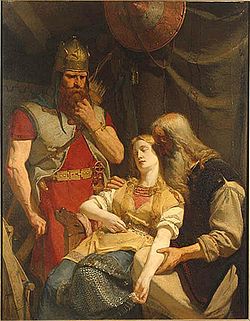
It was borne by two prominent eighth-century figures: Princess Hiltrud of the Franks, daughter of Charles Martel, who married Duke Odilo of Bavaria and later served as regent for their son Duke Tassilo III, and Saint Hiltrude of Liessies, a Frankish noblewoman venerated in northern France and Belgium.
The name remained in use throughout the medieval German-speaking world and saw a modest revival in the late nineteenth and early twentieth centuries, though it is now rare and considered old-fashioned.
In Austria, the designated name-day is September 27th.
Traditional German diminutives and familiar forms include: Hilde, Hildi, Trude, Trudi, and Trudel.
Hiltrud has also occasionally been used in Scandinavian Countries.
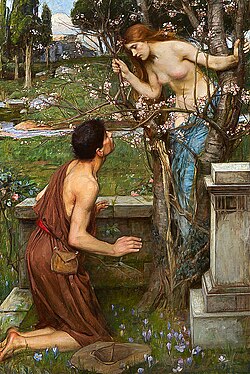
The name appears in Greek mythology. It is connected to a woman who killed herself when her love for Demophon was not returned. She was transformed into an almond or hazelnut tree, depending on the legend. It comes directly from the Greek word, Φυλλίς, meaning, “leaves, foliage,” which shares a root with the words chlorophyll and phyllotaxis. Its Turkish form of Filiz comes from the same root but the meaning slightly changes to “sprout; root.”
It also appears as the name of a minor river god of Bithynia.
It came into widespread use in England in the 16th-century and later spread to the rest of the Anglosphere.
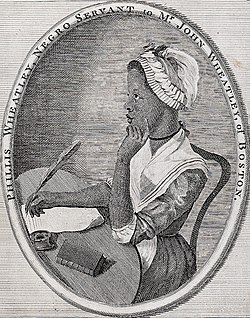
Early Puritan records occasionally include Phyllis/Phillis, reflecting classical learning even among settlers. Phillis Wheatley (1753-1784), the first published African-American female poet, is a striking historical bearer.
An 18th-century English short form was Lissie or Lissy.
It frequently appears in Elizabethan and Restoration poetry and drama. Poets such as Ben Jonson and Andrew Marvell used “Phyllis” as a stock name for a beloved in pastoral verse. Later modernists like Ezra Pound continued this tradition. This usage helped keep it familiar to English speakers for centuries.
It marked its presence in baroque operas (e.g., Handel’s Acis and Galatea includes a character named Phyllis) and in folk songs of the British Isles.
Victorian painters of the Pre-Raphaelite school sometimes chose the Phyllis and Demophon story for mythological canvases.
In the United States, it appeared in the Top 100 Female Names between 1915-1958, peaking at #24 in 1929. In the U.K., it came in at #14 in 1914, #4 in New Zealand in 1911, and #29 in 1922 in Canada.
Its Turkish offshoot of Filiz appeared in the Turkish Top 100 between 1980-1996, peaking at #11 between 1980-1982.
Today, the name is considered dated in the English-speaking world.
Phillyda, pronounced /ˈfɪl.ɪ.də/ in English is an alternate form.
Örvar (modern spellings often drop the umlaut to Orvar) is an Old Norse name meaning “arrow.” It comes from the Old Norse noun örvar (plural of ör “arrow, dart”).
The name is best known from the legendary Icelandic saga hero Örvar-Oddr (“Arrow-Odd”), a famous 13th-century saga recounting the adventures of a far-traveling archer and warrior.
The name was used across the Norse world and carried into later Scandinavian naming traditions
Its designated name-days are July 8th in Finland and September 18th in Sweden.
Notable bearers include Swedish football player, Orvar Bengmark (1930-2004) and Icelandic musician, Örvar Þóreyjarson Smárason (b. 1977).
Other forms include:
Ørvar (Faroese, Norwegian)
Orvar (Finnish, Icelandic, Scandinavian)*
Örvar (Icelandic)
Orwar (Swedish)
*Note: I use this term to designate Danish, Norwegian, Swedish)
The name is from the classical Greek, related toApollo. It was borne by several early Christian saints. The most notable being St. Apollinaris of Ravenna, a Syrian Christian missionary to Ravenna who was martyred there and thereafter became the city’s patron saint.
The French form Apollinaire is linked to the Franco-Polish poet, Guillaume Apollinaire. He lived from 1880 to 1918. He was born Wilhelm Albert Włodzimierz Apolinary Kostrowicki.
Apolinary was common in Poland during the late 19th-century and early 20th-centuries, it is now obsolete. Diminutives include: Apolinek, Apollinek, Apolin, Apollin, Polin, Polinary, Polinarek, Polinaruś, Poli, and Polik.
In Italy, Apollinare was mainly used in the Romagna region due to it being the name of their patrion saint, but it has since fallen out of use.
Apollinaire sporadically appeared in the French Top 1000 between 1900 and 1926 and peaked at #403 in 1923. In 2024, 5 babies were given this name.
Neither its masculine form nor its feminine form had much usage in the English-speaking world. It was mostly used in families of Greek or Eastern European background during the late 19th-century.
Designated name-days include July 20th, July 23rd, and September 12th
A traditional feminine diminutive form in Russian is Polina. Polish diminutives include: Apollinka, Apollina, Apolinka, Apolla, Apola, Pola, Polka, Polcia, Polina, and Polinka. Modern Greek diminutives include: Nαρία (Naría), Πόλλα (Pólla), or Λίνα (Lina). Potential English short forms would include: Apple, Pollie, Polly, and Narey, or Narie.
Bonaventure is the French and English form of the Medieval Italian male name, Bonaventura. It is ultimately made up of the Latin words, bonus “good” and venturas “the things that will come, the future.” A 13th-century Catholic Saint bore this name. He is considered a Doctor of the Church and known for authoring the biography of St. Francis of Assisi.
The name experienced widespread use throughout Catholic Europe until it fell out of use by the early 20th-century. It was the middle name of actor, Spencer Tracy (1900-1967).
The designated name-day is July 15th and September 11 in Croatia.
In recent years, it was the name of one of the ill-fated Lisbon sisters. This character appeared in Jeffrey Eugenides’ novel, The Virgin Suicides (1993). She is referred to as “Bonnie,” for short.
J. Uckelman, S.L. Uckelman. “Bonaventure”. In S.L. Uckelman, ed. The Dictionary of Medieval Names from European Sources, Edition 2023, no. 1. http://dmnes.org/2023/1/name/Bonaventure
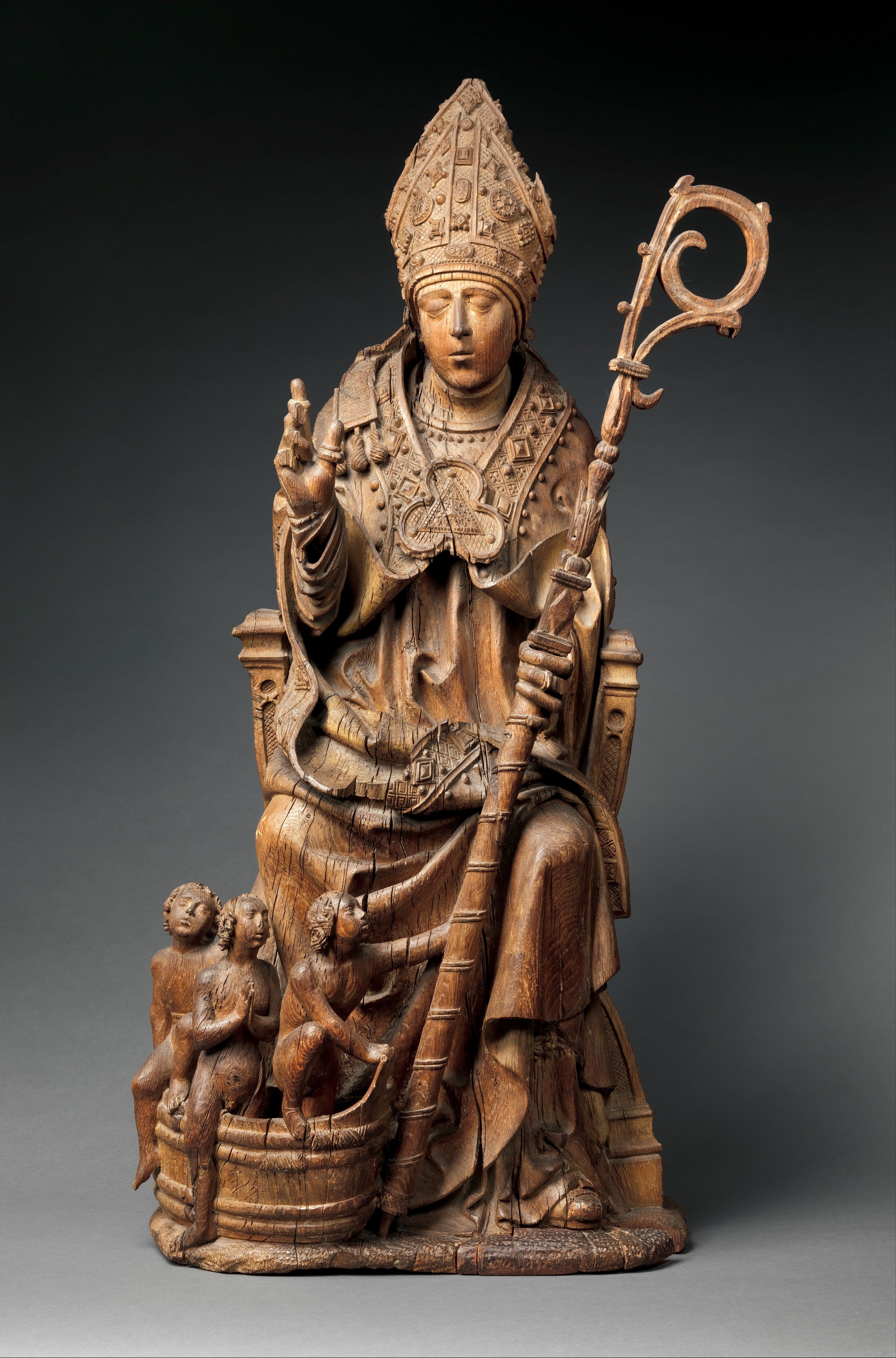
The root name is the Frankish Audomar, which is composed of the elements aud (wealth, fortune), and mari (fame).
It was borne by an 8th-century saint and monk, an abbot of St. Gall, Switzerland and a 7th-century Frankish saint, after whom the French commune of St-Omer was named.
The name is Hebrew, either derived from צל (tsel) (shadow) or צלל (tsalal) (to ring like a bell). In Genesis 4:19, it is the name of one of the two wives of Lamech.
Though it never became a widespread Jewish name until recently, it had usage in the Protestant Anglo world since the 16th-century and experienced mild popularity in the mid to late 19th-century. It appeared in the U.S. Top 100 between 1881 and 1886, peaking at #679. It was borne by Zillah Oakes (circ. 1870s), the namesake of the city of Zillah, Washington. It was also borne by New Zealand Politician, Zillah Smith Gill (1859-1937).
In English literature, Lord Byron used it as the name of the wife of Abel in his 1821 play, Cain. It is the name of a servant in Emily Brontë’s Wuthering Heights (1847), and the name of the titular heroin in the 1865 operetta by Australian composer, William Wilkins Russell. In recent years, it is the name of a character in Madeleine L’Engle’s, A Swiftly Tilting Planet (1978).
It may have occasionally been used as a form or short form of Cecilia.
The name appears in Norse Mythology as the name of the first woman, who has a husband named Ask. They are attested to in the Poetic Edda and the Prose Edda.
The name Embla itself may derive from the Proto-Norse *elm-la (elm tree), the Proto-Norse *Ambilō (vine) or the Proto-Norse eim + la (firemaker) and it has even been connected with the Germanic root word, amal (work).
It is first attested to in Sweden in 1882, in Norway in 1900, and in Iceland after 1950, however, it may have been in use in Medieval times as well.
Between 2010 and 2016, this was among the most popular female names in Iceland. In Iceland, it peaked at #8 in 2016 . It is currently the 96th Most Popular Female Name in Norway (2023).