Médéric

Gender: Masculine
Origin: German
Meaning: “courageous ruler.”

The name is derived from the Old Germanic elements merri (courage) and rik (ruler). It was borne by an 8th-century French saint.

The name is considered rather archaic in France but has always been rather common among the francophones of Canada. It has been borne by several Canadian politicians, the most famous being Médéric Martin (1869-1946), the 32nd mayor of Montreal.

Currently, it is the 308th most popular male name in Quebec, Canada (2010).

Other obscure French forms are Méry and Merri.

Sources

  1. http://www.rrq.gouv.qc.ca/Interactif/PR2I121_Prenoms/PR2I121_Prenoms/PR2SPrenoms_01.aspx
  2. http://fr.wikipedia.org/wiki/M%C3%A9d%C3%A9ric

Rita

The name is a contraction of Margaret but seems to have been used as an independent given name since the Middle Ages.

It was borne by Rita of Armenia (1278-1333) a Byzantine Empress. The name was further popularized in Europe due to the cult of St. Rita of Cascia (1381-1457) a Medieval Italian saint.

The name is used across Europe, including Armenia. Currently, Rita is the 461st most popular female name in Quebec, Canada (2010).

In more recent history it was borne by actress Rita Hayworthe (1918-1987).

Other forms of the name include:

  • Riet (Dutch)
  • Reeta (Finnish)
  • Reetta (Finnish)
  • Riitta (Finnish)
  • Ryta (Polish)

A common Sicilian diminutive is Rituzza.

Source

  1. http://www.behindthename.com/name/rita

Mirko

Gender: Masculine
Origin: Slavic Мирко
Meaning: “peace.”
(MEER-koh)

The name is derived from the Slavic element mir meaning “peace.” It has historically been used as a Croatian form of the Germanic name Emmerich, although unrelated etymologically.

It is currently the 491st most popular male name in Quebec, Canada (2010).

The name was borne by Prince Mirko of Montenegro (1879-1918)

The feminine form is Mirka.

Source

  1. http://sl.wikipedia.org/wiki/Miro
  2. http://www.rrq.gouv.qc.ca/Interactif/PR2I121_Prenoms/PR2I121_Prenoms/PR2SPrenoms_01.aspx

Hadi

Gender: Masculine
Origin: Arabic هادي
Meaning: “leader; guide.”

The name comes from the Arabic meaning “leader; guide.” It is from a theophoric designation for God, Al-Hādi meaning “servant of the Guide.”

It is currently the 475th most popular male names in Quebec, Canada, (2010).

The feminine forms are Hadia, Hadija (Bosnian) Hadya and Hadiya.

Source

  1. http://www.behindthename.com/name/hadi


Malachi

Gender: Masculine
Origin: Hebrew  מַלְאָכִי
Meaning: “my messenger.”

The name is found in the Old Testament as the name of a prophet and the author of the Book of Malachi. He is known for his prophecies, in Christian tradition it is believed that his prophecies foretell the coming of Christ.

Its Irish form of Malachy has always been a common name in Ireland. It was borne by an early Irish saint who is also considered a prophet and a mystic. Though, it is sometimes suggested that Malachy is an anglicized form of Máel Sechlainn.

Currently, Malachi is the 163rd most popular male name in the United States, (2010).

Other forms of the name include:

  • Maleachi (Afrikaans/German)
  • Malaquies (Catalan)
  • Malachiáš (Czech/Slovak)
  • Malachias (Dutch/German/Greek)
  • Malachie (French)
  • Malachy (Irish)
  • Malachia (Italian)
  • Malachiasz (Polish)
  • Malahija Мала́хия (Russian/Serbian)
  • Malaki (Scandinavian)
  • Malaquías (Spanish)
Occasional English short forms are Mal and Chai (KYE).
Source

Kenneth

Gender: Masculine
Origin: Scottish
Meaning: “born of fire.”
(KEN-neth)

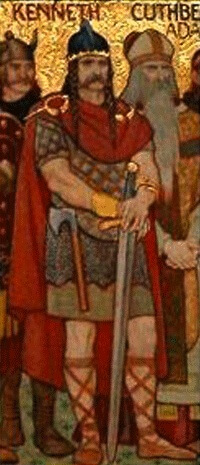
The name is an anglicized form of the Scots Gaelic Cináed meaning “born of fire.” It was borne by the first king of the Scots and Picts in the 9th-century. It was by several subsequent Scottish kings thereafter. It was also borne by a few early Scottish and Welsh saints.

It was used by Sir Walter Scott as the name of a hero in his 1825 novel The Talisman.

Currently, Kenneth is the 160th most popular male name in the United States, (2010).

Other forms of the name include:

  • Kenneth (English)
  • Cináed (Irish/Scottish: kin-NADE)
  • Cionaodh (Irish)
  • Ciniod (Pictish)
  • Kennet (Scandinavian)
  • Cen(n)ydd (Welsh. KEN-nith)
  • Cunedda (Welsh. kun-NETH-thuh)
Common short forms are Ken and Kenny.
Scottish feminine forms are Kenina and Kenna.
Source

Derek

Gender: Masculine
Origin: Frisian

The name is a contracted Frisian form of Diederich. It was imported to England in the 15th-century via trade with the Netherlands. It is currently the 169th most popular male name in the United States, (2010).

Another form is Dirk which is currently the 142nd most popular male name in the Netherlands, (2010).

Sources

  1. http://www.behindthename.com/name/derek
  2. http://en.wikipedia.org/wiki/Derek

Edwin

Gender: Masculine
Origin: Anglo-Saxon
Meaning: “rich friend.”

The name is composed of the Anglo-Saxon elements æde (rich) and wine (friend). It was borne by a Northumbrian king and saint. The name fell out of usage after the Norman Conquest but was revived in the 19th-century. It is currently the 209th most popular male name in the United States, (2010).

Other forms of the name include:

  • Eadwine (Anglo-Saxon)
  • Edwin (Dutch/English/German/Polish)
  • Edvin (Estonian/Finnish/Hungarian/Scandinavian)
  • Otwin (German)
  • Eduino (Italian)
  • Edvino (Italian)
  • Edvinas (Lithuanian)
Common English nicknames are Ed and Eddie.

Feminine forms include:

  • Edwina (English/Polish)
  • Eduina (Italian)
  • Edvina (Italian)
Source

Gianna

Gender: Feminine
Origin: Italian
(JAHN-nah)

Originally a contracted form of Giovanna, the name has been in use as an independent given name since the Middle Ages.

It is currently the 66th most popular female name in the United States (2010).

The name is also used in Greece pronounced (yee-YAH-nah).

Another form is Giannina. Masculine forms are Gianni and Giannino.

Source

  1. http://www.behindthename.com/name/gianna

Raymond

Gender: Masculine
Origin: German
Meaning: “advice protector.”
(RAY-mund)

The name is composed of the Germanic elements ragin (advice) and mund (protector). It was introduced to England via the Normans. It was borne by several saints.

Currently, Raymond is the 225th most popular male name in the United States, (2010).

Other forms of the name include:

  • Remund (Aragonese)
  • Erramun (Basque)
  • Raimon (Catalan)
  • Raimondu (Corsican)
  • Rejmond Рејмонд (Croatian/Serbian)
  • Rajmund (Czech/Hungarian)
  • Raimund (Danish/Finnish/Norwegian/Romanian/Swedish)
  • Ramund (Danish)
  • Raymundus (Dutch/Latin)
  • Raymond (Dutch/English/French)
  • Raimo (Finnish)
  • Reima (Finnish)
  • Reemt (Frisian)
  • Réamann (Gaelic)
  • Redmund/Redmond (Irish)
  • Raimund (German)
  • Reimund (German)
  • Raimundur (Icelandic)
  • Raimondo (Italian)
  • Raimonds (Latvian)
  • Remao (Limburgish)
  • Mao (Limburgish)
  • Raimondas (Lithuanian)
  • Reimund (Norman)
  • Raginmund (Old German)
  • Rajmund (Polish/Slovene)
  • Ramun (Romansch)
  • Arrammundu (Sardinian)
  • Ramundu (Sardinian)
  • Rámon (Spanish)
  • Raimundo (Spanish/Portuguese)
  • Raymundo (Spanish/Brazilian Portuguese)
A common English short form is Ray.

Feminine forms include:

  • Ramona (English/Hungarian/Portuguese/Romanian/Spanish)
  • Raymonde (French)
  • Raimunde (German)
  • Raimonda (Italian)
  • Raimondina (Italian)
  • Rajmunda (Polish)
  • Ramuna (Romansch)
Source