 Gender: Feminine
Origin: French
(OME-BREEN)
The name could either be a contracted form of Ambroisine or an elaborated form of Ambre.
As of 2009, Ambrine was the 443rd most popular female name in France.
Gender: Feminine
Origin: French
(OME-BREEN)
The name could either be a contracted form of Ambroisine or an elaborated form of Ambre.
As of 2009, Ambrine was the 443rd most popular female name in France.
 Gender: Feminine
Origin: French
Meaning: “plum.”
(Pronunciation)
The name comes directly from the French word for plum. It has been in usage since the 18th-century when it appeared on the Revolutionary Calendar under the name-days of October 5 and June 8th, coinciding with the feast of St. Flora. The name fell out of usage after the Napoleonic era, but seems to be going through a vogue again. Its recent resurgence may have something to do with the 1970s French-Swiss Soap-Opera, Prune.
She appears in the French top 500, coming in as the 446th most popular female name in France, (2009).
Not only is Prune the name of the fruit in French, but it is also used to describe a colour and it is a slang in a few French dialects. The meanings are as follows:
 Gender: Feminine
Origin: French/Latin
Meaning: “honour.”
(Pronunciation)
The name is derived from the Roman family name, Honorinus, which is derived from the Latin, Honorius, meaning, “honour.”
The name was borne by a legendary Norman saint who is revered as the patron saint of boatmen. Not much else is know about her, just that she is one of Normandy’s oldest saints. She is believed to have been martyred under Diocletian.
Honorine is also the eponymous heroine of Honoré de Balzac’s 1843 novel.
As of 2009, Honorine was the 455th most popular female name in France.
The designated name-day is February 27.
Other forms include:
 Gender: Masculine
Origin: Arabic كريم Карим
Meaning: “noble; generous.”
(KAH-REEM)
The name comes directly from the Arabic word for, “noble; generous.” In Islam, Karim is one of the 99 designations of Allah and is used to describe the Qu’ran (Al-Qur’an Al-Karim), literally meaning “the Noble Qu’ran.”
The name is used throughout the Islamic world, but is also used among Middle Eastern Christians.
The name has been occasionally used in Latin America, in Brazil, it seems to be a Portugized spelling for the Scandinavian female name Karin, but in this case it is pronounced (kah-REEN).
The name has numerous famous bearers.
As of 2009, Karim was the 260th most popular male name in France.
Other forms of the name include:
 Gender: Masculine
Origin: French
Meaning: “angel.”
(AWnzh)
The name comes directly from the French word for angel, and has been used as a given name since at least the 8th-century C.E.
It is techinically an epicène name, that is, one among the several names found within the French lexicon which has always been gender neutral. However, Ange by itself is more often given to males, while for females, it is usually paired with a feminine name, such as Marie-Ange.
The name was borne by a few medieval saints. One of the most notable being St. Angelus of Jerusalem (1185-1220), a Christian convert of Jewish ancestry who left his native Palestine to join a friary in Sicily. He was eventually martyred by Berenger, a local knight, who killed him in anger after the saint rebuked him for living in an incestuous relationship.
Ange was a very common name among the early Acadians (Cajuns), of Louisiana and French-Canadians.
As of 2009, Ange was the 264th most popular male name in France.
Other forms of the name include:
 Gender: Masculine
Origin: Latin
Meaning: “from Cyprus.”
Eng (SIP-ree-ən)
The name is derived from the Roman family name, Cyprianus, which means, “from Cyprus.”
The name was borne by a 3rd-century Christian theologian, writer, martyr and saint.
As of 2009, its French form of Cyprien was the 272nd most popular male name in France.
Other forms of the name include:
 Gender: Masculine
Origin: Arabic عادل
Meaning: “just; fair.”
The name is derived from the Arabic adjective, عدل (adala), meaning, “just.”
The name is used throughout the Islamic world, though, the it is also used among Middle Eastern Christians.
As of 2009, Adel was the 285th most popular male name while Adil was the 378th most popular.
Other forms of the name include:
A feminine form is Adila (Arabic) and Adile (Turkish)
 Gender: Masculine
Origin: Greek ‘Ιππολυτος
Meaning: “freer of horses.”
Eng (hip-PAHL-ih-tus); Eng Fem (HIP-poh-LY-tee; hi-PAHL-i-tah) Fre (EEP-poh-LEET)
The name is derived from the Greek, Hippolytos (‘Ιππολυτος), which is composed of the elements, hippos (‘ιππος), meaning, “horse” and lyo (λυω) meaning, “to loosen.”
The name was borne in Greek mythology by a son of Theseus, and depending on some sources either the Amazon, Hippolyte (hence the name) or Antiope. He rejected the advances of his step-mother, Phaedra, who, when spurned, complained to Theseus that his son had raped her. In anger, Theseus cursed his own son, using of the his three wishes granted by Poseidon, Hippolytus was dragged to death by his horses after being frightened by a sea-monster. The story was retold both by Euripides in his play Hippolytus and by Seneca the Younger in his play, Phaedra.
His possible birth mother of Hippolyte was an Amazonian queen who possessed a magical girdle which denoted her rank. She appears in the legend of Hercules who seeks her girdle for the princess, Admeta. Hippolyte is so impressed with the immortal’s prowess that she gives Hercules her girdle as a gift. William Shakespeare may have based his character of Hippolyta who appears in A Midsummer’s Night Dream off of Hippolyte the Amazon queen.
The male form of Hippolytus appears several more times throughout Greek mythology as the name of minor characters.
It was also borne by some early renowned Christian saints, including Hippolytus of Rome a 3rd-century Christian theologian, writer and martyr.
In English and early Greek, Hippolyte often appears as a feminine form, but in French, it is an epicène name, that is a unisex name, however, it is more often used on males than on females. As of 2009, Hippolyte was the 286th most popular male name in France.
Other forms of the name include:
 Gender: Feminine
Origin: Greek Ευλαλια
Meaning: “to talk well.”
Eng (yoo-LAY-lee-uh; yoo-LAY-lee); Fre (eu-lah-LEE); Cat (oo-LOW-lee-ah); Sp (oo-LAH-lee-ah)
The name is composed of the Greek elements, eu ευ (good) and laleo λαλεω (talk).
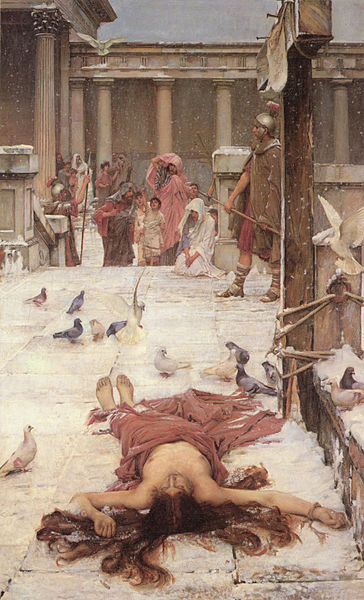
The name was borne by two different early Spanish saints, both of whom are believed to be one and the same person. St. Eulalia of Mérida was a 3rd-century teenage Roman girl who refused to give up her faith, she was subsequently tortured and crucified, legend has it that when she was cut down from her cross, a layer of snow fell to cover her nakedness. The story was the subject of the famous painting by John William Waterhouse, (above).
In the English-speaking world, especially in the United States, Eulalia and her other forms appeared in the U.S. top 1000 from the 19th-century till the 1930s. She never ranked high, the highest only being # 365 in 1893. Her French form of Eulalie also experienced some usage but fell out of the top 1000 by 1900. The highest Eulalie ever ranked in the United States was at # 687 in 1893. Eulalie’s introduction into the United States may have had something to do with Edgar Allan Poe’s 1845 poem, Eulalie.
Eulalie is one of Poe’s less Gothic works, it recounts how a widower once again finds happiness in a girl named Eulalie.
Two famous American bearers were Silent film actress, Eulalie Jensen (1884-1952), and Eulalie Spence (1894-1981) an African-American play-write of West Indian extraction.
Further up in North America, the name was borne by French-Canadian Blessed and religious foundress, Eulalie Durocher, aka, Soeur Marie Rose Durocher, who is credited for finding the Order of the Holy Name of Jesus and Mary (1811-1849).
In French naming history, Eulalie appears in a famous folktale, Jean, the Soldier, and Eulalie, the Devil’s Daughter.
Notable French bearers are numerous, but one of the most famous has to be an early female journalist by the name of Eulalie de Senancour (1791-1896).
In the United States, Eula was probably the most common form. She consistently remained within the U.S. top 1000 between 1880 and 1960. The highest she ever ranked was at # 122 in 1908.
As of 2009, its French form of Eulalie was the 472nd most popular female name in France.
Other forms of the name include:
 The name is taken from the name of a genus of plant and also a genus of butterfly.
It may also be a contracted form of Cornelia.
As of 2009, Nelia was the 476th most popular female name in France.