Bayram, Bajram

  • Origin: Turkic
  • Meaning: “festival; holiday.”
  • Gender: masculine
  • BY-rahm

The name comes directly from the Turkic word referring to any festival or public holiday, whether religious or secular.

Between 1980-2004, the name appeared in the Top 100 Most Popular Turkish Male Names, and peaked at #42 in 1981.

Sources

Latif, Latifa

  • Origin: Arabic لَطِيْف
  • Meaning: “gentle; kind; benevolent.”

Latif is a masculine given-name which comes directly from the Arabic word لَطِيف (gentle; kind; benevolent). In Islam, Al-Latif لطيف, (the Kind; the Benevolent) is one of the 99 names of Allah (God). It’s feminine form is Latifa.

Latif & Latifa are commonly used throughout the Islamic world.

A notable American bearer is actress & singer, Queen Latifah.

Other forms include:

  • Latıif (m), Latıifa (f) (Avar)
  • Lətif (m), Lətife (f) (Azeri)
  • Latheef, Latheefa (Dhivehi)
  • Latifah (f) (Indonesian, Malaysian)
  • Letîf (m), Letîfe (f) (Kurdish)
  • Lәtyjif (m), Lәtyjifә (f) (Tatar)
  • Letife (f) (Turkish)
  • Lateef لطیف, Lateefa(h) (Urdu)

Sources

Fuad

  • Origin: Arabic فُؤاد
  • Meaning: “heart.”
  • Gender: masculine
  • Pronunciation: foo-AD

The name comes directly from the Arabic word for heart. It is used equally among Arab- Muslims & Christians. Among Christians, particularly Palestinians, Chaldeans and Lebanese Christians who profess Roman Catholicism, it is used in reference to the Sacred Heart of Jesus or the Immaculate Heart of Mary, in the same way the Spanish name Corazón is used in the Spanish-speaking world, though in the Arabic case, the name is strictly masculine.

Among Muslims, the term fu’ad is used at least 5 times in the Quran. The name is used throughout the Islamic world.

It is even used among Non-Arab groups in the Middle East, such as Mizrachi Jews.

The name was borne by two Egyptian kings.

Other forms include:

  • Fuad (Amharic, Azeri, Bosnian, Indonesian)
  • Fouad (Maghrebi)
  • Fuat (Turkish)
  • Fawad (Urdu)

A feminine form is Fuada(h).

Sources

Sariyah – meaning, origin & history of the first name

  • Origin: Arabic سارية
  • Urdu: سریا
  • Hindi:  सरिया
  • Bengla: সারিয়া
  • Meaning: “clouds at night.”
  • Gender: Female

Sariyah سارية is from an Arabic word that means “clouds at night.”

It is derived from the Arabic root S-R-A, and can be associated with “night rain” or “night travel.”

Saria and Sarya is the Urdu transliteration and is popular in Pakistan and India among Muslims.

Other forms include:

  • Sarija Сария (Abkhazian, Albanian, Azeri, Bashkir, Bosnian, Chechen, Circassian, Dagestani, Kazakh, Ossetian, Tajik)
  • Sәrija Сәрия (Tatar)

Sources

Javid, Javed

  • Origin: Persian جاوید
  • Urdu: جاوید
  • Punjabi: : ਜਾਵੇਦ)
  • Meaning: “eternal; immortal.”
  • Gender: masculine

The name is derived from the Persian جاود (Javid), meaning “eternal, immortal.”

The name was borne by Azerbaijani poet and playwrite, Huseyn Javid (Hüseyn Cavid) 1882-1941.

Other forms include:

  • Cavid (Azeri/Turkish)
  • Dzhavid Джавид (Chuvash)
  • Javidi ჯავიდი (Georgian)
  • Yavid (Spanish)
  • Javaid جاوید (Urdu)
  • Jawed جاوید (Urdu)

Sources

Masuma

  • Origin: Arabic معصومة
  • Meaning: “innocent; sinless.”
  • Gender: feminine
  • Pronunciation: MAH-soo-mah

The name is from the Arabic word meaning “innocent; sinless.” It was the sobriquet of a Shia Muslim saint by the name of Fatimah bint Musa, known as Fatimah al-Masumah (circ. 7th-century CE). She was the daughter of the seventh Twelver Shi’a Imam, Musa al-Kadhim and the sister of the eight Twelver Shia Imam, Ali al-Rida. Her shrine, which is located in Qom, Iran, is an important point of pilgrimage for many Shi’a Muslims.

The name was also borne by Masuma Sultan Begun (d. 1509), the Queen Consort of the Ferghana Valley & Samarkand & the fourth wife of Emperor Babur, founder of the Mughul Dynasty.

A variant transliteration is Massouma.

Other forms of the name include:

  • Məsumə (Azeri)
  • Masoumeh معصومه (Persian)
  • Masume (Turkish)

Sources

Zuleika, Zuleikha

800px-Rembrandt_Harmensz._van_Rijn_065


  • Origin/Meaning: unknown زُلَيْخا זוליכה‎
  • Gender: female
  • (zoo-LAY-kah)
  • Usage: Arabic, Armenian, English, German, Italian, Ladino, Persian, Portuguese – Brazilian, Spanish

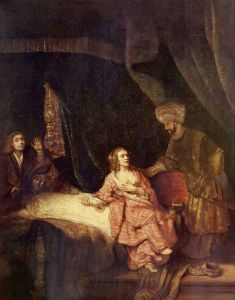
The name is of uncertain origin or meaning, since it appears in Muslim and Medieval Jewish tradition as the name of the wife of Potiphar (who is unnamed in the Old Testament), it is often suspected to be of Coptic origin, though the name is not traditionally used among contemporary Copts.

The wife of Potiphar is mentioned in the Bible as trying to seduce Joseph and later falsely claiming he tried to rape her, which leads to Joseph’s unjust imprisonment. In Medieval Islamic tradition, the story was reinterpreted as a popular love story, the subject of much poetry, she is named Zuleikha and her love for Joseph was interpreted by Sufi poets, especially Rumi and Hafez, to represent the longing the soul has for God. Zuleika is also attributed to be her name in the Sefer haYashar, also known as the Book of Jasher, a Jewish midrash of unknown authorship.

In the English-speaking world, the name first came into use in the early 19th-century, it was most likely popularized by Byron’s 1813 poem, The Bride of Abydos, in which it is the name of the heroine. It was also used by the German poet Goethe for his 1810 poem entitled, Book of Zuleika, in his collection of Eastern inspired poems called West–östlicher Divan. It is the name of the eponymous character in the 1911 novel, Zuleika Dobson by Max Beerbohn, which was later adapted into a musical.

The name is also used in Spanish-speaking countries and Brazil.


Other forms include:

  • Zulejka (Albanian, Bosnian)
  • Züleyxa (Azeri)
  • Zuleica (Catalan, Portuguese, Spanish)
  • Zulejha, Zulejka Зуле́йха, Зулейка (Chechen, Russian)
  • Zelikah (Dutch)
  • Zouleïkha (French)
  • Züleyha (Turkish)
  • Zulayho (Uzbek)

Other Arabic transliterations include: Zulaykha and Zulekha.

Spanish diminutives include: Zula & Zuzu.


Sources

Sephora, Zipporah

Zipporah


Zipporah is derived from the Hebrew צִפוֹרָה, Tsippōrāh, “bird.” It is the name of the wife of Moses in the Book of Exodus. The name was often transliterated from the Greek as Sephora.

Pronounced ZIP-pe-ruh in English (kind of rhymes with Deborah), it was first used by Protestant non-Jews in the English speaking world in the 16th-century. Both Zipporah but more often Sephora were occasionally used in 16th-century England and Colonial America.

Zipporah has always been a popular name in the Jewish diaspora, which has spun-off some colourful offshoots. A favorite among Ashkenazi Jews since Medieval Times, it is the inspiration of the Yiddish name, Faigel, which is from the Yiddish פֿויגל (foigl) meaning “bird.” Pre-Yiddish Knaanic Jews of Slavic lands, particularly in Poland used Sójka (blue jay) as a vernacular form. Due to its similar sound, European-Jews also used Cypriana as a form of Zipporah though the names have no etymological relation.

The name of the cosmetic store was named in reference to Moses’ wife.

Other forms include:

  • Safura, Safrawah صفورا (Arabic)
  • Səfurə (Azeri)
  • Zipora (Breton, German)
  • Sèfora (Catalan)
  • Sipóra (Czech)
  • Sippora (Dutch, Finnish, Scandinavian)
  • Séphora, Zéphora (French)
  • Zippora (German)
  • Sepphora Σεπφώρα (Biblical Greek)
  • Tziporah, Tziporrah צִפּוֹרָה (Modern Hebrew)
  • Cipora, Cippóra (Hungarian)
  • Sefora (Italian)
  • Chipora (Judeo Anglo-Norman)
  • Cipiora, Çapora (Ladino)
  • Seffora (Latin)
  • Ṣaffūrah (Malay)
  • Cippora, Cyppora, Sefora (Polish)
  • Séfora (Portuguese, Spanish)
  • Zípora (Portuguese)
  • Sepfora Сепфора επφώρα (Russian, Modern Greek)
  • Zipóra (Spanish)
  • Cypojra, Cypra (Polish-Yiddish)
  • Bayerle (Medieval Judeo-German)
  • Beverlin, Beverle, Böverle, Böverlin (Medieval Judeo-German)
  • Paye, Payerlayn, Payerl, Payerle, Payerlin (Medieval Judeo-German)
  • Pura, Pure, Purlin (Yiddish)
  • Tsipere, Tsipoyre, Tsipure, Tsipor, Tsipur (Yiddish)
  • Tsiporlin (Yiddish)

Popular diminutive forms are Zippy and Tsipi

Sources

Adhan, Azaan

429px-Jean-Léon_Gérôme_010


The name is derived from the Arabic root ʾadhina أَذِنَ meaning “to listen, to hear, be informed about,” or ʾudhun (أُذُن), meaning “ear.” The Adhan, sometimes romanized as Azaan, is the name of the Islamic call to prayer, which is rung 5 time a day.

Currently, Azaan is the 406th Most Popular Male Name in England & Wales, (2018). Other transliterated forms include: Adaan, Adan, Adhaan, Athan, Edan & Edhaan.

Other forms include:

  • Ezani (Albanian)
  • Ezan Езан (Albanian, Bosnian, Bulgarian, Kurdish, Turkish)
  • Azan Азан (Azeri, Kazakh, Kyrgyz, Malay, Tatar)
  • Azán Аза́н (Chechen)
  • Adan (Javanese)
  • Aadaan (Somali)
  • Azon Азон (Tajik)
  • Ezane (Zazaki)

Sources

Hashim

The name is most likely derived from the Arabic root H26-SH-M  meaning “breaker or pulverizer.” This was a sobriquet for Hāshim ibn ‘Abd Manāf (circ. 5th-century C.E.) who was the great-grandfather of the Prophet Muhammad and found of the Banu Hashim tribe. Borne ‘Amr al-‘Ulā, ot is said he took this name because he used to break up his bread to share in a broth among pilgrims to Mecca and he is also said to have saved the poeple of Mecca from a famine by breaking up his bread into tiny crumbs.

Another transliteration is Hasheem

Currently, Hashim is the 436th Most Popular Male Name in England & Wales (2018).

Other forms include:

  • HIashim ХӀашим (Chechen)
  • Haysim (Indonesian)
  • Hashem هاشم (Persian)
  • Haşim (Turkish)

Sources