Anglo-Saxon variation: Herefrið; English form: Herefrith
German pron: HER-freet
The name is composed of the Germanic elements heri (army) and fridu (peace).
It is currently very rare in contemporary German-speaking countries, a notable bearer being German political scientist, Herfried Münkler (b. 1951).
Herefrið is the Anglo-Saxon version, written as Herefrith in Modern English. It was borne by a 9th-century Bishop of Winchester and an Abbott of Lindisfarne recorded in the works of the Venerable Bede.
It’s designated name-day in Austria is November 9th.
The name is the modern English form of the Anglo-Saxon female name, Eahlswiþ, which is composed of the Anglo-Saxon elements, eahl (temple) and swiþ (strong).
The most famous historical bearer is Ealhswith (Elswith), Queen of Wessex and wife of King Alfred the Great (d. 902). She was the mother of Edward the Elder and Æthelflæd, Lady of the Mercians, and is remembered for her wisdom, learning, and piety.
Her name appears in multiple forms across medieval chronicles: Ealhswith, Ealswitha, Aelswith, Aelswitha, Alswith, Elswith, Elswitha, and Elswyth.
The name gained renewed attention through the popular Netflix/BBC historical drama The Last Kingdom (2015–2022) and its sequel film Seven Kings Must Die (2023), based on Bernard Cornwell’s The Saxon Stories series.
Since 2022, at least 11 girls have been bestowed the name Elswyth in England & Wales.
While Ealhswith fell out of use after the Norman Conquest, Elswith or Elswyth has occasionally been revived in historical fiction and modern England as a rare, archaic revival, akin to Edith and Ethel. It fits within the current trend toward names that blend mythic, Old English, and Celtic sounds, offering an even more unique alternative to trending names such as Eloise,Elowen and Ella.
Giselher is an early Old High German masculine name formed from two classic Germanic elements, gisel (pledge) and hari (army).
The best-known figure is King Giselher of Burgundy, a 5th-century ruler who appears in both history and legend. He is immortalized as a character in the Nibelungenlied, the great Middle High German epic, alongside his brothers Gunther and Gernot.
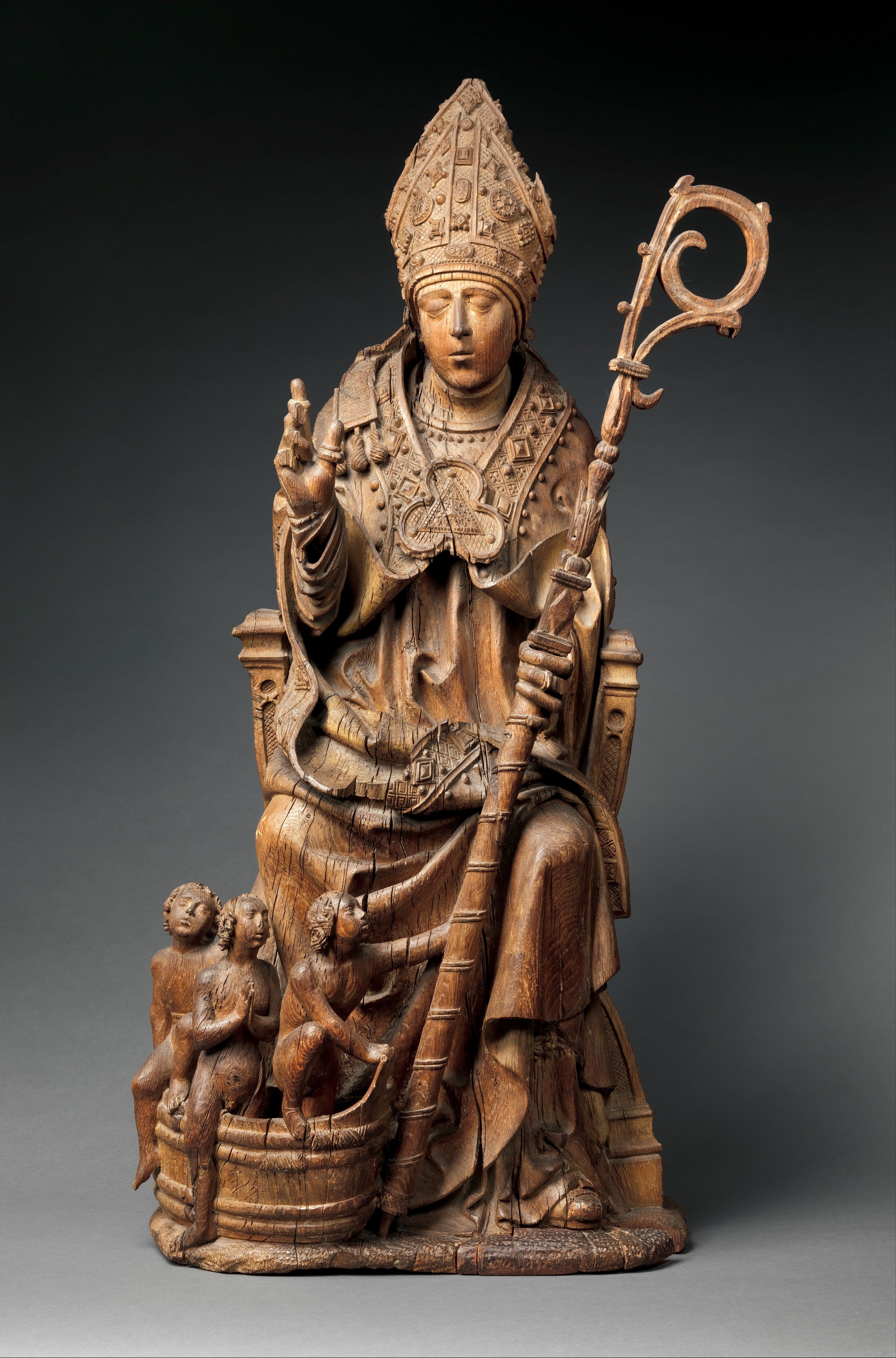
It was also the name of an 11th-century Bishop of Madgeburg who succeeded St. Adalbert.
It is found in records as the name of Teutonic Knights in Estonia, Latvia and Poland. It experienced a minor revival in the early 20th-century but is quite rare in contemporary German-speaking countries.
Its Anglo-Saxon version of Gislhere was borne by an 8th-century Bishop of Selsey.
A more recent bearer was German composer, Giselher Klebe (1925-2009).
Its designated name-day in Austria is September 28th.
S.L. Uckelman. “Giselhar”. In S.L. Uckelman, ed. The Dictionary of Medieval Names from European Sources, Edition 2023, no. 1. http://dmnes.org/2023/1/name/Giselhar.
The name is composed of the Anglo-Saxon words, ūht, ūhta (dawn; twilight; pre-dawn) and rǣd (advice; counsel).
The 11th-century earl of Northumbia, Uhtred of Bambaugh or Uhtred the Bold, bore this name. Bernard Cromwell later based his character of the same name on him in the series, The Saxon Stories (2004).Cromwell was also a descendant of Uhtred of Bamburg.
Since the publication of the aforementioned series, the name has had rare, but revived use in the U.K. As of 2024, 5 babies were given this name in the U.K.
The root name is the Frankish Audomar, which is composed of the elements aud (wealth, fortune), and mari (fame).
It was borne by an 8th-century saint and monk, an abbot of St. Gall, Switzerland and a 7th-century Frankish saint, after whom the French commune of St-Omer was named.
The name was born by an 8th-century Anglo-Saxon female saint who did missionary work in Germany. It is composed of the Anglo-Saxon element, weald (power) and burg (fortress). Her feast day was celebrated on May 1st and the day before is called Walpurgisnacht (St. Walpurgis’ Eve).
In German-speaking countries, the name is most common in Bavaria and Austria, more so at the turn of the 20th-century.
In the Harry Potter series by J.K. Rowling, this is the name of the mother of Sirius Black.
The name spread in use across Europe, especially in Nordic and Germanic countries. Other forms include:
Wealburh (Anglo-Saxon)
Valpurga (Catalan, Italian)
Valburga (Czech, Hungarian, Portuguese, Spanish)
Valborg (Danish, Norwegian, Swedish)
Walburga (Dutch, German, Polish)
Walburg (English)
Valba, Valbe (Estonian)
Valli (Estonian)
Valbjørg (Faroese, Norwegian)
Vappu (Finnish)
Valpuri (Finnish)
Gauburge (French)
Walburge, Valpurge (French)
Waldeburg (German, archaic)
Walpurga (German)
Valbjörg (Icelandic)
Válbor (Sami)
Várbu (Sami)
A common German short form is Wally, while a Swedish nickname is Bojan.
Italian masculine forms are Valburgo, Walburgo, Walpurgo and Valpurgo.
The name is a modern English form of the Anglo-Saxon male name, Wada which is derived from the Anglo-Saxon verb wadan (to go), spawning the modern English verb “to wade.” Several individuals with this as a first name are recorded in the Doomsday Book. It spun off the patronymic surname of the same meaning. It went out of use in Anglo-Norman England but was reintroduced in the 19th-century, possibly used in honor of a family surname.
It is the name of a legendary figure in Germanic folklore, the father of Wayland. The Anglo-Saxon poem, Widsith, makes mention of him and Wade’s Tale is alluded to by Chaucer in Troilus & Criseyde.
In its Old Norse incarnation of Vadi or Vaði, he is made mention of in the Þiðrekssaga and the Poetic Edda.
It is currently the 345th most popular male name in the United States (2022).
Historical Use: England, Medieval France (see French forms)
Modern Usage: English-speaking countries, Spanish-Speaking Countries, Brazil, Philippines
Contrary to popular belief, this is not from a surname, rather, the surname is from the first name. It is a Germanic dithematic name, derived from the Anglo-Saxon Deorwine, composed of the elements deór (wild animal, beast, deer) and wine (friend). Deór had a connotation of brave, compare the modern English words of deer and dire, both of which derive from the same element. It may also derive from the Frankish elements, daroth (spear, lance, javelin) and wini (friend). It was in use in both Medieval France and Anglo-Saxon England. The surname is actually from a patronymic, denoting someone who had a father named Darwin.
A notable bearer is Charles Darwin, English naturalist and writer, best known as the originator of the theory of biological evolution by natural selection (1809-1882). It is also the name of a city in Australia, which is the capital of the Northern Territory.
Darwin has been in and out of the U.S. Top 1000 Most Popular Male Names since 1881, it peaked at #297 in 1983. As of 2022, it was the 986th most popular male name.
Modern feminine forms include Darva and Darwina.
Darwin and Darvin has also experienced recent popular usage in Latin America.
From the word of the same meaning, it ultimately derives from the Anglo-Saxon lufu (love). As a female given name, it has been in use since the Anglo-Saxon period, starting off as a pre-Christian name and later used as a vernacular form of the Greek female name, Agape, being used in honour of several saints who bore the name and was later used by the Puritans.
It forms the basis of several diathematic Anglo-Saxon female names, such as Loveday and Lovewell.
It appeared in the U.S. Top 1000 Most Popular Female Names between 1880-1893 and peaked at #793 in 1885. It reappeared in 2022, coming in as the 752nd most popular female name.
If you are wondering why it also appears in the U.S. Top 1000 Most Popular Male Names, this is actually a different name, Love (pronounced LOO-veh), is the Swedish form of Louis. Its appearance in the U.S. Top 1000 Most Popular Male Names also occurs when there was a huge peak in immigration from Sweden to the United States between 1880 and trickling away by 1909.
Anglo-Saxon forms are Lufu (LOO-voo) and Lufa (LOO-vah), a modern English alternative would be Lova which is also a Swedish feminine form of Love.
Both names are derived from the Old Norse male name, Þórsteinn, literally meaning “Thor’s stone.” The name is attested as early as the 5th-century in Medieval Scandinavia and appears in the Norse saga, Draumr Þorsteins Síðu-Hallssonar.
It was transported to England by Anglo-Saxon & Norse settlers, the Anglo-Saxon form being Thurstan, and remained prevalent even after the conquest of the Normans, who themselves also used the name due to their original Norse heritage. Thurstan was borne by an 11th-century Bishop of York. Thurstan is the progenitor of the English surnames Thurston and Dustin.
Torsten appeared in Germany’s Top 100 Most Popular Male Names between 1960 and 1978, and peaked at #6 between 1964-68. While Torstein was in and out of the Norwegian Top 100 Male Names between 1947-1991, peaking at #84 in 1948. It’s original Old Norse form of Þórsteinn ranked in at #46 in Iceland’s Top 100 Male Names in 2012.