From the Old Norse word for “embers,” in Norse Mythology, this was the daughter of the jötunn known as Logi (fire), the latter who is considered the personification of fire, a long with his wife Glöð (glowing embers). He fathered another daughter Eisa (glowing ember), both of whom were said to be stunningly beautiful.
Its status as a given-name in most Scandinavian countries is a relic from the past but may appeal to parents drawn to authentic early Nordic names.
The name comes directly from the Old Norse word meaning “glowing ember.” In Norse Mythology, this is the name of one of the beautiful daughters of Logi (fire), and Glöð (glowing embers).
Later, it came to be associated as a pet form of Elizabeth or a German form of Aise (short form of any Nordic name beginning in the Egg-, Agi– element.)
Note: the name can also be an Arabic form of Jesus.
The name comes directly from the Old Norse word for “flame; blaze,” and is also used as a poetic word for a sword. It is born in Norse Mythology by Logi, a jötunn and the personification of fire. He was the son of Fornjótr. He is known for winning a meat eating competition against Loki.
A Swedish variation is Loge
It is a cooler and fresher alternative to Logan, with a spark.
The name is either derived from the Old Norse gandr (magic wand; magic staff), or the Old Norse gǫndul meaning, “magical animal; werewolf.”
In Norse Mythology, this is the name of one of the Valkyries. She appears in several early sources, including the Heimskringla, in which it is written:
“Gǫndul and Skögul sent out / to choose among kings.” Their presence seals Hákon’s fate, and they greet him after death — both destroyers and honour-givers.”
In the Poetic Edda, specifically Hákonarmál, she is again one of the Valkyries who welcome Hákon to Valhalla, confirming her dual role as harbinger of death and divine escort.
In the Norse sagas and Skaldic poetry, gǫndul can also function as a kenning (poetic metaphor) for “valkyrie” or “battle-witch,” used interchangeably with other names like Skögul, Hildr, and Mist.
Its rarely used these days in Nordic countries, but whose to say it won’t become popular with the rise of other Norse myth names. However, in modern Icelandic, it may sound a touch to close to the Icelandic slang term, göndull (cock, dick, penis), which yes, shares the same etymology as the name, referring to a staff or a wand, but other Nordic languages wouldn’t have the same associations.
Both names are derived from the Old Norse male name, Þórsteinn, literally meaning “Thor’s stone.” The name is attested as early as the 5th-century in Medieval Scandinavia and appears in the Norse saga, Draumr Þorsteins Síðu-Hallssonar.
It was transported to England by Anglo-Saxon & Norse settlers, the Anglo-Saxon form being Thurstan, and remained prevalent even after the conquest of the Normans, who themselves also used the name due to their original Norse heritage. Thurstan was borne by an 11th-century Bishop of York. Thurstan is the progenitor of the English surnames Thurston and Dustin.
Torsten appeared in Germany’s Top 100 Most Popular Male Names between 1960 and 1978, and peaked at #6 between 1964-68. While Torstein was in and out of the Norwegian Top 100 Male Names between 1947-1991, peaking at #84 in 1948. It’s original Old Norse form of Þórsteinn ranked in at #46 in Iceland’s Top 100 Male Names in 2012.
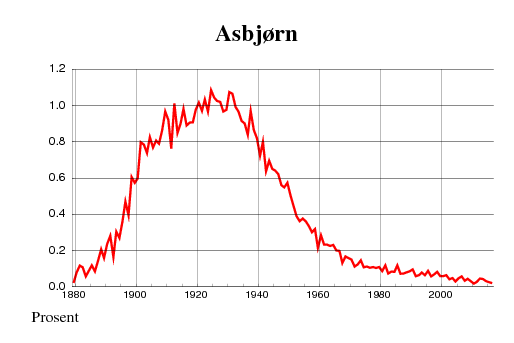
Osborn and Asbjørn are both composed of the Norse elements áss (god) & bjǫrn (bear), essentially meaning “divine bear.” Osborn is the modern Anglo-Saxon equivalent of Osbeorn, the latter of which was prevalent in Anglo-Saxon England and survived into the Norman period as Osbern, later developing into the common English patronymic surnames of Osbourne & Osbourn. Its Scandinavian equivalents still survive today in the forms of Esben (Danish), Espen (Danish, Norwegian) and still Asbjørn (Norwegian); and Asbjörn & Esbjörn (Swedish).
Osbeorn was borne by the son of Siward of Northumbria (circ. 11th-century CE) and one of the fallen of the Battle of the Seven Sleepers in Scotland. It was also borne by Osbern de Crépon (circ. 11th-century CE), one of the stewards of the Duke of Normandy. There are several other famous Anglophone personages who bear it as a surname and forename.
Asbjørn appeared in the Norwegian Top 100 Male Names between between 1945 & 1967, it peaked at #35 in 1946-7, while Espen appeared in the Top 100 in Norway between 1957-2004, peaking at #8 in 1982.
The designated name-day for Asbjörn is May 10th in Sweden.
General Scandinavian diminutive forms used in all Norse countries are Ebbe, Bjarne & Bjarni.
Short forms in English include Oz(z), Ozzie & Ozzy.
Gender: Masculine
Origin: Old Norse
Meaning: “happy victor; gift victor.”
Nor (I-vind)
A few weeks ago I was browsing through some Norwegian birth announcements and noted several unusual names that appeared over and over again. Eivind was one of them. Apparently, Eivind is the Norwegian form of the proto Norse auja “happy, lucky or gift” and windur meaning “victor, winner.” In Norwegian and Scandinavian history, the name was borne by a 9th-century viking by the name of Eyvind Lambi, he figures in the famous Egil’s Saga. Another popular form in Norway is Øyvind and in Sweden it appears as Ejvind.
Currently, the name is the seventy fouth most popular male name in Norway, while its slashed counterpart (see above) comes in much higher at # 27. The name is not as popular in Sweden as it is in Norway.
Its designated name-day was exactly one week ago, August 26th.
Update: Eivindand Øyvind no longer appear in the Norwegian top 100, but as of 2010, its Faroese form of Eivindur was the 8th most popular male name in the Faroe Islands.