Chantal

Gender: Feminine
Origin: French
Meaning: debated
Fre (CHAn-TAHL); Eng (SHAHN-tel)

The name comes from the surname of a popular French Catholic saint, Jeanne Françoise de Chantal (1572-1641), a French noblewoman and widow who became a nun upon her husband’s death, eventually founding the order of the Visitation of Holy Mary.

Originally, the name was used by devout French-Catholic parents, but due to its pleasant and feminine sound, its usage has spread elsewhere. It has been used in the Netherlands, the English-speaking world and in German-speaking countries. In Germany, the term chantalismus was coined, referring to German parents who like to give their daughters foreign and exotic sounding names.

Its popularity in other countries may have been due to the false assumption that the name is derived from the French verb chanter (to sing). In reality, the name may actually be related to a Provençal place name, cantal, (stony place). Even then, the origins of the surname are still a subject of debate.

In France, the name has spun off several double names, such as Marie-Chantal, Jeanne-Chantal and Anne-Chantal.

It is currently the 395th most popular female name in Germany (2011) and the 491st most popular in the Netherlands, (2010).

It is borne by Chantal, Princess of Hanover (b.1955), heiress to a Swiss chocolate fortune and Marie-Chantal, Crown Princess of Greece, Princess of Denmark (b.1968).

Philine

Gender: Feminine
Origin: Greek
Meaning: “friendly; loveable.”
Germ (fee-LEE-neh)

The name was possibly coined by Johann Wolfgang von Goethe for a character in his 1796 novel, Wilhelm Meister’s Aprenticeship. It is most likely derived from the Greek, philein, philéo meaning “friendly, loveable”.

The name has been borne by German actress, Philine Leudesdorff-Tormin (1892-1924) and German opera singer, Philine Fischer (1919-2001).

Currently, Philine is the 407th most popular female name in Germany, (2011).


Mareike

Gender: Feminine
Origin: Frisian
(mah-RIE-keh)

The name was originally a Frisian diminutive form of Maria, but has been used as an independent given name since at least the 1940s. The name was a subject of a 1962 Jacques Brel song in which the singer recounts his love affair with a Flemmish girl.

Currently, Mareike is the 398th most popular female name in Germany, (2011).

Other forms of the name include:

  • Marika (Czech/Estonian/Finnish/Greek/Hungarian/Polish/Slovak)
  • Marijke (Dutch)
  • Marike (Dutch)
  • Mareke (German)


Verena


The name is possibly derived from the Latin, verus, meaning “true.” Others have suggested that the name may actually be of some unknown Egyptian source.

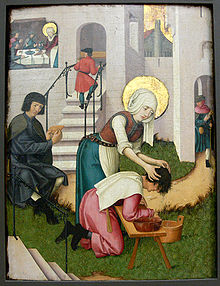
The name was borne by a 3rd-century Egyptian saint who found her way to Switzerland while marching along with the Theban legions. She is considered the patron saint of hairdressers as she was known for converting young native Swiss women to Christianity while washing and styling their hair. There is a shrine dedicated to St. Verena in Zurich, Switzerland.

The name has been popular in Germany and Switzerland and has even experienced some usage in the United States during the 18th and 19th-centuries, no doubt, brought over by German immigrants. It is also an especially common name among Mennonite, Hutterite and Amish families and is a popular name among Egyptian Christians.

It is also the name of a fictional goddess in the popular fantasy/video game series Warhammer. She is the goddess of healing and learning and is based on both Minerva and Athena.

Currently, Verena is the 383rd most popular female name in Germany, (2011).

Other forms of the name include:

  • Virina (Coptic)
  • Vérène (French)
  • Verena Верена (English/German/Italian/Russian/Slovene)
  • Werena (Polish)
  • Frena (Romansch)
  • Varena (Romansch)
  • Vreni (Swiss-German)
  • Vreneli (Swiss-German)


Mete

Gender: Masculine
Origin: Turkish
Meaning: debated
(MET-eh)

The name is a modern Turkish form of the ancient Turkic name Mondu, which is of debated origin. It has been suggested by various scholars that Mondu may be a Chinese corruption of the Turkic honorific title, Baghatur.

In history, the name was borne by Mondu Chanyu (234-174 BCE) an emperor of a Central Asian federation known in Chinese as Xionghu. Mondu is credited as being the founder of the Xiongnu Empire centered in modern day Mongolia. Among the Turks, he is known as Mete Han, and he is considered one of the first known Turkish rulers.

Currently, Mete is the 403rd most popular male name in Germany, (2011).

Other forms of the name include:

  • Mete (Azeri)
  • Ogüz (Azeri)
  • Mede Мөде (Kazakh)
  • Mөde Мөде (Tatar)
  • Oguz (Turkmen)


Orlando

Gender: Masculine
Origin: Italian/Spanish

The name is an Italian form of the Germanic, Roland, meaning “famous land.” Orlando has been in usage in the English-speaking world since at least the 16th-century, most likely due to the character in Shakespeares As You Like It (1599). It also the name of the eponymous character of the Italian epic Orlando Furioso (circ. 1520).

The name has been borne by English composer, Orlando Gibbons (1582-1625), American general, Orlando Ward (1891-1972) and British actor, Orlando Bloom (b.1977).

It is also the name of a city in Florida, which, according to legend may have been named for the Shakespeare character or it could have been named for an American sentinel Orlando Reeves who was killed during the Seminole warrior.

Actor Orlando Bloom was named for Orlando Gibbons.

Currently, Orlando is the 425th most popular male name in Germany, (2011) and the 435th most popular in the United States, (2010).

A feminine form is Orlanda.

Hagen

Gender: Masculine
Origin: German
Meaning: debated
Eng (HAY-gen); Germ (HAH-gen)

The name could be of three possible etymologies, it could be a borrowing from the Danish form of Håkon. Other sources have suggested that it comes directly from the Old High German meaning, “grove; enclosure.” In the case of the German city, this is the most likely etymology. Another possibility is that it is the German form of the Old Norse Högni (protection).

In the Medieval German epic, The Song of the Nibelungs, it is the name of Hagen of Tronje, the slayer of Siegfried and the thief of Nibelungs’ treasure. According to legend, he is half elf and has one eye. He appears in several other German folktales in which he is sometimes portrayed as the hero or the antagonist.

Currently, Hagen is the 430th most popular male name in Germany, (2011).

Another form of the name is Hagano.