Barnabas, Barnaby, Barney

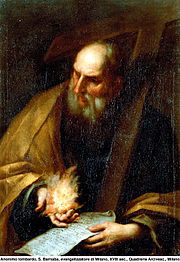
180px-San_Barnaba


The name is borne by St. Barnabas, a companion of St. Paul who was instrumental in converting gentiles to the new Christian faith. St. Barnabas was believed to be a Cypriot Jew whose true name was Joseph but he is referred to as Barnabas in Acts 4:36, which describes the name to mean “son of consolation,” possibly being linked with the Aramaic בר נחמה, bar neḥmā of the same meaning. Many linguists contradict this meaning and claim that the latter part of the name might actually be derived from the Hebrew nabī נביא meaning “prophet.”

St. Barnabas is considered an early apostle and the founder of the Christian Church in Cyprus who was eventually stoned to death by an angry mob in Syria. He is considered the patron saint of Cyprus and his feast day is June 11th.

As a given-name, Barnaby has been the preferred form in England since medieval times. Its usage spread to the rest of the English-speaking world through colonialism. It spawned the diminutive off-shoot of Barney, which has been used as an independent given-name in its own right.

To millennials, Barney is often associated with the beloved purple dinosaur of their childhood. However, he appeared in the U.S. Top 1000 between 1880-1976. Never a huge hit, the highest he ever ranked in the U.S. Charts was #201 in 1887. He hasn’t been seen in the charts since 1976, but in England & Wales he currently ranks in as the #492nd Most Popular Males Name (2018).

Barnaby is currently the 251st Most Popular Male Name in England & Wales (2018). Whereas Barnabás is currently the 32nd Most Popular Male Name in Hungary (2018).


Other forms include:

  • Barnabana برنابا (Arabic, Persian)
  • Barnabas Բառնաբաս ബർണബാസ് (Armenian, Coptic, Dutch, English, Finnish, Frisian, German, Greek, Icelandic, Latvian, Lithuanian, Malayalam, Scandinavian, Syriac, Welsh)
  • Bernaba (Basque)
  • Varnáva Варна́ва (Bulgarian)
  • Bernabé (Catalan, Portuguese, Spanish)
  • Barnaba ბარნაბა (Croatian, Georgian, Italian, Polish, Romanian, Slovenian)
  • Barnabáš (Czech/Slovak)
  • Barnaby (English, Plattdeutsch)
  • Barnabé (French)
  • Balló (Hungarian)
  • Barna (Hungarian)
  • Barnabás (Hungarian)
  • Barnabà (Lombard)
  • Varnava Варнава (Macedonian, Serbian, Russian, Ukrainian)

An obscure Spanish feminine form is Bernabea.

Sources

Marcus, Mark

Il_Pordenone_-_San_Marco_-_Budapest


From one of the most common Roman praenomen, its origin and meaning is uncertain. A popular etymology is that it relates to Mars, others suggest it may be from the Etruscan Marce, which may come from mar (to harvest). It is said the name was originally bestowed on those who were born in March.

Marcellus and the name of the month of March likely shares the same etymological root.

It was borne by several notable Romans, including Mark Antony, Marcus Aurelius & Cicero.

It was the name of one of the Evangelists who authored the eponymous Gospel, known as St. Mark in the Christian world, he is revered as the founder of Christianity in Africa and is traditionally believed to have founded the Church in Alexandria. Coptic Christians hold him in high regard. His bones were smuggled out of Egypt in a barrel of pork fat by Venetian merchants from Alexandria when Egypt fell under Islamic rule and were transported back to Venice where they were eventually installed and dedicated in the Basilica of San Marco.

The name was borne by a 2nd-century pope as well.


Marcus, Mark and Marc have been quite popular in several countries. Marcus was in the U.S. Top 100 between 1970-2000, Sweden’s between 1998-2008, New Zealand’s between 2008-2014, England & Wales between 1996-2003, and in Denmark’s between 1994-2006. Currently, his rankings in other countries are as follows:

  • #54 (Canada, BC, 2018)
  • #87 (Australia, 2018)
  • #100 (Norway, 2018)
  • #209 (United States, 2018)
  • #213 (France, 2018)
  • #236 (England & Wales, 2018)
  • #406 (Netherlands, 2018)

Its latinate form of Marco, which started off as a mainly Italian form, became widespread across the continent. His rankings in the following countries are as follows:

  • #11 (Galicia, Spain, 2018)
  • #16 (Spain, 2018_
  • #23 (Italy, 2018)
  • #65 (Catalonia, Spain, 2018)
  • #81 (Portugal, 2018)
  • #358 (United States, 2018)
  • #436 (England & Wales, 2018)
  • #446 (France, 2018)

It’s English form of Mark appears in the legend of Tristan & Isolde as the name of the King of Cornwall, supposedly the name was not common in the English-speaking world until the 19th-century, but became a hit by the Mid-1900s. Mark appeared in the U.S. Top 100 between 1944-2002, which is quite a long stretch. Mark peaked the highest in popularity between 1955-1970, peaking at #6, six years in a row between 1959-1964.  Marks’s rankings in other countries are as follows:

  • #5 (Slovenia, 2018)
  • #6 (Moscow, Russia, 2018)
  • #21 (Hungary, 2018)
  • #83 (Ireland, 2018)
  • #210 (U.S., 2018)
  • #253 (England & Wales, 2018)
  • #298 (the Netherlands, 2018)

Marc is the French, Catalan & Welsh form and has been popularly used in the English-speaking world, it is currently the most popular male name in Catalonia, 2018 and between 1968-1976 it was in the U.S. Top 100. Marc’s rankings in the popularity charts are as follows

  • #26 (Spain, 2018)
  • #313 (France, 2018)
  • #825 (US, 2018)

Other forms of the name include:

  • Mark Марк (Albanian, Belarusian, Breton, Dutch, English, Maltese, Russian, Ukrainian)
  • Marḳos ማርቆስ (Amharic)
  • Marqus مَرْقُس‎ (Arabic, mainly used among Arab-Christians)
  • Marghos (Armenian)
  • Marko (Basque)
  • Marko Марко (Bosnian, Bulgarian, Croatian, Finnish, Macedonian, Serbian, Slovene, Ukrainian)
  • Markos Μαρκος Ⲙⲁⲣⲕⲟⲥ (Coptic, Greek)
  • Margh (Cornish)
  • Marcu (Corsican, Romanian)
  • Mokus (Croatian, Serbian)
  • Marek (Czech, Polish, Slovak)
  • Marco (Catalan, Dutch, Galician, German, Italian, Portuguese, Spanish)
  • Marc (Catalan, French, Occitanian, Welsh)
  • Marcus (Dutch, English, German, French, Scandinavian)
  • Markus (Dutch, Estonian, Faroese, Finnish, Frisian, German, Scandinavian)
  • Marghus (Estonian)
  • Markko, Markku (Finnish)
  • Marke (Finnish)
  • Marcas (Gaelic)
  • Marx (German, archaic)
  • Maleko (Hawaiian)
  • Márk (Hungarian)
  • Markús (Icelandic)
  • Marchino (Italian)
  • Marcolino (Italian)
  • Marcuccio (Italian)
  • Mareks (Latvian)
  • Marks (Latvian)
  • Markuss (Latvian)
  • Markas, Morkus (Lithuanian)
  • March (Lombard)
  • Markys (Manx)
  • Marquét (Poitvin, diminutive form)
  • Marcos (Portuguese, Spanish)
  • Kusi (Swiss-German diminutive form)
  • Marqōs ܡܪܩܘܣ‎ (Syriac)
  • Mår (Walloon)

It’s feminine forms include Marca but and sometimes Marcia was used as a feminine form, though it is more the feminine equivalent of Marcius.

Other feminine forms include:

  • Markusine (German, obscure)
  • Marchina (Italian)
  • Marcolina (Italian)
  • Marcuccia (Italian)

Sources

Rufus, Rufina

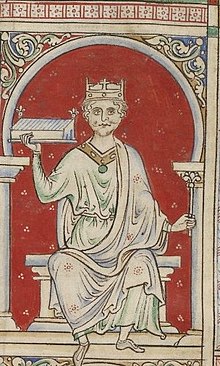
220px-William_II_of_England

King William II


The name comes directly from the Latin word meaning “red-headed.” It was a common Roman cognomen and was borne by a man who is referenced in Romans 16:13 and another who is referenced in Mark 15:21. According to Eastern Orthodox tradition, the aforementioned are one and the same person and is venerated as one of the Seventy Disciples mentioned in the Gospel of Luke. He is also popularly believed to be the son of Simon of Cyrene.

The name is borne by several other saints.

It was the nickname of King William II of England, known as William Rufus III on account of his red-hair.

The name appeared in the U.S. Top 100 2 times, in 1880 & 1882, peaking at #88 in 1880. It remained in the Top 1000 1988.

In England & Wales, the name was the 264th Most Popular Male Name in 2018.

Rufus is used in Dutch, Czech, English, Finnish, German, Latvian, Polish & the Scandinavian languages.

Other forms include:

  • Rufit (Albanian)
  • R’owp’osy Ռուփոսյ (Armenian)
  • Rufess (Bavarian)
  • Ruf Руф (Bulgarian, Catalan, French, Romanian, Russian, Serbian, Ukrainian)
  • Roufaous (Coptic)
  • Rufinus (Dutch, German, Latin, Scandinavian)
  • Ruffe (Finnish)
  • Ruuhva, Ruuhvus (Finnish)
  • Ryffe, Ryyfys (Finnish)
  • Rufin (French, German, Polish)
  • Rhouphon Ροῦφον (Greek)
  • Rúfusz (Hungarian)
  • Ruffo (Italian)
  • Rufillo, Ruffillo (Italian)
  • Rufino (Italian, Portuguese, Spanish)
  • Rufo (Italian, Portuguese, Spanish)
  • Rufinus (Latin)
  • Rufas (Lithuanian)
  • Rupuha (Maori)
  • Rúfus (Slovak)

150px-Santa_RufinaIts feminine form of Rufina was borne by a couple of early saints, one of whom was from Seville, she was a pottery maker who refused to sell her wares for a pagan festival.

Feminine forms include

  • Roufina (Coptic)
  • Rufe (French)
  • Rufine (French)
  • Rufina Руфина (Dutch, English, German, Hungarian, Italian, Polish, Portuguese, Romanian, Russian, Ukrainian, Scandinavian, Spanish)
  • Rufa (Italian)
  • Rufilla (Italian)

Sources

Cassius

Cassius


The name is of uncertain origin or meaning, it has been linked with the Latin cassus, meaning “hollow, empty, vain,” and the Latin cassis (metal helmet). It has also been suggested to be of Etruscan origins. It was the name of a Roman gens, which produced such Roman notables as Gaius Cassius Longinus (died 42 C.E.) who was one of the assassins of Julius Caesar; and Roman historian Cassius Dio (died 235 C.E). The Via Cassia is a namesake of the same clan.

The name was subsequently borne by several early saints, including Cassius of Clermont (3rd-Century C.E.) and Cassius of Narni (d. 558 C.E.). Its feminine forms of Cassia & Cassiana are also borne by several female saints.

A more recent notable bearer is Cassius Clay (1942-2016), which was the birth name of the American Boxer, Muhammed Ali, who was in turn named for his father who was named after the American abolitionist and politician Cassius Marcellus Clay, Sr (1810-1903).

Cassius has been in and out of the U.S. Top 1000 since 1880, between 1880-1895, it was among the Top 1000 and peaked at #425 in 1880. Between 1896-1964, the name did not appear in the U.S. Top 1000. He made a brief appearance in 1964 coming in as the 859th most popular male name. His sudden appearance in 1964 may be due to Muhammed Ali winning the world heavyweight championship of the same year. Between 1964-2008, Cassius was once again expelled from the top 1000. As of 2018, Cassius was 595th Most Popular Male Name in the United States. In England & Wales, he ranks in at #333.

Traditionally pronounced CASH-es in English, it is often shortened to Cash. Another form is Cassian (KASH-en).

Other forms include:

  • Kasi (Basque)
  • Kasian (Breton)
  • Cassi, Cássius (Catalan)
  • Kasije (Croatian, Serbian)
  • Kasián (Czech)
  • Cassianus (Dutch, Latin)
  • Cassius, Kassius (Dutch, German)
  • Cassian (German, Occitanian)
  • Kassian (German)
  • Cassie, Cassien (French)
  • Cassiano, Cassio (Italian)
  • Casiano, Casio (Spanish)
  • Kasiani (Kiswahili)
  • Kasijus (Lithuanian)
  • Kasjusz, Kasjan (Polish)
  • Cássiano, Cássio (Portuguese)
  • Kassij Кассий, Кассій (Russian, Ukrainian)

Feminine forms include:

  • Cássia, Cássiana (Catalan, Portuguese)
  • Kasija (Croatian, Lithuanian, Serbian)
  • Cassia, Cassiana (English CASH-uh, Italian, Occitanian)
  • Cassiane, Cassienne, Cassie (French)
  • Kasja, Kasjana (Polish)
  • Kassija (Russian, Ukrainian)
  • Casia, Casiana (Spanish)

Sources

Nora, Nour

1024px-Dawn._Buryatia,_Russia


This multicultural name has recently experienced a revival. In European countries, the name stems from any name ending in the -nora element, such as Honora & Eleanora. In Arabic, Nora is a variant transliteration of Nurah, which is a strictly feminine version of the unisex Arabic name, Nur (light). Nur is used as one of the 99 attributes of Allah, al-Nur (the light).

The name was used by Henrik Ibsen for his main character in his play, A Doll’s House (1878).

Outside of East Asia, there isn’t a counry where Nora is unhead of or is not in use. Nora has been in out of the U.S. Top 100 since 1880! She currently ranks in as the 30th Most Popular Female Name in the United States. Her rankings in other countries are as follows:

  • #2 (Norway, 2018)
  • #10 (Netherlands, 2018)
  • #11 (Hungary, 2018)
  • #14 (Switzerland, 2018)
  • #15 (Denmark, 2018)
  • #20 (Belgium, 2018)
  • #23 (Austria, 2018)
  • #26 (Catalonia, Spain, 2018)
  • #28 (Sweden, 2018)
  • #38 (Canada, BC, 2018)
  • #47 (Spain, 2018)
  • #64 (Norah, Netherlands, 2018)
  • #79 (Bosnia & Herzegovina, 2018)
  • #84 (Norah, Canada, BC, 2018)
  • #85 (Italy, 2018)
  • #119 (France, 2018)
  • #140 (Norah, United States, 2018)
  • #184 (Norah, France, 2018)
  • #197 (England & Wales, 2018)
  • #283 (Norah, England & Wales, 2018)

Its Dutch version of Noor also ranks high in several popularity charts. This name is also used by Muslim families as a variation of Nur. Her rankings in other countries are as follows:

  • #10 (Netherlands, 2018)
  • #25 (Belgium, 2018)
  • #279 (England & Wales, 2018)
  • #311 (France, 2018)

Noortje is another Dutch version which currently ranks in as the 203rd Most Popular Female Name in the Netherlands.

Other forms of its European version include:

  • Nora Нора Νόρα (Bulgarian, Greek)
  • Noera (Dutch)
  • Noor (Dutch)
  • Noortje (Dutch)
  • Norah (Dutch, English, French)
  • Nonie (English)
  • Noreen (English, Irish)
  • Noora (Estonian, Finnish)
  • Nóra Но́ра (Faroese, Hungarian, Irish, Russian)
  • Nuura (Finnish, Scandinavian)
  • Nóirín (Gaelic)
  • Norina (Italian, Provençal, Romansch)
  • Norá (Sami)
  • Norea (Scandinavian)
  • Norena (Scandinavian)
  • Noria (Scandinavian)
  • Norita (Spanish, Scandinavian)

The Arabic Nur is traditionally a unisex name which is popularly used in many Islamic countries. Its Maghrebi form of Nour currently ranks in the following popularity charts for girls:

  • #40 (Belgium, 2018)
  • #48 (Catalonia, Spain, 2018)
  • #48 (France, 2018)
  • #76 (Spain, 2018)
  • #137 (Italy, 2018)
  • #197 (Netherlands, 2018)

Nur is currently the 87th Most Popular Female Name in Bosnia & Herzegovina (2018).

Other forms of the Arabic version include:

  • Noora, Nura (Arabic, strictly feminine)
  • Noura (Maghrebi Arabic, strictly feminine)
  • Núria (Catalan)
  • Nor (Malay, unisex)
  • Nuru (Swahili, strictly feminine)

Sources

Zara

ZaraThe name has recently become a success in several countries, from England to Turkey, it has several possible derivatives and meanings.

Its English use may have been inspired by the Voltaire play, Zara (1732) (Zaïre in French) which may have been a French corruption of the Arabic female name, Zahra. The play recounts the exploits of a Christian woman named Zara or Zaïre, who is enslaved by Muslims. The name became extremely popular in the U.K. after Princess Anne chose this name for her daughter, Zara Phillips (b.1981).

Alternately, the name has recently become popular in many Slavic countries. It is probably a borrowing from the Bulgarian hypochoristic form of Zaharina (a feminine form of Zachary) or it may be from an Old Slavonic element, žar (fervor, ardor, ember).

Zara currently ranks in several countries’ top female names. Her rankings across the world are as follows:

  • #11 (Malaysia, 2016)
  • #22 (Bosnia & Herzegovina, 2016)
  • #23 (Australia, 2017)
  • #38 (New Zealand, 2016)
  • #40 (Scotland, 2016)
  • #46 (Slovenia, 2016)
  • #56 (Ireland, 2016)
  • #68 (England/Wales, 2016)
  • #197 (Netherlands, 2016)
  • #318 (United States, 2016)

Zara is also the name of a clothing store.

Sources

Majd, Majda

MajdOrigin: Arabic مجد
Meaning: exaltation; glory
Arab (MADGE); Serbo-Cro/Slov. (MYE-dah)

Majd is a traditional unisex Arabic name meaning “glory; exaltation.”

Majd is the acronym for the Algerian political party Mouvement Algérien pour la Justice et le Développement. Majd is also the name of a Lebanese political party.

Majda is also used among Bosnian Muslims as a Slavonic exclusive feminine form of the Arabic Majd; it is also used by Serbian, Croatians and Slovenes as a contracted form of Magdalena.

Another transliteration is Magd.

Sources


Myron

Myron

Origin: Greek
Meaning: “myrrh; perfume”
Gender: Masculine
Eng. (MY-ron); GRK (MEE-rone)

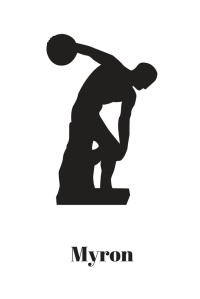
The name comes from the Greek meaning “myrrh; perfume.” It was borne by a 5th-century B.C.E Greek sculptor as well as several Christian saints.

In the United States, especially at the turn of the century, it was used among Jewish families as a form of the Hebrew Meir.

Myron is also the name of a genus of snakes.

For 100 years, between 1900-2000, it was in the U.S. Top 1000 Most popular male name. Myron peaked in 1931 when it was the 192nd most popular male name.

Other forms of the name include:

  • Mirón (Asturian/Galician/Portuguese/Spanish)
  • Miran Міран (Belarussian)
  • Miron Ми́рон (Bulgarian/Croatian/Romanian/Russian/Serbian/Slovenian/Ukrainian)
  • Miró (Catalan)
  • Myrón (Czech)
  • Myron (Dutch/English/French/German/Polish)
  • Mürón (Hungarian)
  • Mýron (Icelandic)
  • Mirone (Italian)
  • Mironi მირონი (Georgian)
  • Mironas (Lithuanian)

A feminine form is Myra.

Sources


Vuk

VukOrigin: Serbo-Croatian
Meaning: “wolf”
Gender: Masculine
(VOOK)

The name comes directly from the Serbo-Croatian word for “wolf” and has been in use since at least the 13th-century. According to tradition, the name was used on a child who had been born after multiple infant deaths, it was used as a sort of token against evil spirits.

The name was borne by several Medieval Serbian rulers and military leaders.

Vuk is also the name a novel and of the title character in the Hungarian children’s novella by István Fekete (1965).

Medieval feminine forms include: Vlkava and Vlčenka.

Sources

Katia, Katja, Katya

KatiaThe name is a Russian diminutive form of Ekaterina and spun off as a well-established independent given name across Western Europe. In Russian, this is the equivalent of Katie.

In France, Katia appeared among the Top 100 most popular female names between 1968 and 1979. Katia peaked at #42 in 1970. As of 2018, the name has not been in the French Top 1000 since 2004. Likewise, in Italy, it appeared in the Top 200 Most Popular Female Names between 1999 and 2007 and peaked at #141 in 1999. While in the United States, Katia appeared in the Top 1000 between 1996 and 2001 and peaked in 1996 at #772.

In the 1980s, Katja became extremely popular in Northern Europe, especially in Germany and Scandinavian countries.

In English, the name is sometime transliterated as Katya.

Its latinate form of Catia is occassionally used in Italy, Romania, Portuguese-Speaking and Spanish-speaking countries. Cátia and Kátia is used in Brazil.

As an independent given name, it is seldom used in Russia.

Countries/Languages in which Katia is in use: Bulgarian, Danish, English, French, German, Greek, Hungarian, Italian, Norwegian, Romanian, Portuguese, Spanish, Swedish.

Countries/Languages in which Katja is in use: Bosnian, Croatian, Danish, Dutch, Estonian, Finnish, German, Latvian, Macedonian, Norwegian, Serbian, Slovenian, Swedish

Sources