Adel, Adil

Gender: Masculine
Origin: Arabic عادل
Meaning: “just; fair.”

The name is derived from the Arabic adjective,  عدل  (adala), meaning, “just.”

The name is used throughout the Islamic world, though, the it is also used among Middle Eastern Christians.

As of 2009, Adel was the 285th most popular male name while Adil was the 378th most popular.

Other forms of the name include:

  • Adel پور (Algerian/Arabic/Coptic/Egyptian/Ethiopian/Kurdish/Lebanese/Persian/Sudanese/Syrian/Tunisian/Uyghur)
  • Adil Адиль
  • (Albanian/Azeri/Bangali/Baloch/Bashkir/Bosnian/Bulgarian/Chechen/Circassian/Dagestani/Kazakh/Moroccan/Ossetian/Pakistani/Tatar/Turkish/Turkmen/Uzbek)
  • Jedil/Yedil Эдил (Kyrgyz)

A feminine form is Adila (Arabic) and Adile (Turkish)

Ridha, Reza

Gender: Masculine
Origin: Arabic رضاء
Meaning: “contentment.”

The name is derived from the Arabic word and virtue, riḍā, a trait discussed in Sufism and the Qu’ran. Riḍā is used to describe the kind of pleasure or contentment one feels when they are following the commands and will of God and the approval that God bestows upon the follower therein.

The name is especially common among Shi’a Muslims, usually bestowed in reference to the concept or in honour of the 8th Shi’a Iman, ‘Alī al-Riḍā, also known as Ali Reza (765-818 CE).

As of 2009, its Maghrebin form of Reda was the 287th most popular male name in France.  Other forms of the name include:

  • Reda (Algerian/Berber/Moroccan/Tunisian)
  • Ridha (Arabic/Malaysian)
  • Riza (Azeri)
  • Reza رضا  (Persian)
  • Rıza (Turkish)

Nadir

Gender: Masculine
Origin: Arabic نادر
Meaning: “opposite.”
(NAH-deer)

The name is derived from the Arabic meaning, “opposite.” It is a term found in astrology, astronomy and topography referring to the point opposite the zenith.

As of 2009, Nadir was the 377th most popular male name in France.

A feminine form is Nadira.

Sabri

Gender: Masculine
Origin: Arabic صبريّ
Meaning: “patient.”
(SAH-bree)

The name comes directly from the Arabic meaning, “patient.”

As of 2009, Sabri was the 397th most popular male name in France.

Feminine forms are Sabriyya and Sabriye (Turkish).

Nabil

Gender: Masculine
Origin: Arabic نبيل
Meaning: “noble”
(NAH-BEEL)

The name comes from the Arabic meaning, “noble”, and is popular among Christians, Muslims and even Baha’i.

It was borne by a an early Christian saint and martyr, a king of Mauretania, who was martyred under his brother Gildon, who took the side of the Pagan Romans.

It was also borne by Nabíl-i-Akbar (1829-1892), one of the 19 Apostles of Bahá’u’lláh and the Great Nabíl (1831–1892), a renowned Bahai historian.

As of 2009, Nabil was the 399th most popular male name in France.

A Berber form is Navil and a feminine form is Nabila.

Said

Gender: Masculine
Origin: Arabic سعيد
Meaning: “happy.”
(sah-EED)

The name comes directly from the Arabic meaning, “happy.”

As of 2009, Said was the 459th most popular male name in France.

Other forms of the name include:

  • Said سعيد Саид (Albanian/Arabic/Azeri/Bosnian/Bulgarian/Chechen/Circassian/Dagestani/Egyptian/Indonesian/Iranian/Javanese/Kazakh/Kyrgyz/Lebanese/Ossetian/Pashtun/Syrian/Tatar/Turkmen/Uzbek)
  • Saïd (Algerian/Moroccan/Tunisian)
  • Sead (Bosnian)
  • Sejad (Bosnian)
  • Sait (Kurdish/Turkish)
The feminine form is Saida.
 

Idris

Gender: Masculine
Origin: Arabic إدريس‎ or Welsh
Welsh Meaning: “ardent lord.”
Arabic Meaning: uncertain

Idris is of two different origins and is used in two separate cultures. In Welsh, it is composed of the elements, udd (lord; prince) and ris (ardent, enthusiastic.” In Welsh mythology it was borne by a giant who used the mountain peak of Cadair Idris (Seat of Idris) as an observatory. Legends claims that if you spend one night on the mountain peak you wake up either as a madmen or as a great poet. The name was also borne by a 7th-century Welsh prince, Idris ap Gwyddno.

In the Qu’ran, the name is borne by a prophet, traditionally ascribed to being the same as the Biblical prophet Enoch. Many modern Islamic scholars now believe that Idris was a separate person from Enoch. In this case, the name is believed to be of pre-Islamic and possibly of non-Arabic roots of undeterminate etymology, some, however have connected the name with the Arabic root d-r-s, meaning, “study.”

As of 2009, Idris was the 479th most popular male name in France. In France it is used both among the Bretons and among recent Muslim immigrants.

Other forms of the Arabic include:

  • Idris إدريس‎) Идрис (Albanian/Arabic/Baloch/Bosnian/Bulgarian/Circassian/Dagestani/Ethiopian/Indonesian/Javanese/Malaysian)
  • İdris (Azeri/Turkish)
  • Idriss (Chadian)
  • Driss (Berber/Maghrebi Arabic)
  • Ydyrys Ыдырыс (Chechen/Kazakh/Kyrgyz/Tajik/Tatar/Turkmen/Uzbek)
  • Idrîs (Kurdish)
  • Idriis (Somali)
  • Idrissa (West African)

Eva, Eve

Gender: Feminine
Origin: Hebrew
Meaning: “life.”
Eng (EEV); (EE-vuh); Germ/Sp/Pol (EV-ah)

The name is borne in the Bible and in the Quran by the first woman created by God. She and her husband were expelled from the Garden of Eden after eating from the Tree of Knowledge.

The name is believed to be derived from the Hebrew roots חַוָּה, Ḥavvāh, from the Hebrew root ḥāyâ meaning “life” and the Semitic element, ḥyw “to live.” Both the Hebrew word chavah meaning “to live” and chayah meaning “to breath” share the same root.

Despite Eve’s fall from Grace in the Bible, the name was always in usage among Jewish, Christian and Muslim communities. In England, its usage can be traced back to the 12th-century. Its Latinate form of Eva, has always been a classic in continental Europe, especially in Germany, Poland, Slovakia and the Czech Republic.

As of 2010, Eva was the most popular female name in the Faroe Islanda and in Slovenia. Eve, Eva and all her various forms’ rankings in other countries are as follows:

  • # 3 (Iceland, 2010)
  • # 4 (French-speaking, Switzerland, 2010)
  • # 5 (Netherlands, 2010)
  • # 7 (Ieva, Lithuania, 2010)
  • # 10 (Armenia, 2010)
  • # 10 (Evie, England/Wales, 2010)
  • # 14 (Northern Ireland, 2010)
  • # 15 (France, 2009)
  • # 17 (Scotland, 2010)
  • # 20 (Belgium, 2009)
  • # 24 (New Zealand, 2010)
  • # 26 (Australia, NSW, 2010)
  • # 29 (Croatia, 2010)
  • # 31 (Evie, Scotland, 2010)
  • # 33 (Evie, Australia, NSW, 2010)
  • # 37 (England/Wales, 2010)
  • # 44 (Eevi, Finland among Finnish-speakers, 2010)
  • # 44 (Ireland, 2010)
  • # 46 (Austria, 2010)
  • # 47 (Canada, BC, 2010)
  • # 48 (Spain, 2010)
  • # 55 (Catalonia, 2010)
  • # 55 (Éabha, Ireland, 2010)
  • # 56 (Eve, Northern Ireland, 2010)
  • # 59 (Eve, Ireland, 2010)
  • # 86 (Norway, 2010)
  • # 91 (United States, 2010)
  • # 92 (Eve, England/Wales, 2010)
  • # 99 (Eve, Australia, NSW, 2010)
  • # 201 (Eve, France, 2009)
  • # 589 (Eve, United States, 2010)
  • # 705 (Evie, United States, 2010)

Other forms of the name include:

  • Eva Ева ევა
    (Afrikaans/Albanian/Armenian/Basque/Belarusian/Bosnian/Catalan/Croatian/Czech/Dutch/Faroese/French/Frisian/Galician/Georgian/German/Icelandic/Italian/Portuguese/Romansch/Spanish/Scandinavian)
  • Evis (Albanian)
  • Mahalet/Mahlet (Amharic)
  • Hawa حواء Хауа (Arabic)
  • Yeva (Armenian)
  • Həvva (Azeri)
  • Yeva Ева Эва (Belarusian/Russian/Ukrainian)
  • Yevga Евга (Belarusian)
  • Hava (Bosnian)
  • Evy (Danish/Norwegian/Swedish: initially a diminutive form, occasionally used as an independent given name)
  • Eveke (Dutch: initially a diminutive form, used as an independent given name, EV-eh-ke)
  • Eve (English/Estonian/Walon)
  • Evie (English)
  • Hawat/Hewa (Egyptian/Coptic)
  • Eeva (Estonian/Finnish)
  • Eevi (Estonian/Finnish)
  • Evi (Estonian)
  • Ivi/Iivi (Estonian)
  • Iivika (Estonian)
  • Ève (French)
  • Eefje, Eefke (Frisian)
  • Hawwa ሕይዋን (Ge-ez)
  • Eua Ευα (Greek)
  • Chava חַוָה (Hebrew: Modern: KHAH-vah, gutteral CH sound)
  • Éva (Hungarian: AY-vaw, diminutive form is Évike)
  • Hawa (Indonesian/Malayalam)
  • Éabha (Irish-Gaelic)
  • Ieva (Latvian/Lithuanian: YEH-vah)
  • Evuzus (Malaysian)
  • Aaue (Manx)
  • Èva (Occitanian)
  • Ewa (Polish: EH-vah, diminutive forms are Ewka, Ewunia and Ewusia)
  • Evá (Sami)
  • Evelia (Spanish)
  • Evita (Spanish)
  • Eba (Tagalog)
  • Havva (Turkish)
  • Efa (Welsh)

Italian masculine form is Evo.

Traditionally, in most European countries, the name-day for Adam and Eve is December 24.

Lamia

Gender: Feminine
Origin: Arabic  لامعة
Meaning: “bright; radiant.”
(LAH-mee-ah)

The name is derived from the Arabic, لمعان (lamian) meaning, “shining.”

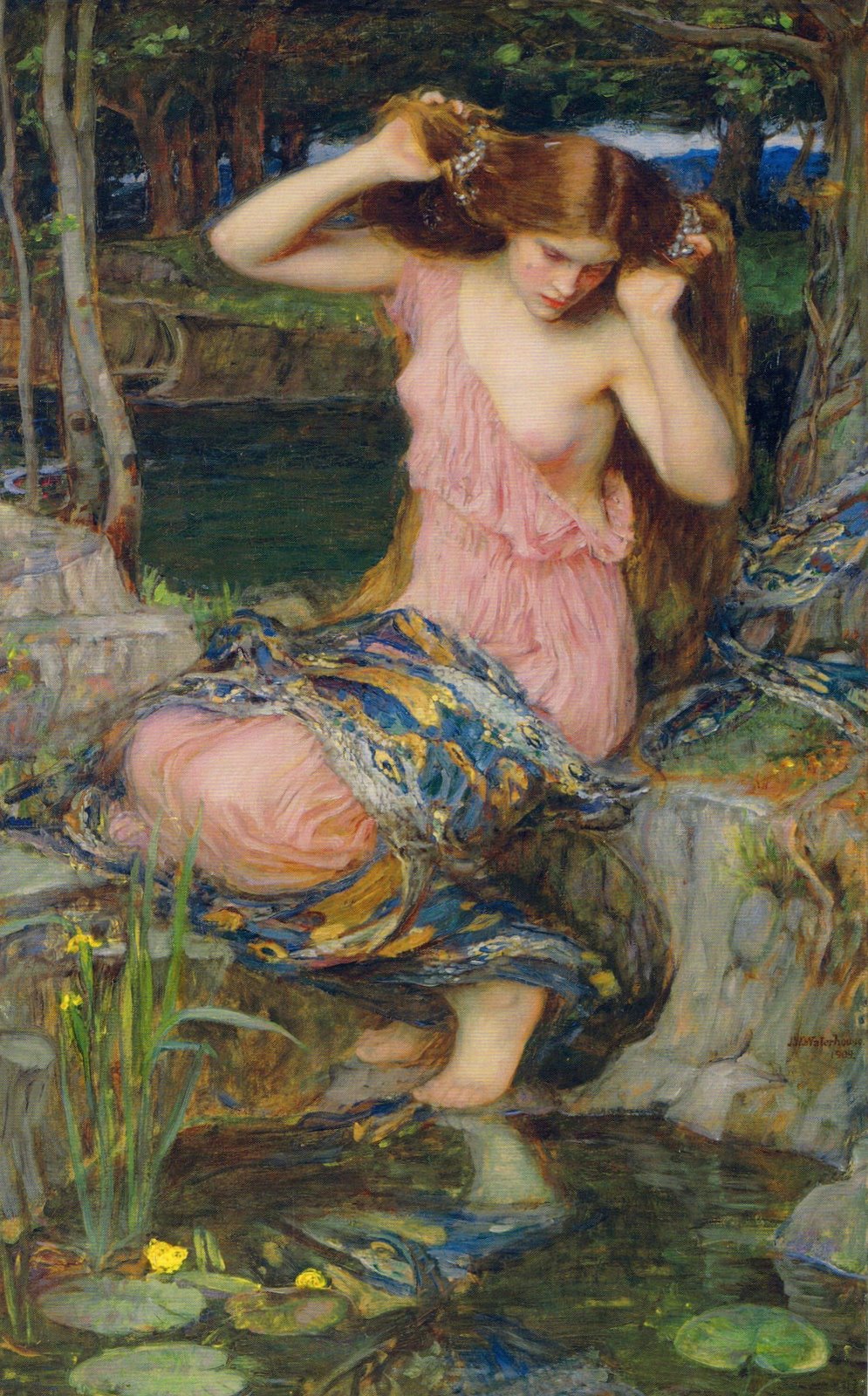
The name appears in Greek mythology as the name of a Greek mythological female creature on par with the vampire. In this case, it has been suggested that the name is derived from the Greek λαιμός (laimos) meaning, “gullet.” However, since the mythical creature was believed to originally been a Libyan queen, the name may be of Semitic roots and may actually be one in the same with the Arabic female name.

In Greek Mythology, Lamia was said to be a beautiful Libyan queen who later became an child eating demon. She is depicted as having a half-serpent body.

The name also appears in Basque folklore as the name of a type of undine with duck feet. Due to its ominous associations in Greek Mythology, the name has never been used in the Western World.

John Keats wrote an eponymous poem which immortalizes the creature.

As of 2010, the Bosnian form of Lamija was the 2nd most popular female name in Bosnia & Herzegovina.

A variant transcription is Lamya.