Ralph

Gender: Masculine
Origin: Old Norse
Meaning: wolf counselor
British English (RAFE); American English (RELF)

The name is derived from the Norse male name, Raðulfr, which is composed of the elements, rað (counsel) and ulfr (wolf). The name has been in usage in England since Anglo-Saxon times, due to viking settlers and remained common even after the Norman conquest. Throughout the centuries, the name has gone through an evolution. In Medieval times it was often rendered as Ralf, then by the 17th-century it was commonly spelled Rafe to reflect the proper pronunciation and by the turn of the century Ralph became a household name (pronounced RELF) in the United States. Within the United States, it was also commonly used as a diminutive form of Raphael or at least as an English equivalent by various immigrants.

The highest the name has ever ranked in U.S. naming history was between 1914 and 1917, consecutively ranking in at # 21. As of 2010, it was the 968th most popular male name. It is currently the 447th most popular male name in the Netherlands (2010).

Its Latin equivalent of Raul ranked in significantly higher, it was the 336th most popular male name in the United States (2010), the 48th most popular in Catalonia (2009) and the 32nd most popular in Spain (2010)

Other forms of the name include:

Raül (Catalan)
Rafe (English)
Ralf (English/German/Scandinavian)
Raul (Estonian/Italian/Portuguese)
Raoul (French)
Radulf (German)
Raulo (Italian)
Rault (Old French)
Raoult (Old French)
Roul (Old French)
Raðulfr (Old Norse)
Raou (Occitanian)

Raúl (Spanish)

Ralphie is a common diminutive form in the English-speaking world.

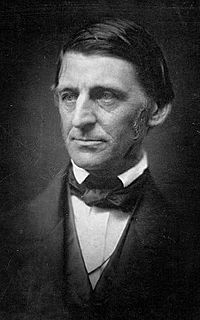
The name was borne by a 12th-century male saint. It is also borne by Ralph Waldo Emerson.

Designated name-days are: March 7 (Estonia), March 27 (Sweden) July 7 (France), August 27 (Sweden)

Raul is also the name of a volcanic island in the Kermadec archipelago.

Sources

  1. Ernst Förstemann, Altdeutsches namenbuch (1900), page 1219
  2. http://www.behindthename.com/name/ralph

Lorena

Gender: Feminine
Origin: English
(loh-RAY-nah)

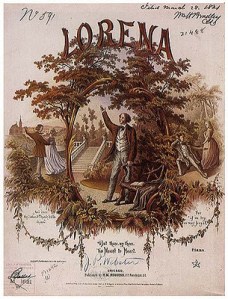
Though it has a latinate sound, Lorena seems to be a very early American invention. It first appears out of nowhere as the subject of a 1856 song, written by a Rev. H.D.L Webster. It is almost for certain that Webster invented the name himself. The song is about a broken relationship Webster had with a girl named Ella Blocksom. He is said to have been inspired by Edgar Allen Poe’s ladylove, Lenore of the Raven, by rearranging the letters, he came up with the sonorous Lorena.

The song was such a hit during the American Civil war that it was often sung by both Confederate and Union soldiers, usually while remembering their far off wives or ladies they courted. No doubt, this caused the name to become a standard and over the past 150 years, it has reached other shores. It is now used across Europe including the former Yugoslavia. In fact, it is currently the 13th most popular female name in Croatia (2009) and the 86th most popular in Bosia and Herzegovnia (2010). Its ranking in other countries, including the United States, are as follows:

#82 (Spain, 2010)
# 238 (the Netherlands, 2010)
#357 (France, 2009)
#964 (United States, 2010)

The name also appears in Margaret Mitchell’s Gone with the Wind as Scarlett O’Hara’s second daughter by Frank Kennedy, Ella Lorena Kennedy.

It is also the name of a municipality of São Paolo, Brazil, a city in Texas and is used as an alternate name for the Ghost Town of Masonic, California.

Source

  1. http://www.behindthename.com/name/lorena-2
  2. http://www.behindthename.com/name/lorena-1

Thaddeus

Gender: Masculine
Origin: Aramaic
Meaning: uncertain
Eng (THAD-dee us; TAD-dee-us)

The name is a Greek transliteration of the Aramaic male name, Thaddai, which is argued to either be derived from an Aramaic word meaning heart or to be an Aramaic version of the Greek male name, Theodore.

In the New Testament, the name is borne by one of the 12 Apostles, known as Jude Thaddeus, especially among Catholics. He is popularly known as St. Jude, St. Thaddeus or St. Jude Thaddeus and is venerated as the patron saint of lost causes.

In American history, the name was borne by the Polish borne revolutionary hero, Taddeusz Kosciuszko (1746-1817).

In 2010, Thaddeus was the 983rd most popular male name in the United States. In Slovenia, Tadej was the 58th most popular male name of 2010.

The name Tadeusz, has always been a popular male name in Poland, it is the name of the title character of one of Poland’s beloved literary classics, Pan Tadeusz by Adam Mickiewicz.

Other forms of the name include:

Aday (Aramaic)
T’adeos Թադէոս (Armenian)
Tadevuš (Belarusian) (tah-DEH-voosh)
Tadija (Croatian) (TAH-dee-yah)
Tadeáš (Czech/Slovak) (tah-deh-AHSH)
Thaddée/Taddée (French) (tah-DAY)
Thaddäus (German) (tad-DAY-oos)
Thaddaeus/Thaddaios  Θαδδαιος (Greek: Biblical)
Tádé (Hungarian) (TAH-day)
Taddeo (Italian) (tah-DAY-o)
Tadas (Lithuanian) (TAH-dahs)
Tadeušas (Lithuanian) (TAH-deh-oo-SHAHS)
Tadeusz (Polish) (tah-DAY-oosh)
Tadeu (Portuguese)
Faddei/Faddey Фаддей (Russian) (FAD-day)
Tadej (Slovene) (tah-DAY)
Tadeo (Spanish) (tah-DEY-o)

Common English diminutives are Tad, Thad and Teddy. In Polish it is Tadek.

The designated name-days are: June 25 (Slovakia), October 28 (Poland) and October 30 (Czech Republic),

Feminine forms include the Italian, Taddea and the Polish, albeit rare, Tadea.

Source

  1. http://www.behindthename.com/name/thaddeus

Pamela

You must be wondering why I would blog about a name that was invented in the 17th-century, well, I figure, over the centuries, Pamela has made such an impact on English literature that she deserves a post on Legitimate Baby Names.

The name, as mentioned above, was invented by Sir Philip Sidney for his Greek inspired work Arcadia.  It is believed that he created the name out of the Greek elements, pan (all) and meli (honey). It was also originally intended to be pronounced (puh-MEE-lah)!

A century later, another British author, Samuel Richardson, used the name for his heroine in his epistology Pamela also known as Virtue Rewarded (1740).  The novel recounts the forbidden love between a British nobleman and his servant, Pamela.

It was used as the nickname for Lady Edward FitzGerald (1773-1831), the wife of Lord Edward, and a bold supporter of Irish independence. Her real name was Stephanie Caroline Anne, and it is unknown as to why she was referred to as Pamela for most of her life, but it is the first time Pamela makes an appearance as a given name in the real world.

Pamela did not break out in popularity until the 1920s, even then, she ranks at a very low 848. By 1953, she made it in the top ten, coming in as the tenth most popular female name in the United States. Currently, Pamela only ranks in as the 983rd most popular female name (2010).

In recent years, due to several famous bearers, the name has recently made an appearance in other countries.  She has been used in Germany, Poland, France, Hungary, Italy, Finland, Sweden and in Spanish-speaking countries. There is even a French equivalent, Pamèle.  Though the name is inspired by Greek, it has yet to make an introduction into Greece.

Its common diminutive is of course Pam and the most famous bearer is Pamela Anderson.

Source

  1. http://www.behindthename.com/name/pamela/comments

Daniel, Danielle

Gender: Masculine
Origin: Biblical Hebrew
Meaning: “God is my Judge.”

If you are like me, you probably think Daniel is dull and overused. Then there is the other camp who might think this is a wonderful classic. It has the youthful nickname options of Dan and Danny and its used in just about every European country with such variants as the Italian Daniele and the Czech and Polish diminutive forms of Danek. Another plus is that, while the name has religious connotations, its doesn’t adhere to a specific denomination. It is fair game for both Jewish and Christian parents alike, Catholic and Protestant. It is even used among Muslims.

The name Daniel is found in the Old Testament, (it has its own book), composed of the Hebrew elements dan meaning “judge” and the 1st person possessive singular suffix of i plus El which was a reference to God.

As for the Biblical Daniel himself, according to the Bible, he was a Jewish boy who was captured by the Babylonians and employed as a sort of dream-reader, (sounds like a pretty cool job). Daniel was so good at his job that he eventually became famous, even among his Persian and Babylonian captives. Due to his prestige and influence, Daniel was also able to persuade his captors to release the Jews back to their homeland. There is far more to the Biblical Daniel’s story than I will write here, but he is probably most noted for his steadfast loyalty to his faith and people as well as his miraculous survival after being thrown in a den of lions.

In the United States, Daniel has been steadfast in its popularity. He currently comes in at # 5. Meanwhile, in the United Kingdom, he comes in at # 7. In Scotland at # 3. In Ireland # 4. While in Spain he comes in at a whopping # 2.

This forms is also used in the Czech Republic, Finland, French-speaking countries, German-speaking countries, Poland, Portuguese-speaking countries, Romania,  Scandinavia, Slovakia and Spanish-speaking countries

Other forms include :

  • Dana (Afrikaans)
  • Danieli (Albanian)
  • Danyal دانيال (Arabic)
  • Taniel (Armenian)
  • Danel (Basque)
  • Danilo (Bosnian/Croatian/Serbian)
  • Deniel (Breton)
  • Danail Данаил (Bulgarian)
  • Danelu (Corsican/Sardinian/Sicilian)
  • Daan (Dutch/Limburgish)
  • Daniël (Dutch)
  • Daaniel/Taaniel (Estonian)
  • Tanel/Tani (Estonian)
  • Taano/Tanno (Estonian)
  • Taneli/Tatu (Finnish)
  • Dāniyyêl דָּנִיֵּאל (Hebrew: Modern)
  • Dániel (Hungarian)
  • Daniló (Hungarian)
  • Dános (Hungarian)
  • Daniele (Italian: dahn-YAY-lay)
  • Daniello (Italian: an archaic version which died out in the 17th-century)
  • Danilo/Danilio (Italian: obscure)
  • Danielius (Lithuanian)
  • Daniilu Данїилъ (Old Church Slavonic)
  • Dani داني (Persian)
  • Daniyal دانيال (Persian)
  • Danil/Dănuṭ (Romanian: duh-NOOTS)
  • Daniil Даниил (Russian)
  • Daniele/Danijel (Slovene)
  • Dani/Däne/Dänu/Danü (Swiss-German: Bern dialect)
  • Danyal/Danyel(Turkish)
  • Deiniol (Welsh)

Czech diminutives are: Dan, Daník, Daneček, Danoušek, Danny, Dandýsek, Dady, Danda, Dáda, Danda, Dannys, Danušík and Dandýsek, Italian diminutive forms are: Nilo, Danio, Danino and Nilio.

Danya Даня is a common Russian and Ukrainian diminutive form.

Let us not forget its feminine versions of Daniella, Daniela and Danielle. As of 2010, its Spanish and Slavic diminutive form of Dania reached the top 1000, coming in as the 999th most popular female name in the United States.

The French Danielle, does not have the same staying power as its masculine counterpart. Though always more common as a middle name, Danielle is one of the quintessential names of the 1980s. In 1987, she came close to reaching the top 10 by hitting # 14. In the last popularity census, Danielle still comes in rather high at # 144.  Its Latinate counterpart of Daniela comes in a tad bit higher at # 121, while the Italian Daniella is all the way down at # 303.

Other forms are:

  • Danijela (Bosnian/Croatian/Serbian/Slovene)
  • Danaila (Bulgarian)
  • Daniela (Czech/German/Polish/Portuguese/Romanian/Scandinavian/Slovene/Spanish)
  • Danielle (English)
  • Danièle (French)
  • Danelia (Italian: obscure)
  • Daniella (Italian)
  • Danila/Danilla (Italian: obscure)

Italian feminine diminutives are : Dana, Dania and Nila.

Designated name-days are: July 21 (Germany/Hungary/Slovakia), December 10 (Poland/Lithuanian), December 11 (Denmark, Estonia, Finland, France, Norway, Sweden), December 17 (Greec/Czech Republic)
Snow Day! Snow Names

Was your baby a snow baby? Born on a snow day? Or perhaps you are just curious to see if here are any names with the meaning of “snow; ice or blizzard.”

As part of the holidays and in honour of the snow rich winter season, I have compiled a list of “snowy” “icy” baby names. Enjoy!

Male

Alluaq “hole in the ice for fishing” (Greelandic)
Andri “snow shoe” (Old Norse)
Anil “wind” (Sanskrit)
Aputsiaq “snowflake” (Greenlandic)
Edur“snow” (Basque)
Fannar “snow drift” (Icelandic)
Frediano “cold” (Italian)
Frosti “frost” (Icelandic)
Govad “the wind” (Persian)
Hjarnar “hard; frozen snow” (Old Norse)
Ilgar “first snow” (Azeri)
Isbert “bright ice” (Frisian)
Isbrand “ice sword” (Frisian)
Izo “ice” (Frisian)
Izozts “ice” (Basque)
Jouko “snow; ice” (Finnish)
Persoq “snow flurry” (Greenlandic)
Pyry “blizzard” (Finnish)
Sarmis “snowfrost” (Latvian)
Sheleg “snow” (Hebrew)

Female

Biruta “snow” (Lithuanian)
Bora “snow” (Albanian)
Dëborake “snow” (Albanian)
Drífa “snowdrift” (Icelandic)
Edurne “snow” (Basque)
Eira “snow” (Welsh)
Eirlys “snowflake” (Welsh)
Elurreta “snowing” (Basque)
Ensilumi “snowfall” (Finnish)
Era “wind” (Albanian)
Esen “the wind” (Turkish)
Fanndís “snow goddess” (Icelandic)
Flykra “snow flake” (Faroese)
Fulga “snowflake” (Romanian)
Fönn “lots of snow” (Icelandic)
Gheata “ice” (Romanian)
Gwyneira “white snow” (Welsh)
Haizea “wind” (Basque)
Halla “frost” (Finnish)
Helbe/Helve “flake” (Estonian)
Himani “snow” (Sanskrit)
Hófehérke “snow white” (Hungarian)
Hukupapa “frost” (Maori)
Ishild “ice battle” (German)
Ilgara “first snow” (Azeri)
Jökla “icicle; glacier” (Icelandic)
Kassoq “bluish piece of ice” (Greenlandic)
Koyuki “little snow” (Japanese)
Kukiko “child of the snow” (Japanese)
Lumi “snow” (Finnish)
Miyuki “silent snow” (Japanese)
Mjöll “fluffy snow” (Icelandic)
Neus “snow” (Catalan)
Neves “snows” (Portuguese)
Nieves “snows” (Spanish)
Nilak “fresh water ice” (Greenlandic)
Pärsla “flake” (Latvian)
Patil “snowflake” (Armenian)
Pire “snow” (Mapuche)
Qinoq “ice sludge'” (Greenlandic)
Tuyét “snow” (Vietnamese)
Sarma/Sarmite “snowfrost” (Latvian)
Shilga “snow” (Hebrew)
Snezhana “snow” (Bulgarian/Croatian/Russian)
Snezhala “snow” (Bulgarian)
Sniedze (Latvian)
Snöfrid “snow peace; snow beauty” (Old Norse)
Snædís “snow goddess” (Icelandic)
Snieguolė “little snow” (Lithuanian)
Śnieżka “little snow” (Polish)
Taidi “snow white” (Estonian)
Tuuli “wind” (Finnish)
Yukiko “snow child” (Japanese)

Gunnar

Gender: Masculine
Origin: Old Norse
Meaning: “war warrior.”
Eng (GUN-ner); Swe (GOON-nahr)

The name is composed of the Old Norse elements, gunnr (war) and arr (warrior).

The name was borne a legendary 5th-century Burgundish king. His exploits appear in the ancient Germanic poetic text Nibelungelied and the Medieval poem Walthurius.

In the Nibelungelied he is mentioned as the King of Worms, the husband of Brunhild and the brother of Kriemhild, whom Siegfried comes to woo.

In some tales, he was betrayed by Attila the hun and murdered by him.

The same character later appears in JRR Tolkien’s epic poem based on Norse legend, The Legend of Sigurd and Gudrun.

Gunnar did not appear in the U.S. top 1000 till 1991 coming in as the 705th most popular male names, as of 2009, he was the 551st most popular male name.

Other forms of the name include:

  • Gūðhere (Anglo-Saxon)
  • Gondicari (Catalan)
  • Vintíř (Czech)
  • Gunder (Danish/Norwegian/Swedish)
  • Gunnar (Danish/English/Estonian/Norwegian/Swedish)
  • Gunner (English/Norwegian/Swedish)
  • Gundur (Faroese)
  • Kunkku (Finnish)
  • Kunnari (Finnish)
  • Kunto (Finnish)
  • Gondicaire (French)
  • Gundohar (Frisian/Dutch)
  • Gundahar (German: archaic)
  • Günter/Günther (German/Hungarian)
  • Gunther (German)
  • Gunter (German/Polish/Spanish)
  • Gundicaro (Italian)
  • Gundaharius (Late Latin)
  • Gunnarr (Old Norse)
  • Gunnár (Sami)
  • Gundo (Swedish)
  • Gunnerius (Swedish: archaic)

The name was also borne by a medieval Czech saint.

The designated name-days are January 8 (Estonia); January 9 (Sweden) and October 9 (Germany).

Sources

  1. http://www.behindthename.com/name/gunnar
  2. http://www.nordicnames.de/wiki/Gunnarr

Thaïs

Gender: Feminine
Origin: Greek
Meaning: debated
Θαΐς
(tye-EES)

The name is of uncertain derivation, though it has been suggested to be from a Greek source meaning “bondage.”

In history, the name was borne by a hetaera (concubine) of Alexander the Great. She is credited by historians for pursuading Alexander to burn down his palace.

Thaïs the concubine is credited more for her fictional roles. In Terence’s Eunuchus, the female protoganist of the same name is loosely based off of her.

In Dante’s Divine Comedy, she is depicted in Hell in the circle of the flatterers (Inferno, XVIII,133-136).

The name was also borne by an early Greek Christian saint. In 1890, Anatole France wrote a novel based on her life, a novel which was later adapted by Jules Massenet into a famous opera of the same name.

Other forms of the name include:

  • Taís (Catalan)
  • Thaïs (English/Greek/French)
  • Thais (German/Spanish)
  • Taide (Italian)
  • Taida (Polish)
  • Taisa/Taisiya Таисия (Russian)
  • Taja (Slovene)
  • Tajda (Slovene)
  • Tajka (Slovene)
  • Tajša (Slovene)

In France, the designated name-day is October 8.

Source

  1. http://www.behindthename.com/name/thais

Edmund

Gender: Masculine
Origin: English
Meaning: “rich protector.”
Eng (ED-mund)

The name is composed of the Anglo-Saxon elements, ead (wealth; riches) and mund (protector).

The name was quite common in Medieval England, both before and after the Norman conquest, and remained common all the way up until this century.

It was borne by two English kings and by two saints.

The highest the name has ranked in U.S. naming history was in 1913, when Edmund was the 130th most popular male name. As of 2009, he does not even rank in the U.S. top 1000.

Other forms of the name include:

Eadmund (Anglo-Saxon)
Edmund (Czech/English/Estonian/German/Polish/Slovak/Slovene)
Edmundur (Faroese)
Edmé (French: archaic)
Edmond (French)
Emond (German)
Ödön (Hungarian)
Játmundur (Icelandic)
Jetmund (Icelandic)
Eamon/Éamonn (Irish-Gaelic)
Edmeo (Italian)
Edmo (Italian)
Edmondo (Italian)
Edno (Italian)
Edmao (Limburgish)
Mao (Limburgish)
Edmundo (Portuguese/Spanish)

Feminine forms include:

Edmonia (English)
Edmée (French)
Edma (Italian)
Edmea (Italian)
Edmonda (Italian)

Nicknames include:

Ed, Eddie, Ned (Dutch/English)
Edi/Edo (Czech/Slovak)
Ödi (Hungarian)

Notable bearers include: English poet Edmund Spenser (1552-1599); Czech philosopher, Edmund Husserl (1859-1938) and New Zealand mountaineer Sir Edmund Hillary (1919-2008)

The designated name-days are:

October 6 (Estonia); October 16 (Poland); October 30 (Poland); November 20 (Poland); December 1 (Poland/Slovakia); March 18 (Sweden).

Source

  1. http://www.behindthename.com/name/edmund

Placid

Gender: Masculine
Origin: English

The name is the English form of the Latin, Placidus, meaning “calm; placid.”

The feminine form of Placidia was borne by the daughter of Emperor Theodosius I.

The name was never very common in the English-speaking world, however, it was occasionally used by the Puritans.

Other forms the name include:

Placid (English/Hungarian)
Placidino (Italian)
Placido (Italian)
Placyd (Polish)
Plácido (Portuguese/Spanish)
Placidus (Latin)

Feminine forms include:

Placide (French)
Placida (Italian)
Placyda (Polish)
Placidia (Sardinian/Sicilian)

The designated name-day throughout Europe is October 5.

The name is borne by 6th-century Italian monk, St. Placido; 17th-century English Protestant Minister, John Placid Adelham; 20th-century Catholic Indian theologian, Father Placid J Podipara; world famous Spanish tenor and opera singer, Plácido Domingo.

Source

  1. http://www.behindthename.com/name/placide