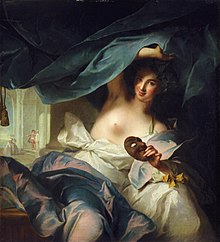
Celia

Gender: Feminine
Origin: Latin
Meaning: “heaven”
Eng (SEE-lee-uh); It (CHEY-lee-ah); Sp (SEY-lee-ah; THEY-lee-ah)

The name is a feminine form of the Roman family name, Caelius, which is derived from the Latin caelum meaning, “heaven.” Alternately, it has also been suggested to be derived from the Estruscan word celi (September).

The name is found as the name of a character in William Shakespeare’s As You Like It (1599).

In the English-speaking world, it is occassionally used as a short form of Cecilia.

Currently, Celia is the 743rd most popular female name, but she is even trendier in other countries. Her rankings are as follows:

# 35 (France, 2008)
# 36 (Spain, 2010)
#49 (Belgium, 2010)
# 89 (Catalonia, 2010)

Other forms of the name include:

Caelia (Ancient Roman)
Zelia (Basque)
Cèlia (Catalan)
Célia (French/Portuguese)
Célie (French)
Zélie (French)
Silke (German/Plattdeutsch)
Silja (Frisian)

A more unusual Italian and Spanish masculine form is Celio and the Polish Celiusz.

Sources

  1. http://www.behindthename.com/name/celia
  2. http://es.wikipedia.org/wiki/Celia_(nombre)

Brice

Gender: Masculine
Origin: English
Eng (BRICE); Fre (BREES)

The name is derived from the Latinized Gaulish name, Bricius, which is in turn derived from a Celtic root either meaning “speckled” or “enchantment.”

The name was borne by a 5th-century saint and disciple of St. Martin of Tours.

Currently, Brice ranked in as the 867th most popular male name in the United States (2010), unfortunately, it’s non-legit spelling of Bryce is the 112th most popular male name. This spelling has only seemed to have appeared within the last 10 years, possibly to reflect the proper English pronunciation.

Other forms of the name include:

Brcko (Croatian)
Bricije (Croatian)
Brizio (Italian)
Brictius (Late Latin)
Bricius (Late Latin)
Brixius (Late Latin)
Bricio (Spanish)

In France, the designated name-day is November 13.

Source

  1. http://www.behindthename.com/name/brice

Luz

Gender: Feminine
Origin: Portuguese/Spanish
Meaning: “light”
Sp (LOOTH); (LOOZ); Por (LOOSH)

The name comes directly from the Spanish word for light, as a given name it started to be used in honour of the Virgin Mary as one of her epithets is Neustra Señora de la Luz (Our Lady of Light).

Its Italian and French equivalent is Luce It (LOO-chey); Fre (LUYS)

It is currently the 744th most popular female name in the United States, 2010.

Its designated name-day is June 1.

Source

  1. http://www.behindthename.com/name/luz
  2. http://es.wikipedia.org/wiki/Luz_(nombre)

Landry

Gender: Masculine
Origin: German
Meaning: “land ruler.”
Eng (LAN-dree); Fre (LAWn-DREE)

Considered the second oldest surname in France, it is a name steeped in history and religion. It is currently one of the most popular male names among Cajun-Americans.

The earliest record of the name Landry is in the 5th-century, where it is recorded as the name of the Bishop of  Sées, later canonized as a saint. In the 5th-century it was borne by another male saint, St. Landry the Bishop of Paris, he is particularly noted for founding the first hospital in Paris, the Hôtel-Dieu. Another Medieval saint who bears the name is St. Landry of Metz.

The name was such a common given name in Medieval France that it later carried over as a patronymic.

St. Landry Parish in Louisiana was named by French settlers in honour of St. Landry of Paris. The name has since fallen out of fashion in France but has remained a classic among the Acadians of Louisiana. In fact, it is currently the 891st most popular male name in the United States, 2010.

The name is derived from the Frankish name, Landericus, which is composed of the Germanic elements, land (land) and ric (power; rule; might).

The name is currently borne by American football player, Landry Jones (b.1989).

It is the name of a town in France, which was also named in honour of St. Landry of Paris.

Other forms of the name include:

Landerik (Czech)
Landerico (Italian/Spanish)
Landeryk (Polish)

Source

  1. http://www.behindthename.com/top/lists/us/2010

Samson

Gender: Masculine
Origin: Hebrew
Meaning: “sun”

Of all the Sam names, Samson seems to be the least appreciated, ranking only as the 867th most popular male name in the United States (“Popular Baby Names.” Social Security Administration. 2011. Social Security Online. 1 Sept. 2011. http://www.ssa.gov/oact/babynames/)

The name is found in the Old Testament as the name of one of the Israelite judges. He was given supernatural strength by God. However, when he admitted to Delilah that the secret to his power was in his hair, she had it shaven off while he was sleeping.

It is derived from the Hebrew שִׁמְשׁוֹן (Shimshon) meaning “sun.”

The name was first introduced in England after the Norman conquest due to the veneration of a Welsh bishop who founded monasteries in Brittany and Normandy.

In Basque folklore it is found as the name of a mighty giant who is attributed to creating the Pyrenees by throwing stones.

Other forms of the name include:

Shamshoun شمشون‎ (Arabic)
Sanson (Basque)
Samzun (Breton)
Samsó (Catalan)
Samson Самсо́н (Czech/English/French/Norwegian/Polish/Russian/Ukrainian/Welsh)
Simson (Dutch/Finnish/German/Swedish)
Sampson Σαμψών (Greek)
Shimshon  שמשון (Hebrew)
Sámson (Hungarian)
Sansone (Italian)
Samsonas (Lithuanian)
Sansão (Portuguese)
Sansón (Spanish)

The designated name-days are: July 10 (Poland) and July 28 (Poland and France).

Common English short forms are Sam and Sammie. In Polish, the diminutive is Samsonik.

Source

  1. http://www.behindthename.com/name/samson

Patience

Gender: Feminine
Origin: English

She is the quintessential Puritan name, however, evidence suggest the name has been in usage far longer than early Colonial America.

It was popularized as a given name by early Christians, the Greeks referred to Constantine’s mother, St. Helen as Ypomoni (Patience). It was Latinized as Patientia and is found as the name of an early Christian martyr.

Its popularity was only enhanced later by the Puritans.

It is currently the 800th most popular female name in the United States, (2010).

Other forms of the name include:

Patientia (Latin)
Patience (French/English)
Ypomoni (Greek)
Pazienza (Italian)

Paciencia (Spanish)

Source

  1. http://www.behindthename.com/name/patience

Precious

Gender: Feminine
Origin: English

Yes! Precious is a legitimate name. Its usage goes all the way back to early Medieval England, and it was quite a common female name in its myriad forms across Western Europe.

It is first attested as a female given name in England in the year 1203, then again in 1279 and in 1327. It was common in Medieval Europe to give females names with nice attributes.

Preziosa appears in Medieval Italy and Preciosa is occassionally used among Spanish-speakers, sometime in reference to the Precious Blood of Christ.

Precious seems to have fallen out of usage by the 15th-century and was not revived until the late 20th-century. In the United States, it is more prevalent in the African-American community.

It is currently 958th most popular female name in the United States (2010).

Sources

  1. http://www.behindthename.com/name/precious
  2. http://www.s-gabriel.org/names/talan/reaney/reaney.cgi?Precious

Thalia

Gender: Feminine
Origin: Greek Θαλεια Θαλία
Meaning: “to blossom” or “abundance”
(THAHL-ee-ah); (TAHL-ee-ah); (tuh-LEE-ah)

A Greek name of a few different etymologies, Thalia could be derived from the ancient Greek Θαλεια (thaleia) meaning “to blossom.” In this case, it was borne by the Muse of Comedy and Idyllic Poetry.

It could also be derived from Θαλία (Thalía) the Greek word for abundance, an adjectival term used to describe lavish parties and banquets. It was borne by the Greek personification of one of three Graces or Charities. Thalia presided over festivities and celebrations.

The name is also borne by a nereid and a nymph in Greek mythology.

Thalia is also the name of a type of gastropod (mollusk) or snail, a genus of plant in the arrowroot family and a bookstore chain found in German-speaking countries.

It is the name of a river in France, named for the nereid.

It is currently most notably borne by Mexican pop-singer, Thalía (b.1971).

As of 2009, Thalia was the 355th most popular female name in France and the 946th most popular in the United States (2010).

Other forms of the name include:

Taliya (Azeri)
Talia (Catalan/Italian/Polish)
Talija (Croatian/Serbian)
Thalie (French)
Thaleia (Greek)
Thalía (Greek/Spanish)
Tália (Hungarian/Portuguese/Slovak)
Talėja (Lithuanian)
Taleja (Polish)
Talía (Spanish)

Sources

  1. http://www.behindthename.com/name/thalia


Carina

The name can either be a derivative of the Latin word for a ship keel, or from the Latin word carus meaning (dear), or it may be from the Italian adjective carina (nice; pretty; sweet). Or it can be a contraction of the name Catharina. It has also been suggested to be a feminine form of the Greek male name, Carinos, one of the many epithets of the God, Apollo.

A common Russian hypothesis is that it derived from the ancient Slavic name, Karna (to cry). Karna also known as Karina was the Slavic goddess of mourning and funeral rites

It is the name of a constellation in the southern sky as well as an early Greek Christian martyr. As of 2010, it was the 60th most popular female name in Austria. While in the United States, it only ranked in at #948.

Karina ranks higher in the United States, coming in at # 288 (2010).

Other forms of the name include:

Carine/Karine Կարինե (Armenian/Dutch/French)
Karina Кари́на (Bulgarian/Czech/German/Greek/Latvian/Lithuanian/Polish/Scandinavian/Ukrainian/Russian/Slovak)
Carina (Estonian/English/German/Italian/Portuguese/Romanian/Scandinavian/Spanish)
Kaarina (Finnish)
Karīna (Latvian)
Karine (Norwegian)
Karyna (Polish)

Designated name-days are: January 2 (Czech Republic), March 17 (Latvia), March 24 (Hungary), May 7 (Sweden), August 2 (Poland), November 7 (Lithuania).

Sources

  1. http://www.behindthename.com/name/karina
  2. http://www.behindthename.com/name/carina-1

Hugh, Hugo

Gender: Masculine
Origin: German
Meaning: “heart; mind; spirit
(HYOO); (HYOO-go)

The name is derived from the Germanic element, hug, meaning “heart; mind; spirit” or even “memory.” The original meaning of the name seems to refer to abstract consciousness.

It appears in Norse mythology in the form of Hugin(n), (thought), the name of one of Odin’s messenger ravens who would fly around Midgård and bring Odin messages. The other raven’s name was Muninn (memory).

It was a very popular name among the Franks and was introduced into England after the Norman invasion. It was borne by an early British saint, Hugh of Lincoln. The name’s popularity spread across the British Isles, often being Gaelicized in Ireland as Aodh and in Scotland as Ùisdean.

It was borne by a 10th-century French monarch, Hugh Capet, founder of the Capetian dynasty.

Hugh is currently the 963rd most popular male name in the United States, while it’s Latin cognate of Hugo ranks significantly higher at # 441. Hugo is currently a very trendy name across Europe. Its rankings in other countries are as follows:

#4 (Spain, 2010)
#6 (Sweden, 2010)
#8 (France, 2008)
# 12 (Catalonia, Spain, 2009)
#13 (Belgium, 2008)
#50 (the Netherlands, 2o1o)
#86 (Australia, NSW, 2010)

Other forms of the name include:

Hugo (Catalan/Czech/Dutch/English/Estonian/Finnish/French/German/Hungarian/Icelandic/Latvian/Polish/Portuguese/Romanian/Scandinavian/Slovak/Slovene/Spanish)
Hugh (English)
Hugues (French)
Hauke (Frisian)
Huguo (German)
Ughetto (Italian)
Ughino (Italian)
Ugo (Italian)
Ugolino (Italian)
Ugone (Italian)
Uguccione (Italian)
Hugas (Lithuanian)
Hudde/Hud (Middle English)
Huginn (Old Norse/Icelandic)
Hugon (Polish)
Ugu (Sardinian)
Shug (Scottish)
Hugolín (Slovak)
Huw (Welsh)

Common English diminutives are: Hewie and Hughie.

Feminine forms include, Huguette (French), Uga (Italian), Ughetta (Italian), Ugolina (Italian).

The designated name-days are: Febuary 3 (Estonia), April 1 (Estonia/Hungary/Poland/Slovakia), April 29 (Germany/Poland), November 3 (Sweden), November 17 (Latvia/Poland).

The rest of its bearers are too numerous to list.

Sources

  1. http://www.behindthename.com/name/hugo
  2. Ernst Förstemann, Altdeutsches namenbuch (1900), page 923