Gender: Masculine
Origin: Finnish
The name is taken from the Kalevala and is either a reference to a young man or may come directly from the Finnish word osma meaning “wolverine.”
The designated name-day is May 11.
Sources
Gender: Masculine
Origin: Finnish
The name is taken from the Kalevala and is either a reference to a young man or may come directly from the Finnish word osma meaning “wolverine.”
The designated name-day is May 11.
Sources
 Gender: Feminine
Origin: Lithuanian
Meaning: “sea.”
(yoo-RAH-tey)
The name is derived from the Lithuanian jūra meaning, “sea.”
One of the most beautiful and romantic stories from Baltic legend has to be Jūratė and Kastytis.
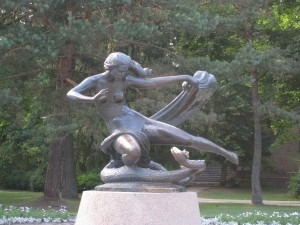
According to the legend, Jūratė was a beautiful marine goddess that lived beneath the Baltic sea in an amber palace. She was the queen of the fishes and ruled over all sea-life. A fisherman by the name of Kastystis was catching too many of her fish. Out of distress, Jūratė came ashore to reprimand Kastytis, but ended up falling in love with him instaed.
Jūratė invited Kastytis to live in her amber palace and they lived in peace. When the thunder god, Perkūnas found out that the immortal sea-goddess had fallen in love with a mortal man, he was outraged, and in retribution, the chief god struck her amber palace, shattering it into tiny fragmented pieces. It is said that the amber pieces found on the shores of the Baltic are the fragments of Jūratė’s palace.
Throughout Lithuanian literary history, the story has been the subject of poems, ballads and it was even recently made into a rock opera.
The designated name-day is April 12.
An obscure Polish form is Jurata.
Sources
 Gender: Feminine
Origin: Lithuanian
Meaning: “fir tree.”
(EG-lay)
Eglė is name with very ancient roots, it is derived from the Lithuanian word for the fir tree or spruce.
In Legend, it was borne by a beautiful maiden who made a fateful pact with the king of the sea serpents. She married him and lived happily after, until she betrayed him by visiting her family in the mortal world. In revenge, Eglė’s family murders her husband. Out of grief, Eglė and her children transform themselves into trees.
The famous Lithuanian poetess, Salomėja Nėris, wrote a poem based off the legend, entitled Eglė žalčių karalienė (1940).
The designated name-days are March 3 (Estonia) and April 4 (Lithuania).
Sources
 Gender: Masculine
Origin: Lithuanian
Meaning: “ash-tree.”
The name comes directly from the Lithuanian word for ash tree, and it is borne in Lithuanian mythology by one of the sons of Eglė and the Sea Snake.
The designated name-day is March 3.
Sources
 Gender: Masculine
Origin: Irish
Meaning: “wolf lover; hound lover.”
(KAHN-ner)
The name is derived from the Old Gaelic name Conchobhar meaning, “wolf lover; hound lover.”
Conor is the traditional Irish spelling while Connor is a common Anglicized version used outside of Ireland.
In Irish legend history, it was borne by a legendary King of Ulster, the lover of Deirdre. It was borne by several other Irish kings and has been a popular name in Ireland for centuries. He is currently the 3rd most popular male name in Ireland, (2008). He is also very popular in other English-speaking countries, his rankings are as follows:
Other forms are Conchobhar and Conchúr.
A popular nickname in Ireland is usually Connie.
Sources
 Gender: Feminine
Origin: Irish-Gaelic
Meaning: “brightness; beauty.”
(NEEV)
The name comes directly from the Gaelic meaning, “brightness; beauty.” In Irish legend, it was borne by the beautiful daughter of the sea god, she fell in love with Oisín, the son of Fionn Mac Cumhail and carried him off to the land of perpetual youth, where he lived with her for 300 years.
Currently, Niamh has enjoyed a recent surge in popularity all over the British Isles. She stands as the 70th most popular female name in England/Wales, (2008). Her rankings in other countries is as follows:
The Welsh form is Nia.
Sources
 Gender: Feminine
Origin: Latvian/Lithuanian
Meaning: “sun.”
The name is of ancient Indo-European roots and is also the modern Latvian and Lithuanian word for the sun.
In ancient Baltic religions, Saule was an extremely important diety, she is considered the goddess of all living things and of fertility. She was also revered as the great mother who extended her shining warmth over all who lived under her.
According to some Lithuanian folk songs, Saulė married Mėnuo, (the Moon), but because of his infidelity, she divorced him, and they ended up living apart, hence is why there is night and day.
Saulė and Mėnuo had 6 daughters, who were embodiments of the stars, Aušrinė, (who prepares the way for her mother each morning), Vakarinė (the Evening Star, who puts her mother to bed each evening), Indraja (Jupiter), Sėlilja (Saturn) and Žiezdrė (Mercury).
On June 23 (Midsummer’s Eve) a great festival was held in Saulė’s honour.
In Lithuanian, the designated name-day for Saulė is February 14th.
Saule is the Latvian form.
Lithuanian masculine forms include: Saulenis and Saulius.
Other Lithuanian forms include: Saulenė, Saulina
Sources
 Gender: Feminine
Origin: Yoruba
Meaning: “mother whose children are like fish.”
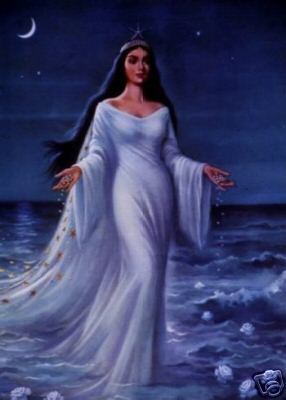
Yemaya is the name of an Orisha in Candomblé, Lucumí/Santería and Vodou. An Orisha is a spirit or diety that reflects an aspect of God. Followers of the above religions are most likely of African heritage and are mostly found in the American south, the Caribbean and in Latin America.
The origins of Yemaya can be traced back to Africa, in Yoruban mythology, Yemoja is a type of mother goddess who lives in the Ogun River. She is considered a special patron of pregnant women and the mother of all dieties and spirits.
Her name is believed to be a contraction of the Yoruba phrase, yeye emo eja, which means, “mother whose children are like fish.”
Her cult was brought to the shores of the New World with African slaves, today, she is often synchronized with the Virgin Mary, in particular Stella Maris (Star of the Sea), and festivals are held in her honour throughout Latin America. In Brazil, especially in Bahía state, her festival usually occurs on February 2, in which devotees send out small offerings to sea, in tiny rafts. Afterwards, a huge festival takes place.
Yemaya and Yemoja are her more common names. She is also known by the following, depending on the religion and country:
The name is occasionally used among devotees, in honour of the orisha.
Sources
 Gender: Feminine
Origin: Welsh/Cornish
Meaning: “white, smooth.”
(gwen-eh-VERE, JEN-nih-FER)
Guinevere is an Old French form of the Welsh female name, Gwenhwyfar, which is composed of the elements, gwen, meaning, “white, blessed, fair, smooth” and hywfar meaning, “smooth, soft.”
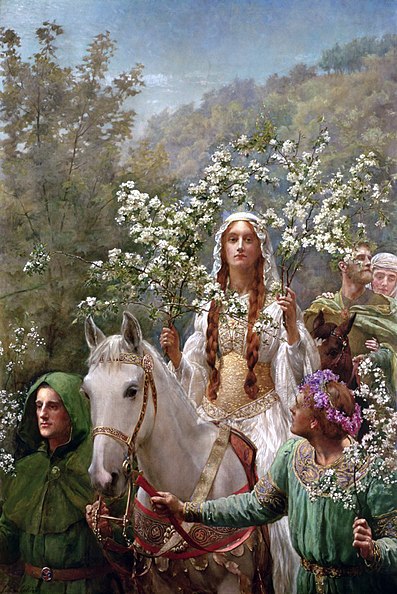
The name came to the Western World’s attention through Chrétien de Troyes’ Lancelot, the Knight of the Cart, which recounts Guinevere’s affair with Sir Lancelot. There are several different variations of the King Arthur myths, in some, Guinevere is barely mentioned and in others, she plays a signficant role, especially in that of Chrétien’s retelling.
Gwenhwyfar has been a common female name in Wales since at least the 11th-century, its Latinate cognate of Guinevere did not become common until the 19th-century, when European romanticism was in vogue.
Its Spanish and Italian cognates of Ginebra and Ginevra have always been common, but do not share the same etymology, rather, Guinevere was translated into Italian and Spanish as Ginevra due to similarity in sound, both of which are actually related to the Italian/Spanish word, ginepro, meaning, “juniper.”
Its Cornish form of Jennifer was a curiosity before the beginning of the 20th-century, it may have first caught the public’s attention in 1906 via George Bernard Shaw’s play, The Doctor’s Dilemma, in which it is the name of a lead character, however, Jennifer did not appear in the 1906 U.S. top 1000.
In fact, Jennifer first cracked the U.S. top 1000 in 1938, coming in as the 984th most popular female name. That same year, academy award winning actress, Jennifer Jones, had made it to the silver screen, but interestingly enough, she was still using her birth name, Phylis Lee Isley, she wasn’t credited as Jennifer Jones until 1943, the same year she won best actress for The Song of Bernadette.
In 1943, Jennifer had already moved up several hundred places, coming in as the 399th most popular female name. By 1956, Jennifer had hit the top 100, coming in as the 97th most popular female name.
It wasn’t until 1966 when she reached the top 10, coming in 10th place. Her popularity really sored between 1970 and 1984, coming in as the most popular female name for almost a decade and a half. It is interesting to note that in 1970, the first year when Jennifer hit # 1, Erich Segal’s romantic novel, Love Story, (in which the main female protoganist is named Jennifer, nicknamed Jenny), was a national best seller. That same year, the book was adapted into a movie.
 Its sudden rise in popularity is still somewhat a mystery, as it was already in the top 10 by 1966, several years before Love Story was even written. It was already in the top 1000 by 1938, and Jennifer Jones did not go by her stage name until 1943, however, the actress may have been somewhat responsible for the name to rise several places in 1943, but the name did not become excessively popular until a good decade later.
Currently, Jennifer is the 84th most popular female name. In other countries, her rankings are as follows:
Jennifer has also been used in French speaking countries, German speaking countries and in Spanish speaking countries.
Other forms of the name include:
A common short form of Guinevere is usually Gwen.
Common pet forms of Jennifer are Jeffy, Jenny, Jennie and Jen.
Notable bearers of Jennifer include American actresses: Jennifer Aniston, Jennifer Connelly, Jennifer Lopez and Jennifer Love Hewitt.
Sources
 Gender: Feminine
Origin: Lithuanian
Meaning: unknown
Lith (bih-ROO-tey); Pol (bee-ROO-tah).
Birutė is a classic Lithuanian name. It’s meaning and origin is debated.
It may be a diminutive form of any Lithuanian name beginning in the Birė element.
Other sources suggest it is derived from the Lithuanian verb birti meaning “to scatter; strew” or “pour out.”
It has also been linked with the Lithuanian verb byrėti meaning “to crumble or to fall apart,” which is associated with the Lithuanian word, byrančiu, meaning, “falling snow.”
In Lithuanian history, the name was borne by the wife of Grand Duke Kęstutis of Lithuania and the mother of Vytautas the Great (d. 1382)
In Lithuania, Birutė is considered a sort of folk heroine, a lot of legends have been attributed to her, one being that Birutė was a vaidilutė or priestess of the gods who guarded the sacred fire. It is believed that Kęstutis kidnapped and married her against her will. After her death, she was made into a sort of pagan folk saint. In 1989, archeological evidence suggested that she had a sanctuary dedicated to her on a hill in Palanga, now named Birutė Hill, it is considered the highest dune in Palanga.
The form of Biruta was also ocassionally used in Poland and Latvia.
A Lithuanian masculine form is Birutis.
The designated name-days are February 5 (Lithuanian) and November 24 (Poland).
Possible translations in other languages could be