Sabrina

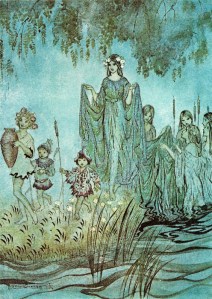
The name is first recorded in Geoffrey of Monmouth’s Historia Regum Britanniae (c.1136) as the name of a princess drowned in the River Severn. Her story is the subject of John Milton’s Comus.

The same story later inspired Samuel A. Taylor’s 1953 stage play Sabrina Fair which was later adapted into a movie starring Audrey Hepburn.

The name did not come into regular usage until the 20th-century, most likely being popularized by the play and movie.

In the 1960s, Sabrina the Teenage Witch was a comic series that debuted.

It is currently the 219th most popular female name in the United States (2010).

Its popularity in other countries is as follows:

  • # 268 (France, 2009)
  • # 491 (the Netherlands, 2010)

The name is also used in German-speaking countries, Greece, France, the Netherlands, Italy and Slovenia.

Other forms of the name include:

  • Sabriina (Finnish)
  • Hafren (Welsh)
Source


Álmos

Gender: Masculine
Origin: Hungarian
Meaning: “dream”
(AHL-moshe)

The name was borne by the first Grand Prince of the Magyars (854-895), according to legend, his mother Emese dreamt that she was impregnated by a Turul bird, begetting Álmos, and she saw he would be the leader of a great nation, hence the origin of his name.

The designated name-day in Hungary is January 1.

Sources

Gunnar

Gender: Masculine
Origin: Old Norse
Meaning: “war warrior.”
Eng (GUN-ner); Swe (GOON-nahr)

The name is composed of the Old Norse elements, gunnr (war) and arr (warrior).

The name was borne a legendary 5th-century Burgundish king. His exploits appear in the ancient Germanic poetic text Nibelungelied and the Medieval poem Walthurius.

In the Nibelungelied he is mentioned as the King of Worms, the husband of Brunhild and the brother of Kriemhild, whom Siegfried comes to woo.

In some tales, he was betrayed by Attila the hun and murdered by him.

The same character later appears in JRR Tolkien’s epic poem based on Norse legend, The Legend of Sigurd and Gudrun.

Gunnar did not appear in the U.S. top 1000 till 1991 coming in as the 705th most popular male names, as of 2009, he was the 551st most popular male name.

Other forms of the name include:

  • Gūðhere (Anglo-Saxon)
  • Gondicari (Catalan)
  • Vintíř (Czech)
  • Gunder (Danish/Norwegian/Swedish)
  • Gunnar (Danish/English/Estonian/Norwegian/Swedish)
  • Gunner (English/Norwegian/Swedish)
  • Gundur (Faroese)
  • Kunkku (Finnish)
  • Kunnari (Finnish)
  • Kunto (Finnish)
  • Gondicaire (French)
  • Gundohar (Frisian/Dutch)
  • Gundahar (German: archaic)
  • Günter/Günther (German/Hungarian)
  • Gunther (German)
  • Gunter (German/Polish/Spanish)
  • Gundicaro (Italian)
  • Gundaharius (Late Latin)
  • Gunnarr (Old Norse)
  • Gunnár (Sami)
  • Gundo (Swedish)
  • Gunnerius (Swedish: archaic)

The name was also borne by a medieval Czech saint.

The designated name-days are January 8 (Estonia); January 9 (Sweden) and October 9 (Germany).

Sources

  1. http://www.behindthename.com/name/gunnar
  2. http://www.nordicnames.de/wiki/Gunnarr

Faustina

Gender: Feminine
Origin: Latin
Meaning: “lucky.”
Eng (faw-STEE-nah)

The name is a feminine form of the ancient Roman cognomen, Faustinus, which in itself is derived from Faustus, meaning, “lucky.”

The name was a common one among the Nerva-Antonine dynasty, being borne by several women in that family, most notably, Anna Galeria Faustina the Elder (100-140) and her daughter of the same name (125-175).

Other forms of the name include:

Fausta (Italian)
Faustina (Croatian/German/Italian/Lithuanian/Spanish)
Faustyna (Czech/Polish)
Faustine (French)
Fausztina (Hungarian)

Male versions include:

Faust (German)
Faustino (Italian/Portuguese/Spanish)
Fausto (Italian/Portuguese/Spanish)
Faustus (Latin)
Faustinus (Latin)

The male version of, Faust is the subject of a German folklore, in which a man by the name of Dr. Faust makes a deal with the devil. This story was later adapted into literature by Christopher Marlowe and Goethe, and was even adapted into a famous opera.

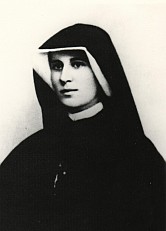
Other notable personages include: Roman noblewoman, Rupilia Faustina (87-138); Faustina, wife of Constantius II (340-366); Faustina Constantia, daughter of Faustina and Constantius II; St. Faustina of Como, a 6th-century Italian saint; Italian Mezzo-Soprano, Faustina Bordoni (1697-1781); Saint Faustina Kowalska, a 20th-century Polish nun and saint (1905-1938).

The designated name-days are: February 15 (Poland); September 23 (France) and October 5 (Poland).

Source

  1. http://www.behindthename.com/php/find.php?name=faustine

Hulda

Gender: Feminine
Origin: Old Norse
Meaning: “to cover; secrecy; lovable, sweet.”
(HOOL-da)

or

Origin: Hebrew Biblical
Meaning: “weasel.”

חוּלְדָה

The name can be traced both Norse Mythology and the Hebrew Bible.

In Norse, the name is derived from the word, hulda, meaning “hiding; secrecy.” In modern Swedish, the name is often associated with the archaic Swedish term of endearment, huld, meaning “sweet; lovable.”

In Norse Mythology, the name was borne by a völva, a Norse shamanic seeress. She is mentioned sporadically in the Ynglinga Saga and the Sturlunga Saga.

This same figure remained quite alive in both modern German and Swedish folklore.

In Scandinavian folklore, she evolved into the huldra, a type of spirit that appears to young men in the form of a beautiful and seductive woman. In some traditions she is evil and in others she is just looking for companionship with a human. She was also known to be particularly fond of colliers.

In German folklore, she is known as Holda, and is considered the supernatural guardian of anything related to female domesticity. In other German traditions, she is referred to as Frau Holle. The most famous account of Holda was written by the Brothers Grimm in 1812, entitled Mother Hulda.

In Biblical tradition, Huldah was the name of a prophetess mentioned briefly in the Old Testament, 2 Kings 22 and 2 Chronicles 34. In this case, the name is derived from the Old Hebrew word for weasel.

Huldah prophesized to King Josiah the destruction of Israel.

Another notable bearer includes Hulda (1881-1946), a renowned Icelandic poet.

The name was quite common in Germany during the 19th and early 20th century, where it was also particularly common among German Jews.

The name also appears in the U.S. top 1000 in the late 19th-century, in fact, in 1891, the name was the 194th most popular female name.

The name has experienced a recent revival in both Sweden and Norway.

The designated name-day is September 8 (Sweden).

Other forms of the name include:

Huldà (Catalan)
Chulda (Czech/Modern Hebrew)
Hulda (Danish/Dutch/English/Faroese/Frisian/German/Icelandic/Norwegian/Swedish)
Hulra (Finnish)
Hulta/Hulti/Hultu/Hultukka (Finnish)
Holda (German)
Holle (German)
Huld (Icelandic/Swedish)
Hulð (Old Norse)
Aldama/Aldana Олдама Олдана (Russian)

An Icelandic male form is Huldar.

Sources

  1. http://runeberg.org/nfbk/0659.html
  2. http://www.behindthename.com/php/find.php?name=hulda
  3. http://www.thorshof.org/spinmyth.htm
  4. http://www.jewishencyclopedia.com/view.jsp?artid=955&letter=H&search=Huldah
  5. http://en.wikipedia.org/wiki/Animal_names_as_first_names_in_Hebrew
  6. http://www.nordicnames.de/wiki/Hulda

Czech

Gender: Masculine
Origin: Polish
Meaning: “to expect; Czech.”
(CHEK)

The name is of uncertain derivation, some sources list it as a derivative of Czesław, while others contend that it is from the Old Polish referring to someone from the Czech lands.

The name appears in Polish legend as the name of the legendary progenitor of the Czech people, the brother of Lech (progenitor of the Poles) and Rus (progenitor of the Russians).

The name is extremely rare in Poland, but its designated name-day is September 2.

Other forms are Czechasz (CHEH-hahsh); and Czechoń (CHEH-hoing).

Sources

  1. http://pl.wikipedia.org/wiki/Czech_(imię)
  2. http://www.behindthename.com/namedays/lists/9.php

Naglis

Gender: Masculine
Origin: Lithuanian
Meaning: unknown
(NAHG-lis)

The name is from a Lithuanian legend, Naglis & Neringa (see Neringa).

It is also the name of a mountain in the resort region of Palanga, Lithuania.

The designated name-day is August 13.

Sources

  1. http://www.behindthename.com/namedays/lists/8.php
  2. http://day.lt/vardai/Naglis
  3. http://en.wikipedia.org/wiki/Giant_(mythology)
  4. http://en.wikipedia.org/wiki/Neringa

Libuše

Gender: Feminine
Origin: Czech/Slovak
Meaning: “dear; pleasant”
(lee-BOO-sheh)

The name is borne by a legendary Czech princess who was considered the mother of the Czech people. In the 8th-century, she supposedly founded the city of Prague. She was the youngest daughter of King Krok and was chosen by her father to be heir to his throne.

The people, however, were not pleased with the idea of a female ruler so she was forced to resign and choose a successor. She pointed her finger in the direction of Stadice and chose a ploughman by the name of Premsyl. Libuse married him and thus began a Czech dynesty.

Its designated name day is July 10.

In German chronicles, the name was often rendered as Libussa or Libusche.

Lauma, Laumė

Gender: Feminine
Origin: Latvian/Lithuanian
Meaning: “elf; fairy; pixie.”
Lv: (LAO-mah); Lit (LAO-may)

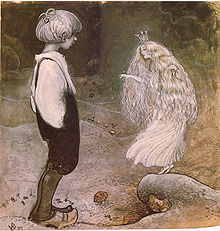
The name is borne in Baltic mythology by a woodland spirit who guards women and children during Childbirth.

In Latvian folklore, Lauma is a sort of fairy midwife who assists in the birth of children. If the mother dies, then it is the Lauma’s role to become a sort of “fairy godmother” to the motherless child. In some Latvian folk stories she is delegated as an evil spirit who replaces a real child with a changeling, in others, she is a beautiful mermaid like spirit who yearns for children but is unable to have her own so kidnaps human babies. She is also known to lure men into marrying her and makes an excellent housewife.

In Lithuanian folklore, the Laumė are the equivalent of the Russian baba yaga, but are much more benign. They have clawed feet and enjoy taking on the menial tasks of women while they sleep, such as doing housework. They are big fans of children and are especially known for their industriousness. They enjoy helping those in need.

The official Latvian designated feast day is July 2. It is a common name in Latvia and occasionally used in Lithuania.

It is also the name of a well-known Baltic lingerie company.

Sources

  1. http://www.behindthename.com/namedays/lists/7.php
  2. http://www.behindthename.com/comment/search.php?terms=lauma
  3. http://en.wikipedia.org/wiki/Lauma
  4. http://www.britannica.com/EBchecked/topic/332311/lauma

Šárka

Gender: Feminine
Origin: Czech
Meaning: debated
(SHAHR-kah)

The name is a very old Czech female given name of uncertain derivation. It is sometimes believed to be connected to an Indo-European word that also has its roots in the Corsican sarra meaning “ridge; hill” and the Spanish sierra (mountain ridge). Hence, the name’s meaning may have something to do with mountain, hill or crag.

The name is borne by a warrior woman of Czech folklore. According to Chronica Boëmorum, by Cosmas of Prague and Dalimil’s Chronicle, Šárka was one of the warrior women who participated in the Maiden’s War, in which a band of female warriors rebelled against the male forces of Libuše’s husband.

Šárka tricked the men by tying herself to a tree, after they rescued her, she put a sleeping potion in their mead and slew them in their sleep.

The same story was also the subject of the 18th-century Czech opera, Šárka by Leoš Janáček (1887)

The designated name-day is June 30.

Sources

  1. http://www.behindthename.com/name/s18a10rka
  2. http://www.finitesite.com/dandelion/DIVVAL.htm
  3. http://ao-institut.cz/Galerie/Ceska-zeme/

Image Courtesy of the ČESKÝ INSTITUT (http://ao-institut.cz/Galerie/Ceska-zeme/)