Sulo

Gender: Masculine
Origin: Finnish
Meaning: “grace.”
(SOO-lo)

The name is derived from the Finnish, sulo, meaning, “grace.”

The designated name-day is February 13.

Affectionate forms are: Suikka, Suikki, Suikku, Suippi, Sulkka and Sulkki.

A feminine form is Sulotar, which would literally mean, “grace woman”or “woman of grace.”

Sources

  1. http://www.nordicnames.de/wiki/Sulo
  2. http://www.behindthename.com/name/sulo
  3. http://verkkopalvelut.vrk.fi/Nimipalvelu/default.asp?L=1

Talvikki

Gender: Feminine
Origin: Finnish
Meaning: “winter.”
(TAHL-veek-kee)

The name is derived from the Finnish, talvi, meaning, “winter.”

Talvi is also used as a name in both Finland and Estonia, (see Talvi).

The designated name-day for Talvikki is February 11.

Sources

  1. http://www.nordicnames.de/wiki/Talvikki
  2. http://www.behindthename.com/namedays/lists/fin.php
  3. Nimitysuutisia. Helsingin Sanomien kuukausiliite, Helmikuu 2004.

Isaiah

Gender: Masculine
Origin: Hebrew
Meaning: “Yahweh is salvation.”
Eng (i-ZAY-ah)

The name is derived from the Hebrew יְשַׁעְיָהוּ (Yesha’yahu), meaning, “Yahweh is Salvation.”

In the Old Testament, it was borne by a prophet, he is considered a major and extremely important prophet among Jews and Christians. Among Jews, his prophecies are mostly interpreted to describe the coming destruction of Jerusalem, while among Christians, his prophecies are believed to foretell the coming of Christ.

The name was always prevalent among Jews and Eastern Orthodox Christians, among Western Christians, the name did not catch on until after the Protestant Reformation.

Currently, Isaiah is the 42nd most popular male name in the United States, (2008) and he is the 84th most popular in Canada, B.C., (2008).

Other forms of the name include:

  • Ash’iyā’ أشعیاء(Arabic)
  • Zaia ܙܝܥܐ (Aramaic/Assyrian/Syriac)
  • Isaiah Ісайя Иса́ия (Belarusian/Russian/Serbian/Ukrainian)
  • Isaïes (Catalan)
  • Izaija (Croatian)
  • Izaiáš/Izajáš (Czech/Slovak)
  • Esajas (Danish)
  • Jesaja (Danish/Dutch/German/Finnish/Latvian/Norwegian/Swedish)
  • Esa (Finnish)
  • Isaïe/Ésaïe (French)
  • Isaie (Fruilian)
  • Esaias Ἠσαΐας (Greek: Biblical)
  • Ikaia (Hawaiian)
  • Yəšaʿyáhu יְשַׁעְיָהוּ (Hebrew: Modern)
  • Ézsaiás/Isaiás (Hungarian)
  • Yesaya (Indonesian)
  • Isaia (Italian/Romanian)
  • Yésaya (Javanese)
  • Isaya (Kiswahili)
  • Izaijas/Ješajas (Lithuanian)
  • Izajasz (Polish)
  • Isaías (Portuguese/Spanish)
  • Isay Исай (Russian)
  • Eseia (Welsh)

In the Orthodox Church, the name-day is May 9.

Sources

Isaac

Gender: Masculine
Origin: Hebrew
Meaning: “laughter.”
Eng (I-zek)

The name is derived from the Hebrew יִצְחָק (Yitzchaq) which is most likely related to the Hebrew verb for laughter, as according to Gen. xviii. 12, Sarah laughed when she heard the angel prophesied that she would bear a son at 90 years of age.

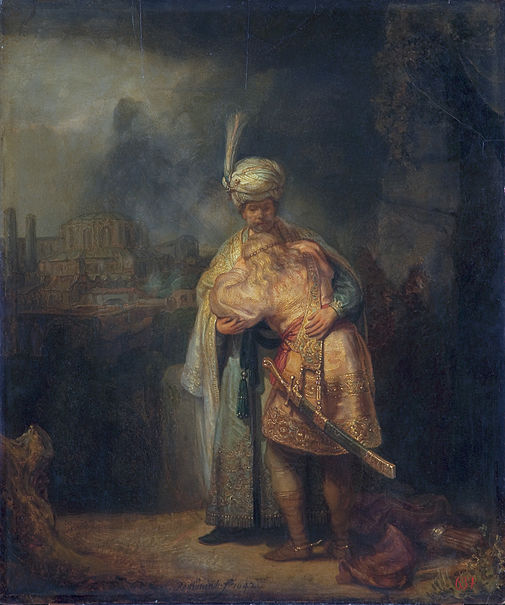
The name is borne in the Old Testament by the son of Sarah and Abraham. One of the most noted accounts between Isaac and his father was when God commanded Abraham to sacrifice Isaac, Isaac being spared at the last moment when God realized that Abraham would sacrifice his own son in order to follow God’s commands.

Isaac later married Rebecca and fathered Esau and Jacob.

Isaac is considered an important patriarch among the Jews and even among Muslims.

In Western Europe, the name did not catch on among Christians until after the Protestant Reformation, in Eastern Orthodox Europe, Isaac was commonly used among Christians since the Middle Ages.

Currently, Isaac is the 37th most popular male name in the United States, (2008), his rankings in other countries are as follows:

  • # 23 (Australia, 2008)
  • # 30 (Canada, B.C., 2008)
  • # 96 (Chile, 2006)
  • # 39 (England/Wales, 2008)
  • # 453 (the Netherlands, 2009)

Other forms of the name include:

  • Isaak (Albanian)
  • Ishaq إسحٰق, إسحاق (Arabic)
  • Sahak Սահակ (Armenian)
  • İshaq (Azeri)
  • Isak Ісак (Belarusian)
  • Ishak (Bosnian/Indonesian)
  • Isaak Исаак (Bulgarian)
  • Isaac (Catalan/English/French/Galician/Portuguese/Spanish)
  • Izak (Croatian)
  • Izák (Czech)
  • Isak (Danish/Norwegian/Swedish)
  • Isach (Danish: archaic)
  • Izaäk (Dutch)
  • Iisak (Estonian)
  • Ísakur (Faroese)
  • Iisakki (Finnish)
  • Isaaki ისააკი (Georgian)
  • Isaak (German)
  • Isaakios Ισαάκιος (Greek: Modern)
  • Yitzchak/Yitzhak/Itzhak יִצְחָק, (Hebrew)
  • Izsák (Hungarian)
  • Ísak (Icelandic)
  • Íosác (Irish-Gaelic)
  • Isacco (Italian)
  • Isaacius/Isaacus (Late Latin)
  • Aizeks/Isacs (Latvian)
  • Izaokas (Lithuanian)
  • Isaaku Ісаакъ (Old Church Slavonic)
  • Izaak/Izak (Polish)
  • Isaque (Portuguese)
  • Isac (Romanian)
  • Isaak Исаак (Russian/Ukrainian)
  • Iosag (Scottish-Gaelic)
  • Isaka (Swahili)
  • İshak/İshâk (Turkish)

A common English short form is Ike.

Finnish diminutives are Iikka and Iirro.

A Yiddish diminutive is Sekel.

In France, the designated name-day is December 20.

A notable bearer is physicist and mathematician, Isaac Newton (1643-1727).

Sources

  1. http://www.jewishencyclopedia.com/view.jsp?artid=174&letter=I
  2. http://www.askoxford.com/firstnames/isaac?view=uk
  3. http://www.behindthename.com/name/isaac
  4. Hoffman William F and George W. Helon, First Names of the Polish Commonwealth: Origins and Meanings (Polish Genealogical Society of America, 1998)

Matilda

Gender: Feminine
Origin: Germanic
Meaning: “might in battle; strength in battle.”
Eng (mah-TIL-dah)

The name is composed of the Germanic elements, maht meaning, “might, strength” and hild meaning, “battle.”

In the English speaking world, the name has existed since Anglo-Saxon times, in the form of Mæðhilde but the Anglo-Norman forms of Matilda and Maud had replaced the former by the 10th-century.

The name was so common among the Norman aristocracy that it took on the reputation as a “Norman name.” The Normans extended their power throughout Western Europe and introduced the name to non-Germanic countries such as Italy, Spain, France and Portugal.

The name was borne by several medieval personages, who include:

St. Matilda (895-968), the first wife of Henry I the Fowler and mother of Otto I. The details of her life are recorded in the Res Gestae Saxonicae, (Deeds of the Saxons), as well as in the vita antiquior and in the vita posterior. Despite her royal lineage, St. Matilda was known for her piety and charity.
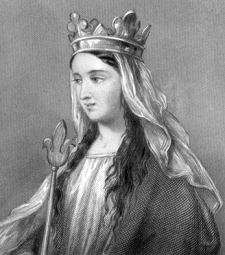
It was later borne by the wife of William I the Conquer, Matilda of Flanders, also known as Maud Le-Vieux, (1031-1083).

In Italian history, it was borne by Countess Matilda of Tuscany (1046-1115), who was known for her support for Pope Gregory VII and for her military exploits.

Edith of Scotland, (1080-1118), changed her name to Matilda upon marrying Henry I of England.

Another English queen who bore the name was Matilda of Boulogne, (1104-1152), wife of Stephen of England. It was also borne by the daughter of Henry II of England, Matilda, the Duchess of Saxony (1156-1189).

In Portugal, it was borne by their first queen-consort, Matilda of Savoy (1125-1158).

Maud was a common vernacular form used more frequently among the lower classes in both England and France. Maud is believed to have originated among the Low Germans since Matilda of Flanders, (who introduced this form of the name), was the daughter of Baldwin of Flanders. Also, in Medieval Dutch and Flemish, when a t appeared between two vowels, it was usually dropped, hence the creation of Maud.

The name was prevalent in England until the end of the 15th-century and was revived at the end of the 19th-century. The name was considered rather old fashioned between the mid to the latter part of the 20th-century, but is now suddenly rising in popularity in several countries.

Currently, in England, she is the 43rd most popular female name, (2008). Her rankings in other countries are as follows:

  • # 14 (Australia, 2008)
  • # 53 (Chile, 2006)
  • # 26 (France, 2006)
  • # 485 (the Netherlands, 2009)
  • # 25 (Norway, 2009)
  • # 25 (Sweden, 2009)
  • # 828 (the United States, 2008)

Its diminutive offshoot of Tilly is currently the 93rd most popular female name in the United Kingdom, (2008).

Other forms of the name include:

  • Matilda Матильда (Afrikaans/English/Finnish/Lithuanian/Russian/Slovak/Spanish/Swedish)
  • Mahthildis (Ancient Germanic)
  • Mæðhilde/Mǣþhild (Anglo-Saxon)
  • Matylda (Czech/Polish)
  • Mathilde (Danish/Dutch/French/German/Norwegian)
  • Machteld/Mechteld (Dutch)
  • Maud (Dutch/English)
  • Maude (English: MAWD)
  • Tilda (English/Finnish/Swedish)
  • Tilly (English: used as an independent given name)
  • Malda/Maldi (Estonian)
  • Milda/Mildi (Estonian)
  • Matilde (Estonian/Italian/Portuguese/Spanish)
  • Mahaut (French: archaic. mah-O)
  • Mahault/Maheu/Maheut (French: archaic)
  • Mechthild/Mechtilde (German)
  • Matild/Mátildá (Hungarian)
  • Matthildur (Icelandic)
  • Mafalda (Italian/Portuguese)
  • Matelda (Italian)
  • Mechtylda (Polish)
  • Matélda (Romanesque)
  • Mallt (Welsh)

Common German diminutives are: Mati, Matty, Hilde, Patty, Patsy, Tilli and Tilly.

English short forms include: Mattie, Tilly and Tilda.

A Dutch and Limbergish pet form is Til.

An Italian short form is Ilde.

A common Germanic diminutive occasionally used as an independent given name is Mette.

Obscure Italian masculine forms include: Matildio and Matildo.

The designated name-day is March 14.

It is also the name of a popular Australian national folk song, Waltzing Matilda.

Sources

  1. http://www.askoxford.com/firstnames/matilda?view=uk
  2. http://www.behindthename.com/name/matilda
  3. http://www.ssa.gov/cgi-bin/babyname.cgi
  4. Das große Vornamenlexikon, Rosa and Volker Kohlheim, Dudenverlag, Mannheim 2007, S. 292
  5. Ladó János, Bíró ÁgnesMagyar utónévkönyv. Budapest: Vince Kiadó. ISBN 963 9069 72 8 (2005)
  6. http://women.timesonline.co.uk/tol/life_and_style/women/article3074698.ece
  7. https://192.49.222.187/Nimipalvelu/default.asp?L=3
  8. http://www.ssb.no/navn/

Samuel

Gender: Masculine
Origin: Hebrew
Meaning: “God has heard.”
Eng (SAM-yoo-el)

The name is derived from the Hebrew שְׁמוּאֵל (Shemu’el) meaning, “God has heard.”

According to 1 Samuel 1:20, Hannah gave her son the name of Samuel in reference to when she had asked God for a son and God had heard her request.

Samuel was the last of the Hebrew Judges and the first of the Hebrew prophets and he also anointed the first two kings of Israel: Saul and David.

The name was always popular among Jews, but did not become prevalent in the English-speaking world until after the Protestant Reformation. The name was especially common among the Puritans of the 17th-century.

Currently, Samuel is the 28th most popular male name in the United States, (2008). In other countries, his rankings are as follows:

  • # 9 Samvel (Armenia, 2008)
  • # 13 (Australia, 2008)
  • # 42 (Belgium, 2006)
  • # 20 (Canada, B.C., 2008)
  • # 88 (Chile, 2006)
  • # 11 (England/Wales, 2008)
  • # 47 (France, 2006)
  • # 98 (the Netherlands, 2009)
  • # 95 (Norway, 2009)
  • # 39 (Scotland, 2009)
  • # 59 (Sweden, 2009)

Other forms of the name include:

  • Samvel (Armenian)
  • Samel (Basque)
  • Samoyla/Samuil Самуил (Bulgarian/Russian/Ukrainian)
  • Samuel (Czech/Dutch/English/French/German/Polish/Portuguese/Scandinavian/Slovak/Spanish)
  • Samuël (Dutch)
  • Samuli (Finnish)
  • Samouel Σαμουηλ (Greek: Biblical)
  • Shemu’el שְׁמוּאֵל (Hebrew: Biblical)
  • Shmuel שְׁמוּאֵל (Hebrew: Modern)
  • Sámuel (Hungarian)
  • Samúel (Icelandic)
  • Samuele (Italian)
  • Samweli (Kiswahili)
  • Samuels (Latvian)
  • Samuelis (Lithuanian)
  • Szmuel (Polish-Hebrew: a Polish transliteration of the modern Hebrew form, used primarily among Polish Jews)
  • Samuilu Самѹилъ (Old Church Slavonic)
  • Samuil (Romanian)
  • Samuèli (Sardinian)
  • Sawyl (Welsh)
  • Shem (Yiddish)
  • Schmuel (Yiddish)

Common English/German short forms are Sam and Sammy.

Czech short forms are: Samo, Samko, Samik , Samenko and Saminko.

A Polish diminutive is Samek.

A Hungarian and Finnish short form is Samu.

An Italian feminine form is Samuela and an obscure Norwegian feminine form is Samueline.

Designated name-days are: February 16 (Germany), August 20 (France/Poland), August 26 (Slovakia) and September 1 (Czech Republic and Sweden).

Sources

  1. http://www.panorama.am/en/society/2008/02/02/name/
  2. http://www.mechon-mamre.org/p/pt/pt08a01.htm#20
  3. http://www.askoxford.com/firstnames/samuel?view=uk
  4. http://www.behindthename.com/php/find.php?name=samuel
  5. Atikian, Martha Bilezikian. Armenians’ Names (Martha Bilezikian Atikian, 1973)
  6. Hoffman, William F. and George W. Helon. First Names of the Polish Commonwealth: Origins & Meanings. (Polish Genealogical Society of America, 1998)

Jonathan

Gender: Masculine
Origin: Hebrew
Meaning: “Yahweh has given.”
(JON-a-THEN)

The name is derived from the Hebrew יְהוֹנָתָן (Yehonatan) meaning, “Yahweh has given.” The name is considered a longer version of Nathan, and shares the same roots as Matthew. Contrary to some sources, John did not start off as short form of Jonathan.

In the Old Testament, it is the name of the eldest son of Saul and a friend of David. Their friendship is often used as an example of the most perfect form of brotherly love among Christian and Jewish ethicists.

In the English speaking world, Jonathan did not catch on until after the Protestant Reformation.

Currently, Jonathan is the 26th most popular male name in the United States, (2008). His rankings in other countries are as follows:

  • # 75 (Australia, 2008)
  • # 58 (Canada, B.C., 2008)
  • # 69 (Chile, 2006)
  • # 101 (the Netherlands, 2009)
  • # 41 (Norway, 2009)
  • # 33 (Sweden, 2009)

Other forms of the name include:

  • Jonatan (Catalan/Croatian/German/Polish/Scandinavian/Slovene)
  • Jonatán (Czech/Slovak/Spanish)
  • Jonathan (Dutch/English/French/German/Scandinavian)
  • Joonatan (Finnish)
  • Ionathan/Jehonathan Ιωναθαν (Greek: Biblical)
  • Yonatan/Yehonatan יוֹנָתָן יְהוֹנָתָן (Hebrew)
  • Jónatan (Icelandic)
  • Ionatán (Irish-Gaelic)
  • Gionatan (Italian)
  • Jónatas (Portuguese)

Common English short forms include: Jon, Jonny, Jonty and sometimes even Nathan.

A common Hebrew short form is Yoni.

The designated name-day is March 1 (France).

Sources

  1. Judges 18:30
  2. http://www.behindthename.com/name/jonathan
  3. http://www.askoxford.com/firstnames/jonathan?view=uk
  4. Hanks, Hardcastle and Hodges, Oxford Dictionary of First Names, Oxford University Press, 2nd edition, p.147.
  5. The Crosslinguistic Study of Language Acquisition – Page 342 by Dan Isaac Slobin

Terhi

Gender: Feminine
Origin: Finnish
Meaning: “mist.”
(TARE-hee)

The name is derived from Terhenetär which was the name of an ancient Finnish goddess who appears in the epic, the Kalevala.

In the Kalevala, Terhenetär is described as a sort of sprite associated with mist and forests. Both names are derived from the Finnish, terhen, meaning, “mist.”

Terhenetär means, “mist lady” or “lady of the mist.”

Another form is Terhikki.

The designated name-day is February 6.

Dorothy

Gender: Feminine
Origin: Greek
Meaning: “gift of the god.”
Eng (DOR-thee); (DORE-e-THEE)

The name is derived from the Greek female name, Δωροθέα (Dōrothea), which is composed of the Greek elements, δωρον (doron) and θεος (theos).

In the early Christian church, the name was borne by a Greek virgin martyr. It was also borne by a 13th-century German saint who is considered the patron saint of Prussia.

In the English speaking world, the name has been in usage since the Middle Ages, but like other saints names, fell out of usage during the Protestant Reformation and was revived in the 18th-century.

Dorothy fell out of the U.S. top 1000 after 2006, when she came in 990th most popular female name. Between 1920 and 1927, she was the 2nd most popular female name.

The name is found in L. Frank Baum’s children fantasy series, The Wonderful Wizard of Oz (1900).

Its English diminutive offshoot, Dolly, was also occasionally used as an independent given name, as is the case with American First Lady, Dolley Madison, (née Dolley Payne Todd Madison), 1768-1849. In fact, the modern English word for doll is supposedly derived from the female given name.
Other forms of the name include:

  • Doroteja Доротеја (Bulgarian/Polish/Serbian)
  • Dorotea (Catalan/Croatian/Estonian/Italian/Norwegian/Slovene/Spanish/Swedish)
  • Dorota (Czech/Polish/Slovak)
  • Dorothea (Dutch/English/German/Greek/Norwegian)
  • Teija (Finnish)
  • Terhi (Finnish: literally means “mist” but is also used as a cognate of Dorothy. See Terhi).
  • Dorothy (English)
  • Dolly (English)
  • Durita (Faroese)
  • Dorothée (French)
  • Dortje/Doortje/Dörtje (Frisian)
  • Dorika (Hungarian)
  • Dorina/Dorinka (Hungarian/Romansch)
  • Dorottya (Hungarian)
  • Dórótea (Icelandic)
  • Dace (Latvian: currently the 7th most popular female name in Latvia, 2005. DAHT-say).
  • Darta (Latvian)
  • Darata (Lithuanian)
  • Dorotëja (Lithuanian)
  • Urta/Urtė (Lithuanian)
  • Dorte/Dorthe (Low German)
  • Dörte/Dörthe (Low German)
  • Dürte/Dürten (Low German)
  • Dortea/Dorthea (Norwegian)
  • Dochna (Polish: archaic)
  • Doroteia (Portuguese)
  • Dorofei Дорофей (Russian)
  • Dorofeja (Russian)
  • Dorote (Swedish)
  • Dorit (Swedish)
  • Dorofija/Dorotija (Ukrainian)

An obscure French diminutive is Dorette.

A Danish diminutive form is Ditte.

German short forms include: Dodo, Dora, Dore, Dorel, Dorett, Dorle, Dorli, Doro, Tea and Thea.

English nicknames are: Dodie, Dodo, Doll, Dolly, Dot, Dottie and Thea.

Polish diminutives are Dosia and Dorotka.

Dorita is a Spanish diminutive.

An Italian masculine form is Doroteo and the Greek masculine form is Dorotheos.

Theodora shares the same etymology.

The designated name-day is February 6.

Benjamin

Gender: Masculine
Origin: Hebrew
Meaning: “son of the south; son of the right hand.”
Eng (BEN-juh-min)

The name is borne in the Old Testament by the youngest son of Jacob and Rachel. According to Rabbinical scholars, Benjamin was initially named Benoni, an illusion to Rachel dying after childbirth, meaning, “son of my pain.” Jacob had changed his name to Benjamin, a name which is somewhat debated.

According to most sources, Benjamin is composed of the Hebrew elements ben meaning, “son of” and jamin, which can either be interepreted as meaning, “the right side” or “the south” since in ancient Hebrew, there was no grammatical difference between “right” and “south.” This may be in reference to the idea that Benjamin was born in Canaan. However, the meaning of “the right side” can also be in reference to strength and virtue.

In the Samaritan Penteteuch, the name is rendered as Benjamim, which literally means “son of days” which may be a reference to Jacob’s old age when Benjamin was born.

The name was always common among Jews, but did not become common among western Christians until after the Protestant Reformation, among Eastern Orthodox, the name was in usage since the Middle Ages, since it was also borne by an early Eastern Christian martyr.

Currently, Benjamin ranked in as the 25th most popular male name in the United States, in other countries, his rankings are as follows:

  • # 10 (Australia, 2008)
  • # 62 (Belgium, 2006)
  • # 7 (Canada, B.C., 2008)
  • # 1 (Chile, 2006)
  • # 18 (England/Wales, 2008)
  • # 53 (Hungary, 2008)
  • # 65 (the Netherlands, 2009)
  • # 17  (Norway, 2009)]
  • # 60 (Scotland, 2009)
  • # 47 (Slovenia, 2005)
  • # 36 (Sweden, 2009)

In French, benjamin is also a slang term for a young child, roughly translating to “kid.”

Other forms of the name include:

  • Binyamin בִּנְיָמִין بنيامين (Arabic/Hebrew)
  • Benxamín (Asturian/Galician)
  • Benkamin (Basque)
  • Benjamí (Catalan)
  • Benghjaminu (Corsican)
  • Benjamin Бењамин (Croatian/Danish/Dutch/English/Finnish/French/German/Serbian)
  • Benjamín (Czech/Icelandic/Slovak/Spanish)
  • Beniamín Βενιαμίν (Greek)
  • Peni (Hawaiian)
  • Benjámin (Hungarian)
  • Beniamino (Italian)
  • Bendžamins (Latvian)
  • Benjaminas (Lithuanian)
  • Beniamin (Polish/Romanian)
  • Benjamim (Portuguese)
  • Veniamin Вениамин (Russian)
  • Bünyamin (Turkish)

Common Dutch, German and English short forms are: Ben, Benny and Benji.

French short forms are Ben and Jamin.

Hungarian diminutives are Benke, Benkő, Benő and Béni.

Obscure but legitimate feminine forms are: Benjamine (French), Benjámina (Hungarian), Beniamina (Italian).

Famous bearers include:

Current Prime Minister of Israel, Benjamin Netanyahu (b.1949), Jewish Khazar ruler, Benjamin (9th-century C.E.), St. Benjamin of Persia (5th-century C.E.), Pope Benjamin II of Alexandria (1327-1339), Benjamin Franklin (1706-1790) Benjamin Disraeli (1804-1881) and Ben Affleck (b.1972).

Designated name-days are: January 3 (Hungary), March 31 (France/Slovakia), December 20 (Finland) and December 28 (Sweden).