Constantine

Gender: Masculine
Origin: Latin

The name was originally a diminutive form of the Latin male name Constans, but due to the fame and notoriety of Constantine the Great, the name exclusively became an independent given name in the beginning of the Middle Ages.

Currently, its German form of Konstantin is the 39th most popular male name in Austria, (2010) and the 60th most popular in Germany, (2011).

Other forms of the name include:

  • Kosta (Albanian)
  • Kostandin (Albanian/Basque)
  • Kostandini (Albanian)
  • Kostandianos Կոստանդիանոս (Armenian)
  • Kustentin (Breton)
  • Konstantin Константин (Bulgarian/Croatian/Czech/Finnish/German/Hungarian/Macedonian/Plattdeutsch/Russian/Scandinavian/Serbian/Slovene)
  • Constantí (Catalan)
  • Constantijn (Dutch)
  • Stijn (Dutch)
  • Constantine (English)
  • Kuestantinos (Ethiopian)
  • Konsta (Finnish)
  • Constantin (French/German/Romanian)
  • Konstantine კონსტანტინე (Georgian)
  • Constantinos Κωνσταντινος (Greek)
  • Costas Κώστας (Greek)
  • Dinos Ντίνος (Greek)
  • Konstantínus (Icelandic)
  • Costantino (Italian)
  • Costanzo (Italian)
  • Konstantīns (Latvian)
  • Konstantinas (Lithuanian)
  • Konstantyn (Polish)
  • Konstanty (Polish)
  • Constantim (Portuguese)
  • Constantino (Portuguese/Spanish)
  • Costel (Romanian)
  • Costin (Romanian)
  • Dinu (Romanian)
  • Kuonstantėns (Saimogaitian)
  • Antine (Sardinian)
  • Costantìnu (Sardinian)
  • Custantino (Sicilian)
  • Konštantín (Slovakian)
  • Kostyantyn остянтин (Ukrainian)
  • Cystennin (Welsh)
Common Russian diminutives are Kosta and Kostya.

Feminine forms include:

  • Konstandina (Albanian/Greek/Slovene)
  • Konstantina Константина Κωνσταντίνα (Bulgarian/Croatian/Czech/Greek/Macedonian/Hungarian/Russian/Serbian/Slovene)
  • Dina (Greek)
  • Konstantyna (Polish)
  • Costantina (Italian)
  • Constantina (Latin/Portuguese/Romanian/Spanish)
  • Costela (Romanian)

Rocío

Gender: Feminine
Origin: Spanish
Meaning: “dew”
Sp (roh-THEE-o); Lat Am Sp (roh-SEE-oh)

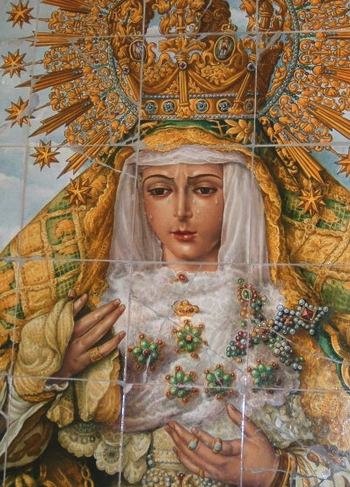
The name comes directly from the Spanish word for dew and was originally used in reference to an epithet of the Virgin Mary, María del Rocío (Mary of the Dew).

La Virgen El Rocío is a famous shrine found in Almonte Spain, where each year, a famous procession is held for a birch carved statue of the Virgin Mary known as María del Rocío. The procession attracts at least one million people a year.

The name is currently the 16th most popular female name in Argentina, (2009).

Its rankings in other countries are as follows:

  • # 29 (Spain, 2010)
  • # 34 (Chile, 2010)
  • # 72 (Catalonia, 2010)


Juliana, Gillian

Gender: Feminine
Origin: Latin
Eng (JOO-lee-AH-nah); (JILL-yen; JILL-ee-EN)

The name is a feminine form of the Roman male name Iulianus, which is intern derived from Julius. Today, Julian is considered the English masculine cognate, but was used as a feminine name in Medieval England, as in the case of St. Julian of Norwich (1346-1416), an English mystic who is considered to be the first woman to have ever published a book. Though Julian remained a popular saint even after the Reformation, the name fell out of usage and was not revived until the 19th-century: as a male name. It was thereafter that Gillian and Juliana were used as the official feminine forms in the English-speaking world. Juliana has been the name of several other saints throughout Europe, and was most recently borne by Queen Juliana of the Netherlands (1909-2004).

Its Italian form of Giuliana is currently the 39th most popular female name in Argentina, (2009) and the 376th most popular in the United States, (2010). While its Central European form of Julianna is currently the 176th most popular female name in the United States, (2010).
Other forms of the name include:

  • Yuliana Юлиана (Bulgarian/Russian)
  • Julijana Јулијана (Croatian/Macedonian/Slovene)
  • Juliana (Dutch/English/Polish/Portuguese/Slovenian/Spanish)
  • Gillian (English)
  • Juliane (French/German)
  • Julienne (French)
  • Julianna (Hungarian/Polish)
  • Giuliana (Italian)
  • Giulianella (Italian)
  • Iuliana (Romanian)
  • Uliana Ульяна (Russian/Ukrainian)

Baptiste

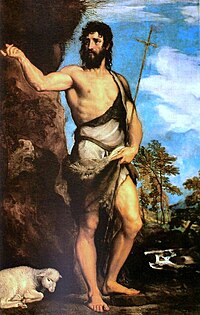
John the Baptiste, Titian

Gender: Masuline
Origin: Greek
Meaning: “to dip.”
Fre (bah-TEEST)

The name is derived from the Greek word βαπτω (bapto) meaning, “to dip.” The name was originally bestowed in honour of St. John the Baptiste and is often paired with John and its various cognates.

Currently, its Spanish form of Bautista, is the 19th most popular male name in Argentina, (2009). While Baptiste ranked in as the 30th most popular name in France and the 80th most popular in Belgium, (2009).

Other forms of the name include:

  • Battista (Corsican/Italian)
  • Battistu (Corsican)
  • Ghjuvan Battistu/Ghjuvan Battista (Corsican)
  • Jean-Baptiste (French)
  • Baptist (German)
  • Podromos πρόδρομοσ (Greek)
  • Giambattista (Italian)
  • Baptista (Occitanian)
  • Batista (Occitanian)
  • Bautista (Spanish)
  • Juan Bautista (Spanish)

A French feminine form is Baptistine.

Magali

Gender: Feminine
Origin: Provençal
Meaning: Mary Magdalene
(mah-gah-LEE)

The name is specific to Provence and was originally used in honour of St. Mary Magdala as it was traditionally believed that after the death of Christ she settled in what is now Provence living as a hermit.

The name is said to be a contraction of Maria and Magdalina, the Provençal forms of Mary and Magdalene.

Magali is currently the 48th most popular female name in Argentina, (2009)

Its popularity in Latin America may have been popularized by the Brazilian comic books Turma da Mônica (Monica’s Gang) in which a character is named Magali.

Macarena

Gender: Feminine
Origin: Spanish
(mah-kah-RAY-nah)

The name is used in reference to an epithet of the Virgin Mary, María Santísima de la Esperanza Macarena is a shrine in the barrio of Macarena, Seville. It is believed that the barrio got its name from a temple named for a person named Macarius.

The name has been a fairly common female given name in Spain and was brought to attention via the 1990s song of the same name, which is actually singing about a girl named Macarena.

Currently, Macarena 50th most popular female name in Argentina, (2009).

Pia

Gender: Feminine
Origin: Latin
Meaning: “pious; dutiful; devoted.”
(PEE-ah)

The name is a feminine form of the Late Latin male name Pius which means exactly what it says! Its masculine form was mainly used as a religious name, taken by priests, monks and popes (twelve of whom bore the name).

The name may have been used in reference to a line in a prayer to the Virgin Mary (Salve Regina)

O clemens, O pia, O dulcis Virgo Maria

It was also borne by a 3rd-century Carthaginian Christian saint and martyr.

It was a very popular name in Scandinavia, particularly in Sweden at the beginning of the 20th-century all the way up until the 1960s. The earliest records for the name Pia in Sweden go as far back as 1848.

Currently Pia is the 22nd most popular female name in Slovenia (2010) and the 28th most popular in Chile, (2010). Her rankings in other countries are as follows:

  • # 25 (Germany, 2011)
  • # 40 (Austria, 2010)
Other forms of the name include:
  • Piia (Finnish/Estonian)
  • Pía (Spanish)
Masculine forms include:
  • Pius (German/Latin)
  • Pio (Italian)
  • Pío (Spanish/Portuguese)


Amaro

Gender: Feminine
Origin: Spanish
Meaning: debated

The name could either be derived from a Germanic name Adhemar which may be composed of the elements ot (wealth; fortune) and mar (fame) or it could be from a Latin adjective amarus meaning “bitter.”

The name was borne by a legendary saint whose cult is especially popular in the regions of Galicia and Asturias. It is said that he travelled on his boat to heaven.

The name is currently the 44th most popular male name in Chile, (2010).

Marius, Mario

Gender: Masculine
Origin: Latin
Meaning: debated
Eng (muh-RYE-us)

There are several different theories as to the name’s etymology, it is derived from the Roman gens name of supposed Oscan origin (an extinct language spoken by the ancient Sabines). It has been suggested that the root of the name may actually be from the Latin words mas or maris (male) or it could be from the Latin mare (sea), the plural of which is Maria. It has also been suggested to be related to the name Mars. By Christian times the name was used as a syncretized form of the Biblical Hebrew, Miriam, bestowed as a masculine form. It’s etymology has been assumed to be a masculine form of Mary or Maria since, and was bestowed as such, especially in Southern European countries in the form of Mario.

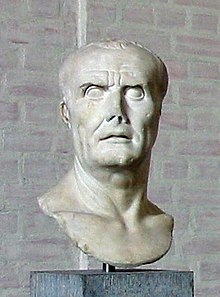
In France, the name is traditionally used in the region of Provence, where the famous Roman general, Gaius Marius (b. 2nd-century BCE) is still considered a hero for crushing the Teutonic forces near Mount Saint-Victoire.

Currently, Marius is the 22nd most popular name in Norway, (2010). His rankings in other countries are as follows:

  • # 40 (Denmark, 2010)
  • # 83 (France, 2009)

Its Southern European form of Mario is currently the 10th most popular male name in Spain, (2010). His rankings in other countries are as follows:

  • # 41 (Croatia, 2010)
  • # 44 (Catalonia, 2010)
  • # 91 (Chile, 2010)
  • # 207 (United States, 2010)

Other forms of the name include:

  • Marijo (Croatian)
  • Mario (Croatian/Italian/Spanish)
  • Márius (Czech/Slovak)
  • Marius (Dutch/French/German/Romanian/Scandinavian)
  • Marios Μαριος (Greek: modern)
  • Máriusz (Hungarian. MAHR-yoos)
  • Marijus (Lithuanian)
  • Mariusz (Polish. MAR-ee-OOSH)
  • Mário (Portuguese/Hungarian)
  • Marij Ма́риус (Russian)
  • Màriu (Tuscan)

Santiago

Gender: Masculine
Origin: Spanish
Meaning: “saint James.”

The name is composed of the Spanish words santo (saint) and Iago (the Medieval Spanish form of Jacob).

The name was originally used in honour of St. James the Apostle. Tradition has it that St. James the Apostle travelled to the Iberian peninsula after the death of Christ and it is said that he is buried under the church of Santiago de Compestela in Galicia, Spain.

Santiago was also used as a battle cry by Spanish Christians during the Reconquisition from the Moors.

He is currently a very popular name throughout the Spanish-speaking world. In Mexico he is the most popular male name (2010). In other countries his rankings are as follows:

  • # 36 (Chile, 2010)
  • # 70 (Spain, 2010)
  • # 99 (Catalonia, 2010)
  • # 133 (United States, 2010)

His offshoot of Diego has been argued to be a form of the Greek didache (teaching) but was originally bestowed in honour of St. James the Apostle.

Diego does not lag that far behind his more elaborate counterpart. He is currently the 3rd most popular male name in Mexico, (2010) while in other Spanish-speaking countries he ranks in at:

  • # 9 (Spain, 2010)
  • # 11 (Chile, 2010)
  • # 57 (Belgium, 2008)
  • # 74 (France, 2008)
  • # 85 (United States, 2010)
  • # 303 (the Netherlands, 2010)

Other forms of the name Diego include:

  • Xanti (Basque)
  • Dídac (Catalan)
  • Didacus (Late Latin/Medieval Spanish)
  • Diogo (Portuguese)
  • Tiago (Portuguese)
  • Thiago (Portuguese: Brazilian)

Its Portuguese form of Tiago is the 5th most popular male name in Portugal (2008) and the 95th most popular male name in France, (2008). While Diogo is the 4th most popular male name in Portugual, (2008). And according to Babycenter Brasil, Tiago is the 34th most popular male name among registered users.

Both Diego and Santiago have been used as place names throughout the New World.