- Origin: Greek Φυλλίς
- Meaning: “leaves; foliage.”
- Gender: Female
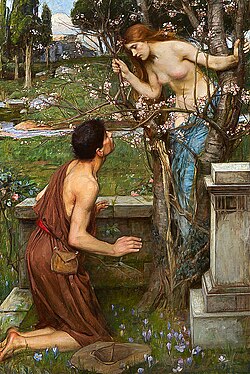
The name appears in Greek mythology. It is connected to a woman who killed herself when her love for Demophon was not returned. She was transformed into an almond or hazelnut tree, depending on the legend. It comes directly from the Greek word, Φυλλίς, meaning, “leaves, foliage,” which shares a root with the words chlorophyll and phyllotaxis. Its Turkish form of Filiz comes from the same root but the meaning slightly changes to “sprout; root.”
It also appears as the name of a minor river god of Bithynia.
It came into widespread use in England in the 16th-century and later spread to the rest of the Anglosphere.

Early Puritan records occasionally include Phyllis/Phillis, reflecting classical learning even among settlers. Phillis Wheatley (1753-1784), the first published African-American female poet, is a striking historical bearer.
An 18th-century English short form was Lissie or Lissy.
It frequently appears in Elizabethan and Restoration poetry and drama. Poets such as Ben Jonson and Andrew Marvell used “Phyllis” as a stock name for a beloved in pastoral verse. Later modernists like Ezra Pound continued this tradition. This usage helped keep it familiar to English speakers for centuries.
It marked its presence in baroque operas (e.g., Handel’s Acis and Galatea includes a character named Phyllis) and in folk songs of the British Isles.
Victorian painters of the Pre-Raphaelite school sometimes chose the Phyllis and Demophon story for mythological canvases.
In the United States, it appeared in the Top 100 Female Names between 1915-1958, peaking at #24 in 1929. In the U.K., it came in at #14 in 1914, #4 in New Zealand in 1911, and #29 in 1922 in Canada.
Its Turkish offshoot of Filiz appeared in the Turkish Top 100 between 1980-1996, peaking at #11 between 1980-1982.
Today, the name is considered dated in the English-speaking world.
Phillyda, pronounced /ˈfɪl.ɪ.də/ in English is an alternate form.
Other forms include:
- Filida Филлида (Bulgarian, Russian, Serbo-Croatian)
- Fílide, Fil·lis (Catalan)
- Fyl(l)is (Czech, Polish, Slovak)
- Phyllis (Dutch, English, German, Classical Greek, Scandinavian)
- Phillida (English)
- Phillis (English)
- Phyllis, Phyllide (French)
- Fýllis (Greek – Modern)
- Fillide, Filide (Italian)
- Phillidis (Latin)
- Filis, Filija (Latvian, Lithuanian)
- Fílide, Fílis (Portuguese)
- Fílide, Filis (Spanish)
- Filiz (Turkish)
- Fillida Філліда (Ukrainian)
Sources