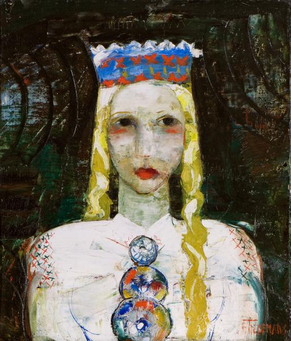
Latvian: Meitene tautas tērpā by
Jānis Tīdemanis (1930)- Origin: Latvian, Lithuanian, Estonian
- Meaning: “beauty, grace, artistic refinement.”
- Lithuanian form: Dailė
- Gender: Female
- Pron: DYE-lah; DYE-leh
Derived from the Latvian poetic word daile, meaning, “beauty, grace, or artistic refinement.”
The noun daile itself was standardized by linguist and writer Atis Kronvalds in 1868, who likely modeled it on Lithuanian dailė (“art, artistic creation”). Both words share the Baltic root dail-, conveying ideas of beauty, craftsmanship, and aesthetic harmony.
As a personal name, Daila and its variant Daile first appeared in Latvian name calendars in the late 19th century, but did not come into regular use until the 1920s, during the national revival when many symbolic native words were adopted as given names.
Regional and Linguistic Variants
- Daile – an older or alternative Latvian form, also used in Estonia.
- Dailė – Lithuanian form (still occasionally used).
- Dailīte – rare Latvian diminutive (dye-LEE-teh).
- Dailis – masculine form used in both Latvian and Lithuanian (DYE-lis).
- Dailonis – rarer Latvian masculine variant (DYE-loh-nis).
The designated name-day for Daila is February 4th (Latvia); and December 3 for Daile (Latvia).
Sources
- Siliņš, Kārlis. Latviešu personvārdu vārdnīca [Dictionary of Latvian Personal Names]. Rīga: Avots, 1990.
- https://en.wiktionary.org/wiki/daile
- https://vardai.vlkk.lt/vardas/Daile
- https://et.wikipedia.org/wiki/Daile
- https://en.wikipedia.org/wiki/Girl_in_a_Folk_Costume