Ansgar

Gender: Masculine
Origin: German
Meaning: “God’s spear.”
(AHNS-gahr)

The name is composed of the Germanic elements, ans (god) and gari (spear). Ansgar is believed to be the progenitor of the name Oscar.

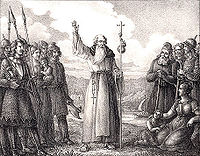
The name was borne by St. Ansgar of Bremen (801-864), an early German saint who is most famous for trying to convert the Danes and Swedes.

Currently the the name is the 408th most popular male name in Germany, (2011).

Other forms of the name include:

  • Anschar (Bavarian)
  • Anscari (Catalan)
  • Anschaire (French)
  • Anskar (Frisian/German)
  • Ansgar (Icelandic/German/Scandinavian)
  • Anscario/Ansgario (Italian)

Erwin, Irvin

Gender: Masculine
Origin: German
Meaning: “army friend.”
Germ (AIR-veen), Eng (ER-vin)

The name is derived from the Old High German, Hariwini, which is composed of the elements, hari (army) and win (friend).

A notable bearer was Austrian physicist, Ervin Schroediger (1887-1961).

It is currently the 419th most popular male name in Germany, (2011), while Ervin is the 87th most popular male name in Bosnia & Herzegovina, (2010)

Other forms of the name include:

  • Ervin (Albanian/Bosnian/Croatian/Hungarian/Slovene)
  • Erwin (Dutch/German/Polish/Swedish)
  • Irvin (English)
  • Ervino (Italian)
  • Ervīns (Latvian)
  • Ervín (Slovak)
 Feminine forms are the Hungarian, Ervina and the Polish, Erwina.


Shirin

Gender: Feminine
Origin: Persian
Meaning: “sweet.” شیرین
(SHEE-reen)

The name is from the Persian meaning, “sweet” and is a fairly classic female name in Iran. The name is found in an 800 year old epic romantic poem, Khosrow & Shirin, which recounts the exploits of an Armenian princess and her royal Persian lover. Her story may have been based on the eponymous favorite wife of the Sassanid King Khosrow II (c.628 CE).

Currently, Shirin is the 455th most popular female name in Germany.

The name is also used throughout Central Asia, including Afghanistan, Pakistan and Armenia.

Other forms of the name include:

  • Şirin (Azeri/Kurdish/Turkish)

Wiebke, Viveka

Gender: Feminine
Origin: Frisian
Meaning: “war.”
Germ (VEEP-ke); Swe (VEE-vek-kah)

The name is derived from a Germanic element, wig, meaning, “war.” It was especially popular in Germany during the 1940s and became dated by the 1970s. It is currently experience a slight revival, coming in as the 470th most popular female name in Germany, (2011).

Its Swedish version of Viveka, (sometimes spelled Veveca, Vivica), gained attention in the English-speaking world through American actress, Vivica A. Fox (b.1964).

Other forms of the name include:

  • Vibe (Danish)
  • Vibeke (Danish/Norwegian)
  • Viben (Danish)
  • Vibeka (Faroese)
  • Wibke (German)
  • Viveka (Norwegian/Swedish)
  • Vivikka (Norwegian)
  • Wubbeke (Plattdeutsch)
  • Wübbecke (Plattdeutsch)

Masculine forms include Wiebe (the 496th most popular male name in the Netherlands) and Wiebo.

Cosima

Gender: Feminine
Origin: German/Italian
Germ (KOH-zee-mah); It (KOH-zee-muh)

The name is a feminine form of Cosmas. It was introduced into Germany through Cosima Wagner (1837-1930) the daughter of Hungarian composer, Franz Liszt and the wife of German composer, Richard Wagner. She was the director of the Beyreuth Festival for 31 years.

Currently, Cosima is the 416th most popular female name in Germany, (2011). German supermodel, Claudia Schiffer, recently chose this name for her youngest daughter, Cosima Violet (b. 2010), as did writer and director Sofia Coppola the same year. It is also the name of Lady Cosima Windsor (b.2010) and Australian pop singer, Cosima De Vito.

Another German for is Kosima.