Samira

Gender: Feminine
Origin: Arabic; Sanskrit  سميرة‎, समीर
(sah-MEE-rah)

The name is a feminine form of the Arabic or Sanskrit male name, Samir.

Currently, Samira is the 89th most popular female name in Germany, (2011).

Other forms of the name include:

  • Samira Самира (Azeri/Chechen/Kazakh/Kyrgyz/Tatar/Tajik/Turkmen/Uzbek)
  • Zamira Замира (Azeri/Chechen/Kazakh/Russian/Tajik/Turkmen)
  • Samira  مخملباف (Farsi)
  • Sameera (Indian)
  • Semra (Bosnian/Turkish)

Samira is used in Albania, Bosnia & Herzegovina, throughout Central Asia and within the Middle East.

Dana

The name is of a few different etymology depending on the source of the bearer. In Slavic-speaking countries, the name is a short form of any name containing the element dan meaning, “gift.” It could also be used as a diminutive form of Danijela or Daniela.

The name is also a modern form of the ancient Celtic theonym, Dânu, an early Irish mother goddess of the Tuatha Dé Danann. Her name has been traced to early Indo-European roots and is believed to have some connection to water. This element appears in several river names across Europe, such as the Dnieper, Danube and Don. This form is borne by Irish singer, Dana Scallon (b.1951).

Its usage in the English-speaking world may actually derived from a Danish surname, usually pronounced (DAY-nah) in English, the former are both pronounced (DAH-nah).

Currently, Dana is the 146th most popular female name in Germany, (2011). Her rankings in other countries are as follows:

  • # 248 (Netherlands, 2010)
  • # 463 (United States, 2010)


Sina

Gender: Feminine
Origin: German
Germ (ZEE-nah)

The name is a contracted form of either Rosina or Gesina.

It was a common enough name in the 18th and 19th-centuries and even appeared in the U.S. top 1000 between 1880 and 1899. The highest it ranked within those years was in 1884 coming in as the 463rd most popular female name. This may have been due to a large influx of German immigrants at the time.

Currently, it is 75th most popular female name in Germany (2011).

Lenja

Gender: Feminine
Origin: German
(LEN-yah)

The name is possibly from a Slavic diminutive form of Helena.

It may have first been brought to the public attention via Austrian singer, Lotte Lenja (aka Lotte Lenya) 1898-1981.

It is currently the 109th most popular female name in Germany, (2011).

Another spelling is Lenya.

Marla

The name has a few different etymologies depending on its source. In Germany, it is a contracted form of Marlene, now used as an independent given name.

In Russia, it is the name of an indigineous nature based pre-Christian religion practiced by the Mari in the Republic of Mari El. The name is sometimes used among the Mari much in the same way Christians use the names Christian and Christine and Muslims use Islam.

The Marla religion is one of the last traditional beliefs to have survived Christianization and has co-existed with Russian Orthodoxy for centuries. The name has also been used by non-Mari Russians as well.

Currently, Marla is the 141st most popular female name in Germany, (2011). In Russian, it is spelled as Марла.

In the United States, the name is often associated with Socialite, Marla Maples (b.1963).

Mona

The name could be of several different etymologies depending on the source of the bearer. In Nothern Europe, it is a contracted form of Monika or any name that contains the element -mona. 

In the case of the Mona Lisa, mona is an archaic Italian title, being a contraction of madonna.

It has been suggested that the name could be from the Greek monos (one) and it can also be used as an anglicized form of the Gaelic, Muadhnait (little noble one).

The name is used throughout the Middle East, in this case it is derived from the Arabic منى (muna) meaning, “wishes; desires.”

Currently, Mona is the 160th most popular female name in Germany, (2011).


Titus

Titus (Roman Emperor)Gender: Masculine
Origin: Latin
Meaning: “title of honour.”
Eng (TY-tus)

The name comes from the Roman praenomen which is derived from the Latin, titulus, meaning “title of honour.”

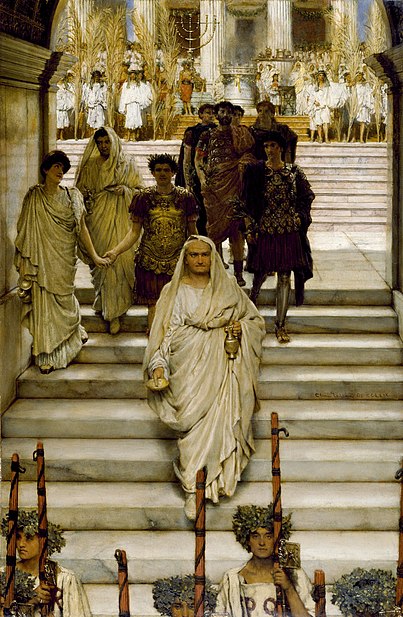
In Ancient History, the name is borne by Titus Flavius Vespasianus, the tenth Roman emperor in the Roman Empire and the second of the Flavian Dynasty.

In the New Testament, the name is borne by a companion of St. Paul who later became the first bishop of Crete and was a recipient of one of Paul’s epistles.

The name was also used by Shakespeare for his tragedy Titus Andronicus (1593).

Currently, Titus is the 253rd most popular male name in Germany, (2011) and the 397th most popular in the United States, (2010).

Other forms of the name include:

  • Tito (Aragonese/Basque/Galician/Italian/Portuguese/Spanish)
  • Titus (Czech/Danish/Dutch/English/French/German/Latin/Norwegian/Swedish)
  • Tiitus (Finnish)
  • Tite (French)
  • Titos Τιτος (Greek Biblical)
  • Titou τιτου (Greek Modern)
  • Titusz (Hungarian)
  • Títus (Icelandic/Slovak)
  • Titas (Lithuanian)
  • Titu Тітъ (Old Church Slavonic)
  • Tytus (Polish)
  • Tit Тит (Romanian/Russian/Croatian/Slovene)

An Italian, Portuguese and Spanish feminine form is Tita.

The designated name-day is January 4th.

Leif

Gender: Masculine
Origin: Old Norse
Meaning: “descendant; heir.”
Eng (LEEF); Eng/Swe/Ice (LAFE); Nor (LIFE)

The name is derived from the Old Norse, Leifr meaning (heir, descendant). It is most famously borne by Norse Explorer, Leif Eriksson (970-1020), who is regarded as the first European to set foot on North America and is credited for discovering Greenland.

The name has always been prevalent throughout Scandinavia. However, its usage in Germany is relatively recent where it’s currently the 263rd most popular male name, (2011). The name has also had prevalent usage in North America, particularly within the Midwest where a large Scandinavian-American population resides, one notable American bearer being former teen pop idol, Leif Garrett (b.1961).

Other forms of the name include:

  • Leif (Danish/English/Faroese/Finnish/German/Icelandic/Norwegian/Swedish)
  • Leif(f) (Danish: obscure)
  • Lejf (Danish: obscure)
  • Leifur (Icelandic: more common form)
  • Leiv (Norwegian)
  • Leifr (Old Norse)